Jan Suraaj Party’s depth in campaigning, convincing and coalescing the masses has been legendary. Every household in Bihar is focussed and intent in blood hound style to bring Jan Suraaj Party in power at the Patna Assembly in November 2025
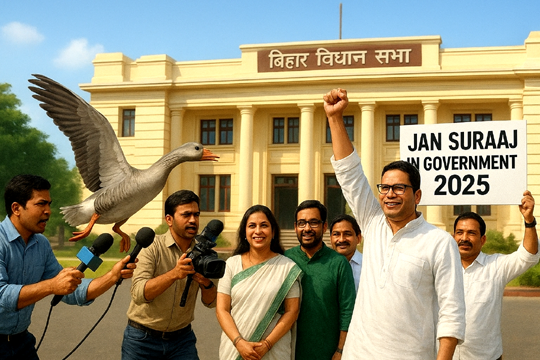
In a scene that could easily pass for political theatre with a dash of slapstick comedy, media crews were last seen chasing a large wild goose outside the Bihar Assembly, while Prashant Kishor and his Jan Suraaj Party quietly prepared to waltz into government with over 180 seats in hand. The goose, we are told, represented the grand distraction — a decoy as ingenious as the Bengal 2021 red herring — while the real storm brewed in the minds and hearts of 13 crore Biharis.
Jan Suraaj and Prashant Kishor have been on an effective campaign trail since 2021 after Prashant Kishor won the Bengal elections for Mamata Banerjee in 2021. The campaign in Bihar has never been about “vote for me and my party and we shall make life better for you” Instead the campaign has always been about “You idiots, you have been spoiling your life by voting for people who rob you and exploit you. Learn to vote for your future and a better life for your children.” This way Prashant Kishor has always been much more of a social reformer and less of a career politician. He reiterates every time that it has never been about his occupying political posts and gaining from them but more about intrinsic improvement of Bihar. Observing this trajectory, one suspects that it has been Prashant Kishor’s dream all along to become a social reform mover and shaker pointing him towards the Prime Minister’s post in the distant future. This could be one of the reasons why Prashant Kishor doesn’t wish to be labelled as a chief minister demoting his personal brand from the top post in India.
Meanwhile, people in Bihar refuse to divulge on camera that they will vote in hordes for Jan Suraaj Party for fear of being killed by Rashtriya Janata Dal’s goons on hire. Lalu Prasad Yadav’s political party viz Rashtriya Janata Dal prides itself on being an expert in this matter.
Secretly, every person in Bihar is throbbing at the seams to throw out both the National Democratic Alliance dispensation as well as the Rashtriya Janata Dal as quickly as possible. Currently, Bihar has 38 administrative districts. In nearly all of these districts the call for Jan Suraaj is heard in silent screams because Biharis have been subjected to torture and humiliation for the last 50 years. A household with no income and totally dependent on the largesse of local hooligans cannot have any self-respect and pride. This was the condition of Biharis since 1970.
A Revolution in Plain Sight
Since 2021, Prashant Kishor — the man who made Bengal’s Didi roar again — has been walking, talking, and occasionally scolding his way across Bihar’s dusty lanes. His campaign wasn’t the usual politician’s sugar-coated promise of “I’ll make your life better.” No. Kishor’s version was more like a stern teacher addressing a perpetually failing class:
“You idiots, you’ve been voting for the same people who rob you. Stop blaming God and start using your brains.”
And, lo and behold, Bihar listened. Not because they liked being called idiots — but because it was the first time a politician didn’t pretend to be their saviour. Kishor wasn’t selling dreams; he was selling discipline. And Bihar, tired of scams, floods, and broken roads, bought it wholesale.
From ‘Sattu and Sarcasm’ to Strategy and Substance
Kishor’s Jan Suraaj movement was built on one mantra: Stop whining, start fixing. Over four years, his team spread out like a disciplined army — not of sloganeers, but of problem-solvers. Each district became a miniature experiment in governance.
Here’s how the 38 districts of Bihar — once a geography lesson in despair — slowly turned into the map of a movement.
- Patna – The Command Centre of Common Sense
In Patna, the Jan Suraaj headquarters became less of a party office and more of a workshop. Volunteers ran workshops on how to complain productively instead of just loudly. Roads were cleaned not by municipal orders, but by inspired college students who realized tweeting pothole pictures wasn’t the same as fixing them. The city began to buzz with newfound pride — and the media, predictably, called it “unprecedented civic awareness.” - Gaya – From Temple Town to Training Ground
Gaya, once known for spiritual enlightenment, now became the hub of political enlightenment. Jan Suraaj workers trained villagers in how government budgets actually work. One farmer famously told a visiting MLA, “We now know where every rupee goes — and where yours went.” That MLA hasn’t been seen since. - Nalanda – The Old Wisdom Returns
Nalanda, where ancient scholars once debated philosophy, rediscovered its spirit of reason. Local Jan Suraaj chapters ran reading clubs — except instead of philosophy, they studied local governance papers and past scams. The result? Voters who could quote fiscal deficit figures better than most TV anchors. - Muzaffarpur – Litchi Land Turns Literate
Muzaffarpur, famous for litchis and mysterious fevers, became the poster child of pragmatic politics. Jan Suraaj health volunteers created a rural clinic model that made government hospitals look prehistoric. Even mosquitoes, sensing a shift, began to migrate to neighbouring districts. - Darbhanga – Maithili Pride Meets Modern Politics
In Darbhanga, Jan Suraaj merged Maithili pride with a new-age political confidence. The youth there no longer brag about migrating to Delhi — they brag about staying put. Local slogans like “Ebar hamre gaon me sarkar!” (This time, government in our own village!) replaced the tired refrain of “Sarkar kuchh nahi karti.” - Bhagalpur – Silk and Self-Reliance
The silk city found its thread of independence again. Jan Suraaj cooperatives taught weavers to market directly online. One elderly artisan said, “Earlier politicians gave us thread for free. Now we have our own brand.” Bhagalpur silk sarees now trend on Instagram — with the caption “#SuraajWoven.”
And so the wave spread district by district — sometimes slow, sometimes silent, but unstoppable.
Let’s run through the rest of Bihar’s transformation at lightning speed, because the list is as long as the Ganga herself.
- Purnia – Youths stopped doing TikTok dances and started making microfinance apps.
- Katihar – The train junction became a hub for Jan Suraaj logistics; volunteers now run the most punctual political network in the state.
- Kishanganj – A border district long ignored found unity through education camps. Kishor’s volunteers turned madrassas into digital classrooms.
- Araria – Farmers formed co-ops that now lend money to small shopkeepers instead of borrowing from them.
- Supaul – Flood victims built their own embankments; bureaucrats were politely told to “watch and learn.”
- Madhepura – The land of Lalu’s legacy quietly flipped. Youths there coined a new slogan: “Ab netagiri nahi, naukri chahiye.”
- Saharsa – The local Jan Suraaj team runs 24-hour water pumps — funded by voluntary donations.
- Sitamarhi – Women self-help groups turned into election campaign cells.
- Madhubani – The famed painters illustrated corruption stories through art — and posted them on Jan Suraaj billboards.
- Samastipur – Railway workers there launched the “Clean Track, Clean Politics” campaign.
- Vaishali – The ancient democracy rediscovered its roots. Locals now hold mock assemblies to discuss civic budgets.
- Saran – Once RJD’s citadel, now a Jan Suraaj fortress. Even paan sellers discuss electoral reforms.
- Siwan – The birthplace of the once-feared mafia dons now breeds social entrepreneurs.
- Gopalganj – Every tea stall displays a photo of Prashant Kishor with the caption: “He made us believe again.”
- West Champaran – Gandhian legacy meets Kishor’s modern reform. Organic farming booms.
- East Champaran – School dropout rates fell after Jan Suraaj introduced “Study with Sattu” programs.
- Bettiah – Local leaders now livestream Gram Sabha meetings — transparency at its finest.
- Motihari – Jan Suraaj youth built apps that track local development funds.
- Buxar – The city of valor discovered digital courage — using AI to flag fake political promises.
- Bhojpur – Once known for caste wars, now known for cooperative dairy startups.
- Rohtas – Brick kiln workers formed unions that negotiate wages transparently.
- Kaimur – Naxal-prone zones transformed through employment drives and solar power plants.
- Aurangabad – The self-proclaimed “mini Patna” now produces local radio shows explaining Jan Suraaj policies.
- Jehanabad – Farmers got together to crowdfund irrigation projects; no politician dared take credit.
- Arwal – The smallest district, but loudest in pride. People there say, “Hum Jan Suraaj ke brand ambassador hain.”
- Nawada – Women leaders run 70% of local committees — something unheard of before 2021.
- Jamui – Maoist-hit areas turned peaceful through micro-industry revival.
- Banka – Known for temples, now for tech. Students there designed the “Suraaj Tracker” app.
- Munger – Gun town to “Fun town.” Youths abandoned illegal arms for drone training programs.
- Lakhisarai – Rural journalists, mentored by Jan Suraaj, report development instead of despair.
- Sheikhpura – Locals turned unclaimed land into public gardens.
- Begusarai – The red fortress turned saffron, then blue — finally white, the color of calm progress.
The Secret Behind the Silence
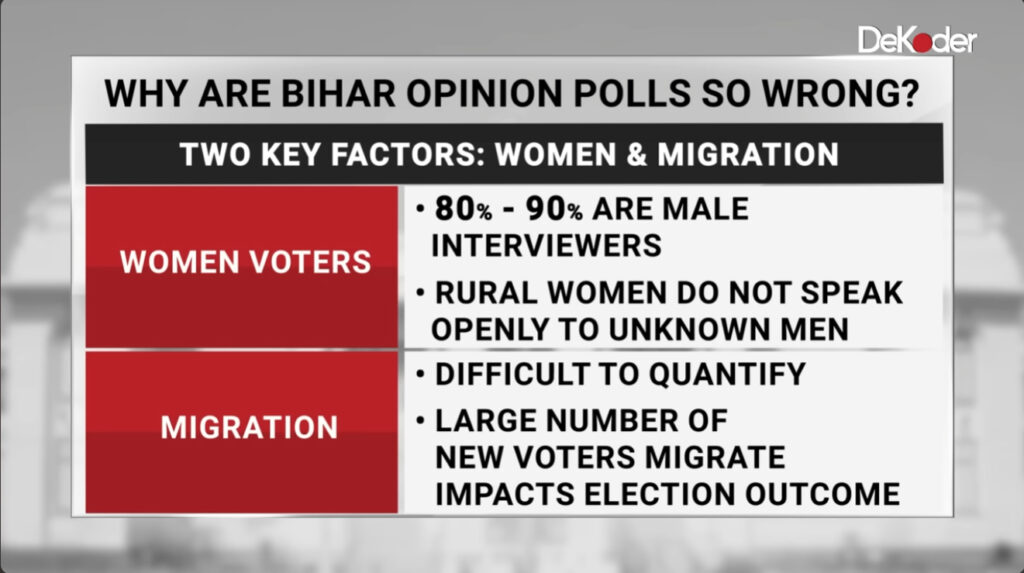
Curiously, despite the growing roar, Biharis on camera still say nothing. Ask a rickshaw-puller who he’s voting for, and he’ll look left, right, and whisper, “Jan Suraaj,” as though uttering a state secret.
Why? Because old habits die hard. Fear of lathi politics — courtesy of RJD’s legendary goon squads — still lingers. Yet beneath that silence lies a volcano ready to erupt in November 2025.
The Great Media Miscalculation
Meanwhile, the national media — ever eager for melodrama — fell for the “wild goose chase.” As Jan Suraaj volunteers quietly built bridges, schools, and trust, journalists were busy speculating whether Kishor was joining Congress, BJP, or starting a startup in Silicon Valley.
They forgot that Jan Suraaj’s convener Prashant Kishor was already running the biggest startup in India — a startup called Common Sense.
By the time the media realized what was happening, Bihar had already decided its next Chief (or non-Chief) Minister. Kishor, ever the strategist, refused to declare whether he’ll take the top seat. Today, it has been firmly declared that he will not be filing his nomination for contesting elections. His admirers claim he’s “playing 4D chess.” His critics say he’s “being coy.” Kishor himself says, “Leadership is not about chair, it’s about change.”
And that’s precisely the line that’s got everyone hooked.
The Humour of Hope
For a state long mocked for backwardness, Bihar is now laughing — at itself, and at its past. Street jokes like “Ration card se pehle aayega Jan Suraaj card” or “Bijli gayi, par Vishwas aaya” flood tea shops. Even memes have turned prophetic. One viral image shows Kishor’s face photoshopped on Superman with the caption: “Ab hum udaenge corruption.”
The humor hides something serious — a shift in self-respect.
From Desperation to Determination
For decades, Bihar’s identity was built on migration, caste, and corruption. But the Jan Suraaj model replaced dependence with dignity. The movement taught Biharis that governance isn’t an act of charity; it’s a responsibility.
As one old farmer in Saran put it,
“Earlier, we were begging for roads. Now we are building them — and billing the government.”
That, perhaps, sums up Bihar’s new DNA: accountability as self-expression.
The Coming Coronation
So as November 2025 approaches, Bihar stands on the cusp of history. The RJD camp looks bewildered, NDA is performing yoga for calmness, and Congress — as usual — is writing condolence notes for itself.
Meanwhile, Jan Suraaj marches on, district by district, door by door, conversation by conversation. There are no loud rallies, no Bollywood songs, no vote-bank gimmicks — only quiet conviction and the faint echo of Kishor’s mantra:
“Badalna hai, toh khud se shuru karo.”
(“If you want change, begin with yourself.”)
The Final Laugh
When the results roll in, don’t be surprised if you see Prashant Kishor smiling modestly outside the Bihar Assembly while the media, still panting, continues chasing another wild goose — perhaps this time a metaphorical one.
For once, Bihar isn’t laughing at the circus. Bihar is the circus ringmaster.
And the ringmaster’s name, this time, is Jan Suraaj.