
Russia could face defeats on several fronts simultaneously — not because of a single catastrophic blow, but due to accumulated strategic overstretch, weakened military capacity, and crumbling alliances
By Debasish Roy
CEO, Royalle Corporation (www.royalle.in)
In October 2025, a series of interlinked military, diplomatic, and geopolitical setbacks have placed Russia in one of the most precarious strategic positions since the collapse of the Soviet Union. As Ukraine continues to claw back territory, allies and former partners of Moscow are realigning, regional conflicts are flaring without Russian intervention, and asymmetric warfare is redefining the balance of power. Together, these trends point toward a plausible scenario in which Russia could face defeats on several fronts simultaneously — not because of a single catastrophic blow, but due to accumulated strategic overstretch, weakened military capacity, and crumbling alliances.
1. Ukraine’s Counteroffensive: A War of Attrition Turning Against Moscow
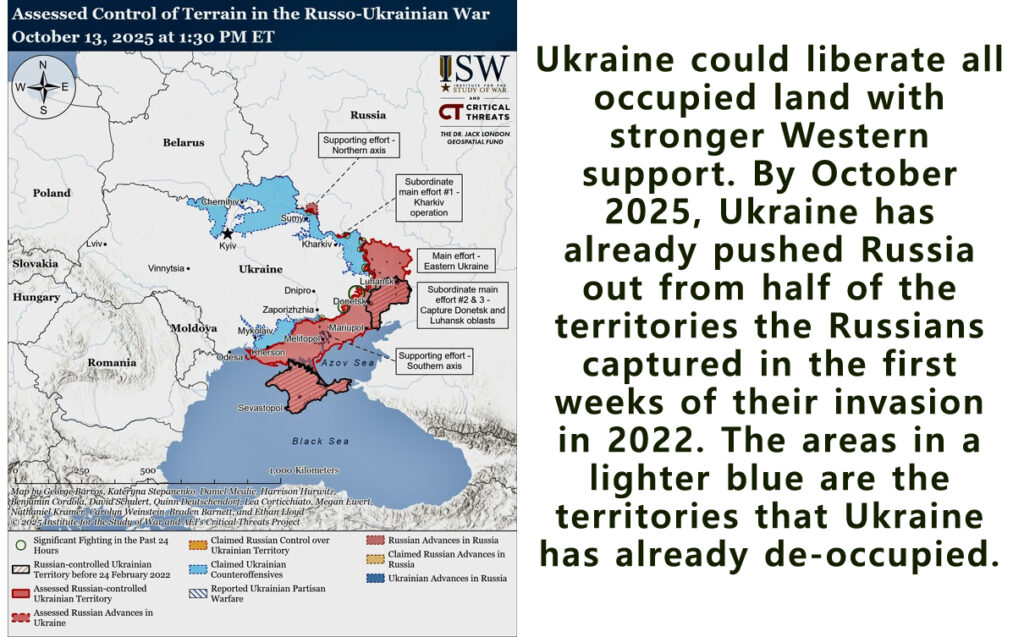
Ukraine’s intelligence chief, Kyrylo Budanov, declared recently that Ukraine “can win the war with Russia and liberate all the land occupied by Russian forces.” This assertion, far from being rhetorical, reflects tangible battlefield progress. By October 2025, Ukrainian forces have successfully retaken half of the territory seized by Russian troops during the early weeks of the February 2022 invasion. The de-occupied areas — stretching across large swathes of Kharkiv, Kherson, and Zaporizhzhia regions — mark a remarkable reversal of Russia’s initial gains.
The tide began turning in mid-2023, when a combination of improved Ukrainian command structures, integrated Western weapon systems, and innovative tactics disrupted Russia’s slow-moving offensive. A striking example came in June 2025 with “Operation Spiderweb,” a deep-strike drone assault on multiple Russian military airbases, conducted solely by Ukraine’s Security Service (SBU). This operation showcased Ukraine’s growing asymmetric capabilities: domestically designed drones flew hundreds of kilometers to strike strategic airfields inside Russia, evading traditional air defense networks and causing significant damage to aircraft and logistics.
While Western powers did not directly participate in this operation, they studied it closely. The U.S. and NATO have since incorporated lessons from “Spiderweb” into their own defense doctrines, recognizing the potency of low-cost, high-impact drone swarms. For Russia, however, the operation highlighted a glaring vulnerability: its inability to defend its interior military assets against modern asymmetric warfare, even after years of combat experience in Ukraine.
According to Budanov, with stronger and more consistent Western support, Ukraine could liberate all occupied territories, including Crimea. Russia’s inability to deliver a decisive victory after more than two and a half years of full-scale war has exposed its strategic limits. An estimated 300,000 Russian troops remain bogged down on Ukrainian soil. Meanwhile, Russia has suffered severe equipment losses, including thousands of tanks, artillery systems, and aircraft, with its defense industrial base struggling to keep pace.
This grinding war of attrition has not only bled the Russian military; it has eroded Moscow’s aura of invincibility, encouraging challenges from regions once firmly under its sway.
2. The Collapse of the Russian Security Umbrella in the Caucasus
One of the clearest signs of Moscow’s diminishing geopolitical clout came in September 2023, when Azerbaijan launched a major offensive in Nagorno-Karabakh, effectively ending three decades of Armenian control over the disputed enclave. Russian peacekeepers, deployed under the 2020 ceasefire agreement, were given minimal notice and offered no meaningful resistance. Within days, the region’s 120,000-strong Armenian population fled en masse, marking the end of the Nagorno-Karabakh Republic.
The political fallout was immediate. Armenian Prime Minister Nikol Pashinyan, once considered a reluctant ally of Moscow, openly labeled the Russian-led Collective Security Treaty Organization (CSTO) “a threat to national security.” By mid-2024, Armenia had formally withdrawn from the CSTO — a remarkable departure for a founding member state. Public opinion mirrored this geopolitical shift: a Gallup poll showed Armenian support for CSTO membership collapsing to 17%, while backing for NATO rose to 29%, a dramatic increase from previous years.
This episode sent shockwaves through the post-Soviet space. It demonstrated that Russia, distracted and overextended in Ukraine, could no longer act as a credible security guarantor in its own backyard. For decades, Moscow used military power, energy leverage, and institutional alliances like CSTO to maintain influence over its neighbors. Nagorno-Karabakh revealed the fragility of that architecture.
3. Central Asia’s Strategic Drift Away from Moscow
The Central Asian republics, long considered part of Russia’s near-abroad, are increasingly pursuing independent foreign and security policies. A striking example came in January 2024, during a border dispute between Tajikistan and Kyrgyzstan — both CSTO members. Instead of turning to Moscow for mediation, the two countries resolved the dispute through Turkish mediation, reflecting Ankara’s growing influence in the region.
This diplomatic realignment followed Russia’s failure to intervene on Kyrgyzstan’s behalf during a similar flare-up in 2022, when Moscow was deeply entangled in the early phases of the Ukraine war. Central Asian governments took note: Russia’s capacity to project power beyond its immediate borders was shrinking, and its willingness to expend resources on allies was waning.
Simultaneously, China’s Belt and Road Initiative has continued to reshape regional dynamics, while Turkey has leveraged cultural and linguistic ties to build new security partnerships. In this environment, Moscow is no longer the default arbiter of regional conflicts. Its strategic bandwidth is simply insufficient to manage simultaneous crises while sustaining the war in Ukraine.
4. Russian Influence Weakening Beyond Eurasia
Russia’s geopolitical reach has also been tested further afield. In West Africa, Russian mercenaries — particularly those affiliated with the Wagner Group’s successors — have suffered rising casualties amid local uprisings and French-supported counter-operations. Following Wagner’s leadership crisis after the June 2023 mutiny and the subsequent reorganization of its assets under the Russian Ministry of Defense, operational effectiveness plummeted.
African regimes that once welcomed Russian mercenaries as a cheap alternative to Western security assistance have grown wary of their declining performance and Moscow’s inability to provide sustained support. This weakens Russia’s leverage in strategic theaters like the Sahel, where it had hoped to challenge Western influence.
5. Economic and Military Overstretch
At the core of Russia’s vulnerability is strategic overstretch. The war in Ukraine has consumed vast resources: hundreds of thousands of troops, enormous quantities of ammunition, and much of Russia’s advanced military hardware. Sanctions have crippled key sectors, especially technology imports crucial for precision-guided weapons. While Moscow has received support from North Korea in the form of artillery shells and ballistic missiles, this underscores dependence on secondary powers rather than strength.
Unlike the Soviet Union, which maintained a vast alliance network, modern Russia’s partnerships are transactional and limited. North Korea’s assistance, while tactically significant, does not compensate for Russia’s industrial degradation. Western sanctions have restricted access to high-end semiconductors and defense electronics, forcing Russian industry to rely on smuggled components and older, less reliable technologies.
The cumulative effect is a military that can defend existing positions with difficulty but struggles to conduct large-scale, combined-arms offensives. Russian strategic bombing campaigns have relied heavily on Iranian Shahed drones and aging Soviet-era bombers. Meanwhile, domestic discontent is simmering as conscription campaigns drag more citizens into a costly and seemingly endless war.
6. Western Strategy: Indirect Pressure and Containment
The U.S. and its allies have carefully avoided direct military confrontation with Russia. Instead, their strategy revolves around four main pillars:
- Sustained military, financial, and humanitarian aid to Ukraine, ensuring Kyiv can continue fighting without Western boots on the ground.
- Severe sanctions on Russian banks, defense entities, and individuals, aiming to erode Russia’s long-term war-making potential.
- Reinforcement of NATO’s eastern flank, through forward deployments, intelligence sharing, and large-scale joint exercises, deterring any Russian escalation beyond Ukraine.
- Countering Russian propaganda and disinformation, through coordinated messaging, tech platform moderation, and exposure of covert influence operations.
Although U.S. policy under the Trump administration has shifted somewhat — suspending some joint European initiatives and encouraging Europe to shoulder more defense burdens — the core strategic approach remains intact. Europe, for its part, has increased defense spending to historic levels, and NATO cohesion has strengthened since 2022.
This indirect pressure has forced Moscow to fight a prolonged, resource-draining war without triggering a direct East-West conflict. Over time, this attritional strategy compounds internal Russian weaknesses.
7. A Multi-Front Vulnerability
Taken individually, each of these developments — Ukrainian counteroffensives, the Nagorno-Karabakh retreat, Central Asian drift, West African setbacks, and sanctions — may not be fatal to Russian power. Together, however, they form a strategic spiderweb, ensnaring Moscow from multiple directions simultaneously:
- Military pressure in Ukraine continues to bleed manpower and materiel.
- Geopolitical retreat in the Caucasus signals to allies that Moscow’s guarantees are unreliable.
- Central Asian independence erodes Russia’s influence in a region critical to its strategic depth.
- Overseas losses in Africa undermine its narrative as a global power alternative to the West.
- Economic strangulation limits its capacity to rearm and modernize.
This multifront vulnerability mirrors historical precedents: major powers often collapse not from a single decisive battle, but from simultaneous challenges that overwhelm their capacity to respond.
8. Conclusion: The Prospect of Russian Defeat Without Invasion
It is crucial to understand that “defeating Russia” in this context does not mean Western tanks rolling into Moscow. Rather, it refers to a cumulative strategic unraveling in which Russia loses the ability to sustain its military operations, maintain its alliances, and project power effectively.
Ukraine’s battlefield resilience is the spearpoint of this process, but the weakening of Russian influence across multiple regions amplifies the effect. For Moscow, the danger is not just territorial losses in Ukraine — it is the erosion of its great-power status, the fragmentation of its security alliances, and the economic exhaustion that could force a strategic retreat on several fronts simultaneously.
Whether this scenario fully materializes depends on sustained Western commitment, Ukrainian adaptability, and internal dynamics within Russia itself. But as of late 2025, the trajectory is clear: Russia faces the most serious strategic vulnerabilities in decades, many of them self-inflicted through repeated aggressions and miscalculations.
The world may not witness a dramatic capitulation. Instead, Moscow could find itself entangled in its own web — stretched thin, unable to respond decisively, and slowly but inexorably defeated across multiple fronts at once.