
As Bihar heads into a crucial political transition, Kishor’s Jan Suraaj movement has gained traction not by promising the moon, but by laying bare the rot within governance and vowing to address education — the toughest and least politically glamorous plank
Patna / New Delhi | October 20, 2025
In India’s often chaotic political theatre, where populist promises are made with ease and forgotten with even greater ease, two figures stand out for their contrasting trajectories — Arvind Kejriwal, the anti-corruption crusader turned political chameleon, and Prashant Kishor, the strategist-turned-politician positioning himself as a reformist statesman.
As Bihar heads into a crucial political transition, Kishor’s Jan Suraaj movement has gained traction not by promising the moon, but by laying bare the rot within governance and vowing to address education — the toughest and least politically glamorous plank. His sharp contrast with Kejriwal, who swept Delhi on a wave of promises of free electricity, free water and hundreds of new schools and colleges that never materialised, has become a defining narrative in Indian politics.
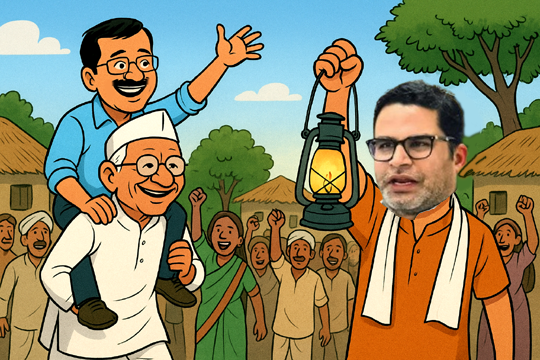
The Promise Maker Who Never Delivered
When Arvind Kejriwal stormed to power in Delhi in 2015, his movement carried the halo of the India Against Corruption agitation. His party, the Aam Aadmi Party (AAP), positioned itself as a radical departure from traditional politics, promising transparent governance and an end to cronyism.
Kejriwal’s 2015 manifesto made some headline-grabbing pledges:
- Free electricity up to 200 units per household, and subsidised rates thereafter.
- 24×7 piped water to every household.
- Construction of 200 new schools and 20 new colleges to accommodate Delhi’s booming student population.
- Better roads and infrastructure, particularly in outer Delhi.
While the electricity subsidy was implemented, it came with a heavy fiscal burden and led to mounting deficits. Water supply remained patchy, with many parts of outer Delhi still dependent on tankers and private suppliers.
But it was in education that the gap between rhetoric and reality became starkest. Kejriwal promised 200 new schools and 20 new colleges during his 2015–2020 term. Not one new college was built. The government opened zero new schools, focusing instead on refurbishing existing infrastructure — a politically clever but substantively limited move. Even as AAP’s advertising showcased model schools with modern classrooms, these were largely upgrades to a handful of institutions, not systemic expansion.
By 2019, AAP’s own RTI replies confirmed that no new schools or colleges had been constructed, despite repeated promises. Instead, budget allocations were re-routed to publicity and welfare subsidies.
Infrastructure development lagged behind too. Key road expansion projects in outer Delhi were delayed or scrapped, while the city’s public transport network struggled with reduced bus fleet numbers despite promises to expand.
From Crusader to Turncoat
Kejriwal’s political journey is marked by a steady dilution of his founding ideals. Once branding himself as a corruption-fighter who would “change the system,” he gradually adopted the same tactics he once decried — backroom alliances, soft Hindutva signalling, and even covert understandings with parties he had called corrupt.
His party that once vowed to never ally with the Congress, quietly extended support during parliamentary voting. His overtures to regional satraps and his shifting stances — from advocating full statehood for Delhi to compromising on core principles for political expediency — painted a picture of a leader driven more by survival than by vision.
By the 2024 Lok Sabha elections, Kejriwal found himself embroiled in multiple investigations, including the alleged excise policy scam, where senior AAP leaders were arrested. His own image as a clean politician took a severe beating, weakening the moral foundation on which his party had been built.
Enter Prashant Kishor: A Different Proposition
In stark contrast stands Prashant Kishor, the architect of multiple election victories for others, now charting his own political course in Bihar. Unlike Kejriwal’s 2010s insurgency, Kishor has built his movement slowly and deliberately. His Jan Suraaj Yatra, launched in 2022, was less a campaign blitz and more a ground-level diagnosis exercise — walking across villages, interacting with lakhs of people, and identifying structural failings.
Most remarkably, Kishor chose education as his central election plank — a choice political veterans considered politically risky. Jobs, subsidies, caste arithmetic, and populist giveaways have been the traditional vote magnets in Bihar. Kishor, however, argued that “without fixing education, no job guarantee or industrial policy can stand on firm ground.”
He laid out the current dismal state of Bihar’s education system with brutal clarity:
- “Where there are school buildings, there are no teachers.
- Where there are teachers and buildings, there are no students.
- Where all three exist — teachers, buildings and students — no education is happening.”
Rather than making grand promises of industrialisation or mass employment — a favourite of career politicians — Kishor focused on fewer but better schools, emphasizing teacher attendance, learning outcomes, and community accountability.
Rejecting the Freebie Culture
Kishor has also been remarkably candid in rejecting the political freebie culture. In 2025, when the BJP government in Bihar attempted to offer ₹10,000 to every woman as a last-minute electoral sop, Kishor was one of the first political leaders to condemn the move as a “vote-buying gimmick”.
The announcement, made by the Prime Minister himself after the model code of conduct had effectively frozen new schemes, was seen as a blatant attempt to bypass electoral fairness. Kishor called it out as “an insult to women and democracy”, urging voters to reject such “temporary bribes”. Remarkably, the Bihar electorate did just that — the scheme backfired, and analysts pointed to Kishor’s messaging as one of the factors that neutralised its impact.
Unlike Kejriwal, who used subsidies as his political engine, Kishor has eschewed cash handouts or free utilities. His campaign materials are notably devoid of promises of free electricity, gas cylinders, or pensions. Instead, he has positioned himself as the architect of long-term systemic reform, willing to take the hard road rather than the shortcut.
Calling Out the Criminal Nexus
Another key differentiator between Kishor and most mainstream politicians — including Kejriwal — is his unflinching criticism of the criminal-political nexus. In a state like Bihar, where politics has long been intertwined with muscle power, this stance is both bold and risky.
Kishor has repeatedly named and shamed competitors with criminal backgrounds, including sitting MLAs and MPs. He has refused alliances with parties dominated by criminal elements, even when such tie-ups could have offered him an easier route to power.
During his Yatra, he told villagers: “These people sitting in power today — most of them have either criminal cases, corruption charges, or have switched sides multiple times. I am not here to join their club. I am here to break it.”
This willingness to alienate entrenched political power brokers distinguishes him from others like Kejriwal, who after initial bluster, quietly integrated into the very system he once vowed to dismantle.
Visionary vs Populist
Prashant Kishor’s politics reflects long-term state-building thinking, whereas Kejriwal’s politics represents short-term populism wrapped in moral rhetoric.
- Kejriwal: Promised tangible, immediate freebies — electricity, water, schools, colleges — many unfulfilled. Adopted power tactics of traditional parties. Shifted ideological positions for expediency.
- Kishor: Promises intangible but crucial reforms — education quality, governance accountability. Rejects freebies. Challenges entrenched political actors.
One example stands out. Kejriwal promised 200 schools and 20 colleges — delivered none. Kishor promised to fix the few schools that exist — arguably a harder, slower, but ultimately transformative path.
The Strategic Mind with a Statesman’s Lens
Kishor’s background as a strategist lends him a certain analytical clarity that sets him apart. Having helped craft winning campaigns for Narendra Modi (2014), Nitish Kumar (2015), Captain Amarinder Singh (2017), Jagan Mohan Reddy (2019) and Mamata Banerjee (2021), Kishor understands the mechanics of Indian elections arguably better than anyone else.
But unlike others who stayed behind the scenes, Kishor has stepped into the arena himself, risking personal credibility. And rather than using his skill to manipulate voters with slogans and sops, he has chosen education reform — perhaps the most unglamorous yet essential issue — as his battleground.
A New Kind of Political Leadership?
India’s post-independence political history has seen reformers emerge periodically, only to be swallowed by the system — or become the system themselves. Kejriwal’s journey from idealist to pragmatist is a textbook example. Kishor’s journey is still unfolding, but the early signs suggest a deliberate refusal to follow the populist path.
His calling out of criminal politicians, rejection of last-minute cash sops, focus on education over freebies, and willingness to walk across villages rather than fly in for rallies have created a new idiom of political engagement in Bihar.
Whether this translates into long-term governance success remains to be seen. But it is undeniable that Kishor represents a strategic visionary with a statesman’s lens, whereas Kejriwal has evolved into a political operator who abandoned his original ideals.
AAP’s Corruption Exposed After Defeat: Budgets Squandered, Promises Forgotten
The electoral defeat of the Aam Aadmi Party (AAP) has pulled back the curtain on a series of financial irregularities and governance failures that paint a grim picture of the party once celebrated as a beacon of clean politics. Investigations and audits conducted in the aftermath have revealed widespread misuse of public funds, particularly in the areas of pollution control and publicity spending, exposing how governance gave way to self-promotion.
Pollution Control: One Machine for an Entire City
One of the most startling revelations concerns Delhi’s pollution control budget. Over the years, the AAP government repeatedly promised an aggressive battle against toxic air. Budget after budget allocated hundreds of crores of rupees for pollution management — including funds for smog towers, mechanized road sweepers, dust suppression equipment, and real-time monitoring.
However, post-defeat audits revealed a shocking reality: only one pollution control machine had actually been purchased for the entire city, despite the enormous sums earmarked for the purpose.
For a megacity of over 20 million people, one machine is effectively symbolic — a token gesture rather than a real intervention. Meanwhile, pollution levels continued to worsen year after year. Delhi remained the world’s most polluted capital, with hazardous AQI levels during winter months becoming a grim annual ritual. Experts now point to gross financial mismanagement, where allocated funds were either diverted, left unutilized, or spent on contracts with little tangible outcome.
Advertising Over Governance
Perhaps the most blatant misuse of taxpayer money lay in AAP’s advertising blitzkrieg. During its tenure, the Delhi government spent thousands of crores of rupees on publicity, splashing Chief Minister Arvind Kejriwal’s face across newspapers, television screens, and hoardings across India — not just Delhi.
In fact, government expenditure data revealed that advertising consumed a disproportionately large share of the state budget, often at the cost of infrastructure projects and public services. Pages in national newspapers were routinely bought to run full-page advertisements, sometimes several in a single edition, with Kejriwal’s image prominently displayed.
Critics have argued that this was nothing short of personality cult-building with public funds, blurring the line between government communication and party propaganda. Instead of investing in long-term infrastructure — like new schools, hospitals, or pollution control systems — vast sums were spent manufacturing a public image of efficient governance that did not match reality on the ground.
Fall from the Moral High Ground
The Aam Aadmi Party rose to power in 2015 as the embodiment of India’s anti-corruption movement. Its leaders promised honesty, transparency, and people-centric governance. However, the years that followed saw a steady slide into the same patterns of patronage, waste, and self-promotion that they once denounced.
The revelations post-defeat — from the token purchase of a single pollution control machine to the lavish misuse of advertising funds — have shattered the party’s carefully constructed image. What was once a symbol of change has, in the eyes of many citizens, become just another example of political hypocrisy and corruption.
Conclusion
As Indian politics enters a new decade, the contrast between Prashant Kishor’s slow-burn, reform-oriented politics and Arvind Kejriwal’s short-term populist theatrics has sharpened.
Kejriwal’s story is one of unfulfilled promises and ideological U-turns. Kishor’s is one of uncompromising honesty and structural vision.
If Kishor’s movement succeeds in Bihar, it could herald a new template of political leadership — one that rejects the corrupt club, faces hard truths, and bets on real reform over easy applause. In a political landscape hungry for authenticity, this contrast may prove decisive not just for Bihar, but for India’s broader democratic trajectory.


Poor voters, conditioned by freebies, prioritize immediate survival over long-term vision. With limited resources, parties must choose between development and patronage.
An unproven newcomer like PK lacks the track record to be credible and cannot yet be compared to established parties. Power corrupts , and absolute power absolutely corrupts
I’d definitely be cautious, but still vote for this change