
Shareholders only lose value of shares they hold. They never stress on losing their assets as farmers fret over losing their land to government acquisition. Why can’t farmers become shareholders?
By Debasish Roy
CEO, Royalle Corporation (www.royalle.in)
The Indian agricultural landscape is stained by a crisis that transcends mere economic hardship; it is a profound human tragedy. Since the mid-1990s, the term “farmer suicide” has become a grim, recurring indicator of policy failure, climate vulnerability, and crippling debt. The statistics are horrifyingly clear: data from the National Crime Records Bureau (NCRB) documents that between 1995 and 2014, staggering 296,438 farmers took their own lives. While the rate may have slowed in recent years, the distress is far from over, with 100,474 suicides reported between 2014 and 2022. In 2022 alone, the toll stood at 11,290 persons involved in the farming sector, a crisis concentrated particularly in states like Maharashtra, Karnataka, and Andhra Pradesh.
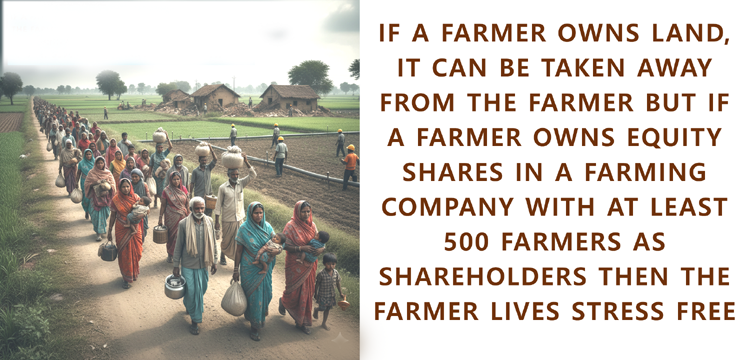
Yet, as the traditional models of relief—loan waivers, price supports, and crop insurance—prove inadequate to address the systemic rot, a radical, almost heretical proposition emerges: abandon the model of individual proprietorship altogether. This headline calls for farmers to surrender their title deeds, pool their land into massive blocks of 400-500 farmers, and transfer it to a professionally managed public company, transforming themselves from struggling cultivators into equity shareholders.
This dramatic pivot seeks to solve the agrarian crisis by substituting the known risks of the field with the abstract risks of the financial market. The question is no longer about shielding the farmer from the monsoon or the moneylender, but whether this new model merely trades the heartbreak of farmer suicide for the massive, catastrophic peril of “shareholder suicide.”
I. The Roots of the Crisis: Fragmentation, Debt, and Policy Inertia
To appreciate the gravity of the proposed solution, one must first understand the structural rigidities of Indian agriculture. The distress is a direct consequence of a historical legacy and modern policy decisions that have left the small farmer fatally exposed.
A. The Curse of Fragmentation
The most fundamental constraint on agricultural productivity is land fragmentation. Driven by inheritance laws and population growth, the average size of operational holdings in India has plummeted from 2.28 hectares in 1970-71 to an estimated 1.09 hectares by 2002-03, with over 80% of all holdings falling into the “small and marginal” categories. These minuscule plots preclude the use of modern, cost-efficient technology, hinder large-scale irrigation, and make farming an economically unviable enterprise. It is a system built on subsistence, not profitability.
B. The Vicious Cycle of Indebtedness
Indebtedness is the single, overwhelming correlate to farmer suicide. Studies consistently point to a toxic cocktail of rising input costs (seeds, fertilisers, diesel) and non-remunerative output prices. When institutional credit is inaccessible—a common issue for small farmers lacking clear titles or adequate collateral—they turn to private moneylenders. These informal loans carry usurious interest rates, often exceeding 60% per annum, trapping the borrower in a spiral of debt. A single crop failure, triggered by an untimely monsoon or a pest attack, can wipe out an entire season’s investment and push the farmer to the point of no return.
C. The Limitations of Existing Policy
While the government has introduced measures like the Pradhan Mantri Fasal Bima Yojana (PMFBY) for crop insurance and minimum support prices (MSP), their effectiveness is often blunted by administrative delays, coverage gaps, and market distortions. Even the Farmer Producer Organisation (FPO) model, a key policy push aimed at aggregation, falls short of the proposed radical shift. FPOs typically aggregate farmers for input purchase, marketing, and value addition, granting them better bargaining power. Crucially, however, the FPO model preserves the individual farmer’s ownership of land, limiting the extent of operational consolidation and mechanisation that can be achieved. The headline’s proposal represents a leap from this voluntary cooperation to compulsory corporate integration.
II. The Radical Cure: Corporate Farming and Equity
The vision of transforming farmers into shareholders rests on the promise of solving the two largest structural failures: scale and stability.
A. Achieving Economies of Scale
Pooling land into a large corporate entity, perhaps 400−500 blocks aggregating to several thousand acres, would immediately unlock economies of scale. The company could invest in deep-bore irrigation systems, deploy precision agriculture tools (drones, soil sensors), procure inputs in bulk at discounted prices, and establish integrated value chains, including post-harvest processing and logistics. This shift from 1-hectare subsistence farming to large-scale, industrial agriculture could potentially elevate Indian farming to a competitive global level.
B. Financial De-risking and Wealth Creation
The greatest theoretical benefit is the transfer of risk. Instead of relying on volatile, lumpy annual harvests, the farmer-shareholder receives a structured income stream: a salary (for their labour as farm-workers) and dividends (as returns on their equity). More importantly, the farmer’s primary asset—the land—is no longer a locked, illiquid, and often debt-encumbered property. It is converted into a transferable, financial asset (equity share). In a successful, well-governed public company, the value of this equity could appreciate, offering a genuine path to intergenerational wealth creation and social mobility that land ownership in its current fragmented form can no longer provide.
III. The Catastrophic Risk: The Specter of ‘Shareholder Suicide’
The proposed solution, however, carries a risk of systemic, concentrated failure far exceeding the individual tragedies it seeks to replace. Giving up land ownership for equity fundamentally changes the nature of the asset and the risk profile.
A. The Vulnerability of Financial Assets
Land, in a distress scenario, is a tangible and resilient asset. Even if a crop fails, the land retains an intrinsic, collateral value. Equity, by contrast, is a volatile and abstract asset. A few consecutive years of poor corporate performance, a major management scandal, a sudden shift in government trade policy, or a collapse in global commodity prices could render the company’s stock virtually worthless.
Where a single farmer today faces financial ruin and is forced to commit suicide, a failure of the public farming company could destroy the primary wealth of 400-500 families simultaneously. This risk is not an abstract market fluctuation; it is an economic annihilation of an entire village or community, a synchronized financial event that could trigger an unparalleled wave of social and political instability. The term “shareholder suicide” is therefore a metaphor for a new kind of institutional failure: the instant, massive disenfranchisement of thousands of vulnerable individuals whose entire security is concentrated in a single, failing corporate vehicle.
B. Governance and Regulatory Challenges
The success of this model is entirely predicated on impeccable corporate governance.
- Asymmetry of Information: The vast majority of small and marginal farmers are semi-literate and lack the financial literacy to monitor a public company, understand its balance sheets, or interpret share price movements. They would be entirely dependent on the integrity and skill of the professional management, creating a colossal principal-agent problem.
- Preventing Asset Stripping: Rigorous legal safeguards would be required to prevent the powerful management or large external investors from engaging in asset stripping or misallocation of profits—for example, diverting profits through subsidiaries or setting excessive management fees—at the expense of the farmer-shareholders.
C. The Legal and Political Minefield
Implementing this on a national scale would require an overhaul of some of India’s most sensitive laws:
- Land Ceiling Acts: Nearly all Indian states have laws limiting the maximum acreage an individual or company can hold to prevent the re-emergence of feudal landlordism. These laws would need to be repealed or substantially amended to allow the formation of the proposed corporate farms, a move that is politically charged and has historically faced massive public resistance, as seen during the debates over the Land Acquisition Act amendments.
- Corporate Structure: The law must ensure the farmer-shareholders retain effective voting control over the company, preventing hostile takeovers or dilution of their equity, perhaps through the creation of a special class of shares or a protective trust structure.
IV. The Verdict: Trading Certainty for Volatility
The proposition to turn India’s farmers into equity shareholders is one of the boldest and most direct challenges to the existing agrarian status quo. It is an economic argument for efficiency, scale, and modern risk management. The distress evidenced by the NCRB data—the failure of 11,290 lives in a single year—provides the moral urgency for radical action.
However, the cost of this radicalism is immense. It forces a vulnerable population to trade the familiar, albeit deadly, risks of the farm for the alien, unpredictable volatility of the financial market. Land is a form of insurance, a fundamental social contract; its replacement by an equity share transfers the ultimate risk of livelihood from nature (monsoon) and usury (moneylender) to the corporate board and the stock exchange. Until robust, iron-clad mechanisms are created to ensure transparent governance, financial literacy, and an absolute guarantee of minimum asset value, the fear of “shareholder suicide”—the mass destruction of wealth and security when the corporate entity fails—will rightly haunt this proposal. The path to agricultural reform must involve a transition that builds capacity and safeguards the farmer’s asset, rather than one that asks the most vulnerable members of society to bet their last remaining resource on the unforgiving complexities of the financial market. The challenge is not merely to aggregate land, but to stabilize the farmer’s life, and a volatile equity instrument is a dangerous foundation for such stability.