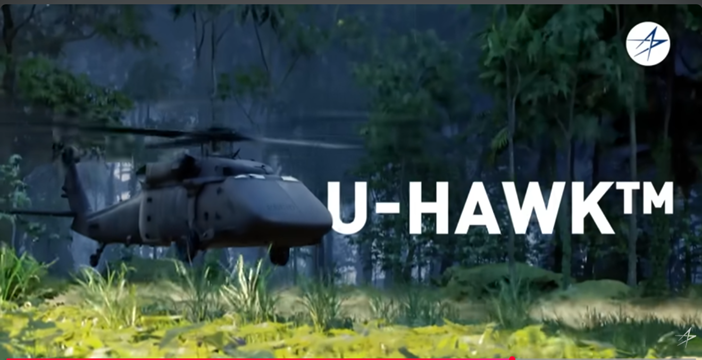
By early 2022, Sikorsky and DARPA successfully demonstrated the first fully autonomous flight of a UH-60A Black Hawk
The Black Hawk helicopter has, for decades, symbolized the backbone of tactical air mobility for the U.S. military and its allies. Now, in a dramatic leap toward the future of military aviation, this iconic aircraft has undergone a revolutionary transformation: it can fly without a pilot. The U-Hawk, a pilotless or optionally crewed variant of the Black Hawk, represents a confluence of cutting-edge autonomy, mission adaptability, and strategic foresight.
Evolution from Black Hawk to U-Hawk
The UH-60 Black Hawk entered service with the U.S. Army in the late 1970s, replacing the UH-1 Iroquois (Huey)… This set the stage for autonomy to enter the tactical rotorcraft domain. In 2014, DARPA launched the Aircrew Labor In-Cockpit Automation System (ALIAS) program… By early 2022, Sikorsky and DARPA successfully demonstrated the first fully autonomous flight of a UH-60A Black Hawk…
Core Technologies Behind the U-Hawk
The U-Hawk is not a new airframe; rather, it is a sophisticated overlay of software, sensors, and actuators onto the proven UH-60 platform. At its heart are three key technological pillars:
a. Sikorsky MATRIX™ Autonomy: Matrix integrates advanced computer vision, sensor fusion, machine learning algorithms, and flight control logic…
b. ALIAS Digital Co-Pilot: ALIAS acts as a cockpit automation layer, using robotic actuators to manipulate existing cockpit controls…
c. Advanced Sensors and Communication Links: The U-Hawk employs LiDAR, radar, EO/IR, GPS/INS systems, and high-bandwidth datalinks to maintain autonomy…
Mission Profiles and Tactical Utility
The U-Hawk’s defining feature is its optionally crewed capability. This allows it to operate autonomously in high-risk environments, while still retaining the ability to fly with a crew. Key mission profiles include:
a. Logistics and Resupply
b. Medical Evacuation
c. Troop Insertion and Extraction
d. Contested Airspace and High-Risk Reconnaissance
Strategic Implications
The introduction of pilotless Black Hawks carries profound strategic implications beyond tactical flexibility. These include:
a. Force Multiplication
b. Resilience in Peer Conflicts
c. Cost and Training Implications
d. Ethical and Legal Considerations
Challenges and Limitations
Despite its promise, the U-Hawk program faces challenges such as cybersecurity vulnerabilities, certification hurdles, reliability in adverse conditions, and institutional cultural shifts.
Global Interest and Competitive Landscape
The U.S. is not alone in pursuing autonomous rotorcraft. China, Europe, and Israel have active programs. The U-Hawk’s maturity gives the U.S. a technological edge but also sets off an arms race in autonomy.
The Road Ahead
Operationalizing the U-Hawk will be a multi-year process. Matrix retrofits to existing Black Hawks provide a quick path to fielding. Future Vertical Lift programs will likely feature autonomy as a baseline capability.
Conclusion
The U-Hawk is more than technological curiosity. It represents the convergence of autonomy, adaptability, and strategic foresight in battlefield mobility. Its pilotless capability marks the dawn of a new era in military rotorcraft operations.