
The man can eat burgers. He approaches burgers with the dedication of a medieval monk illuminating sacred manuscripts. Entire policy meetings had reportedly been interrupted by the arrival of burgers. Every policy paper bore smudges of ketchup. It isn’t the white house any more, it’s the white bun
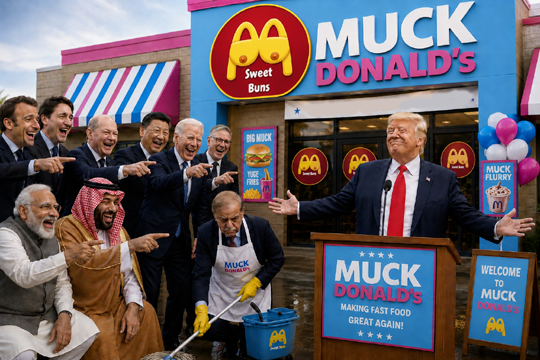
The year is 2030, and history has finally caught up with Donald Trump. Depending on whom one asked, he was either a realtor who occasionally became president or a president who occasionally remembered he was a failed realtor. Some historians described him as a television personality who accidentally stumbled into geopolitics and never quite found the exit.
By 2030, however, the real estate empire had become a complicated collection of mortgage statements, disputed valuations, nostalgic brochures and optimistic PowerPoint presentations. The political legacy was even harder to market. Libraries had entire sections devoted to explaining things he had said on Monday that contradicted things he had said on Tuesday, which themselves contradicted things he had said on Wednesday.
Former associates often remarked that there was only one skill nobody had ever successfully questioned.
The man could eat burgers. Not merely consume them. Not merely enjoy them. He approached burgers with the dedication of a medieval monk illuminating sacred manuscripts. Entire policy meetings had reportedly been interrupted by the arrival of burgers. Campaign strategists had seen their carefully prepared presentations pushed aside by trays of burgers. International visitors occasionally discovered that trade negotiations were scheduled suspiciously close to lunchtime. Policy papers always bore smudges of ketchup.
Eventually, as doors began closing elsewhere, Trump decided to lean into his one universally acknowledged expertise. If life gives you lemons, make lemonade. If life gives you lawsuits, launch a burger chain.
The problem was location. Nobody in the United States wanted to lease him a property. Shopping malls politely declined. Developers declined less politely. Several landlords reportedly installed caller identification systems specifically to avoid answering his calls. Canada was no better. One Toronto property owner allegedly replied to an inquiry by mailing back a photograph of a locked door. Mexico was even less enthusiastic. The country’s real estate sector held what newspapers described as “a brief but unanimous meeting.” They replied with one sentence. “Hey, we built the wall, this time.
After months of searching, he found a willing landlord in Jamaica. Nobody knows whether the owner fully understood the proposal or simply enjoyed the entertainment value. Either way, a lease was signed. Construction began immediately. Workers expected another luxury hotel. Instead they were informed they would be building a fast-food restaurant.
The name alone caused confusion.
“Muck Donald’s.”
At first everyone assumed it was a typo.
Then they realized it was not.
The logo featured a suspiciously familiar pair of golden arches that somehow resembled an article of clothing, accompanied by the slogan “Sweet Buns.”
Trademark lawyers around the world simultaneously experienced unexplained headaches.
The restaurant’s marketing department, consisting mainly of Trump and three enthusiastic social media interns, struggled to settle on a permanent catchphrase.
Every week a new slogan appeared.
“Come and muck around.”
“Sweet buns, suck on them.”
“Just forget what I did.”
“Burgers bigger than your memory.”
“Fact-free food for a fact-free future.”
Customers never knew which slogan would greet them.
Neither did employees.
Neither, apparently, did Trump.
The resulting confusion became part of the brand.
People began visiting simply to discover what slogan had appeared that morning.
Within weeks Muck Donald’s became Jamaica’s most photographed tourist attraction.
Not because of the food.
Because nobody could believe it existed.
A menu inspired by alternative realities
The menu represented perhaps the purest expression of the Muck Donald’s philosophy.
Traditional restaurants usually attempt to present food accurately.
Muck Donald’s preferred a more creative approach.
The flagship burger was called the Executive Order.
The menu claimed it weighed three pounds.
Independent measurements suggested it weighed slightly less than one.
When confronted, management clarified that the figure represented “potential weight.”
Another bestseller was the Alternative Facts Burger.
Customers could choose their own size regardless of physical reality.
If a customer believed it was the largest burger in the world, staff were instructed to congratulate them on their excellent judgment.
The restaurant’s breakfast menu featured the Covfefe Combo.
Nobody knew what it contained.
Not even the kitchen.
Every order emerged differently.
Some customers received eggs.
Others received pancakes.
One unfortunate tourist received six onions and a milkshake.
Management called this “culinary innovation.”
The drinks menu was equally memorable.
Diet Denial Cola contained twice the sugar of regular cola.
Freedom Fries Float featured ice cream balanced precariously on top of french fries.
The Presidential Punch promised to make customers feel powerful, important and vaguely confused.
The side effects generally matched the advertising.
Meanwhile, the children’s menu included collectible toys based on famous moments from Trump’s career.
There was the Tiny Hand Action Figure.
The Windproof Hair Challenge Set.
The Build Your Own Wall Construction Kit.
The Limited Edition Golf Cart of Destiny.
Collectors queued around the block.
Parents questioned their life choices.
Children remained delighted.
Food critics remained horrified.
The restaurant became an internet sensation.
Visitors posted photographs daily.
Reviewers struggled to categorize the experience.
Was it satire?
Was it business?
Was it performance art?
Nobody knew.
The uncertainty itself became a tourist attraction.
The international expansion nobody expected
Against all odds, Muck Donald’s succeeded.
Not because people loved the food.
Not because the service was efficient.
Certainly not because the branding was subtle.
It succeeded because humanity has always possessed an infinite appetite for spectacle.
Visitors flew from around the world to witness what newspapers increasingly referred to as “the edible political museum.”
Soon investors began calling.
Not serious investors.
Mostly billionaires with unusual senses of humor.
Within a year, new locations appeared.
A branch opened in Las Vegas featuring slot machines that dispensed ketchup packets.
A Dubai outlet offered gold-plated onion rings.
A London branch installed a special queue called Brexit Lane that promised faster service while somehow taking longer.
The Paris location introduced gourmet surrender croissants.
The Tokyo restaurant offered robotic servers programmed to compliment customers every thirty seconds.
Each franchise introduced local variations.
Each variation somehow became stranger.
The company held its first global conference in 2032.
Delegates arrived expecting serious business discussions.
Instead they received baseball caps, burger vouchers and a keynote speech titled “Why Reality Is Negotiable.”
The speech lasted four hours.
Nobody learned anything.
Everyone received commemorative ketchup bottles.
Shareholders declared the event a success.
Financial analysts were less convinced.
Economists attempted to explain the phenomenon.
Sociologists produced lengthy reports.
Psychologists wrote books.
The simplest explanation was also the most accurate.
People enjoyed laughing.
And Muck Donald’s provided industrial quantities of laughter.
Customers frequently spent more time photographing signs than eating food.
The gift shop generated more revenue than the kitchen.
One bestselling item was a coffee mug displaying every slogan the company had ever used.
The mug required unusually large dimensions.
New slogans appeared faster than they could be printed.
Former political opponents unexpectedly became customers.
Former supporters became customers too.
Tourists visited.
Journalists visited.
Academics visited.
Even rival fast-food executives secretly visited.
Many arrived intending to mock.
Most left carrying souvenir T-shirts.
When burgers became foreign policy
Success eventually went to Trump’s head.
Admittedly, this had happened before.
But now he possessed a multinational burger empire.
The consequences were spectacular.
He began referring to himself as the Secretary of Snacks.
He proposed solving international disputes through competitive burger-eating contests.
Trade agreements would be replaced by combo meals.
Tariffs would be calculated using onion ring indexes.
Diplomats laughed.
Then realized he was serious.
The annual Muck Summit became one of the world’s strangest gatherings.
Presidents, prime ministers and celebrities attended partly out of curiosity.
The opening ceremony featured synchronized ketchup fountains.
The closing ceremony featured fireworks shaped like hamburgers.
One year a delegation accidentally signed a memorandum of understanding while waiting in line for milkshakes.
Nobody could later remember what had been agreed.
Markets nevertheless rallied.
Television coverage became enormous.
Commentators spent hours analyzing burger symbolism.
News channels displayed charts comparing approval ratings with french fry consumption.
Political scientists collectively reconsidered their career choices.
The company launched Muck TV, a streaming service devoted entirely to food, golf and self-congratulation.
Subscriber numbers exceeded expectations.
Content quality did not.
Yet somehow audiences remained fascinated.
Perhaps the modern world had become too complicated.
Perhaps Muck Donald’s offered comforting absurdity.
Or perhaps watching rich people argue about burgers was simply entertaining.
Whatever the explanation, the empire continued growing.
By 2035, Muck Donald’s had become one of the world’s most recognizable brands.
Business schools taught case studies about it.
Most concluded with the same sentence:
“Please do not attempt to replicate this strategy.”
Just forget what I did
Looking back, historians still debate the true significance of Muck Donald’s.
Was it a fast-food chain?
A comedy franchise?
A political afterlife?
A monument to branding?
Or merely a reminder that reality occasionally develops a sense of humor?
The restaurant’s final and most famous slogan eventually answered the question.
“Just forget what I did.”
Customers adored it.
Critics mocked it.
Merchandise sales exploded.
The phrase appeared on hats, shirts, mugs, aprons, beach towels and limited-edition ketchup dispensers.
It became a cultural phenomenon.
Ironically, the slogan ensured that nobody forgot anything.
Visitors kept arriving.
Photographs kept circulating.
The legend kept growing.
And somewhere in Jamaica, at the original restaurant where it all began, tourists still gathered beneath the famous red-and-yellow logo.
They ordered Executive Orders.
They drank Presidential Punch.
They bought souvenirs.
They laughed.
Most importantly, they told stories.
Because long after the burgers were eaten and the milkshakes were finished, the real product of Muck Donald’s was never food.
It was entertainment.
The chain had discovered the secret formula every politician, businessman and television producer had spent decades chasing.
People will forgive many things.
People will forget many things.
But they will never stop watching a spectacular train wreck if it comes with fries.
And so Donald Trump, the former real-estate mogul, part-time president, full-time headline generator and accidental fast-food emperor, finally found the one industry perfectly suited to his talents.
An industry where exaggeration was expected.
Consistency was optional.
And every customer left slightly confused but strangely satisfied.
In other words, he had finally come home.
To Muck Donald’s.
Where the buns were sweet, the slogans changed daily, and reality was always served medium rare.