
Salads and water can make Trump less of a liar. Leaders who command armies, oversee nuclear arsenals, and influence global markets bear obligations extending beyond ordinary expectations. Maintaining personal health is part of that responsibility because it supports the ability to serve effectively. Trump the Chump is not up to those standards
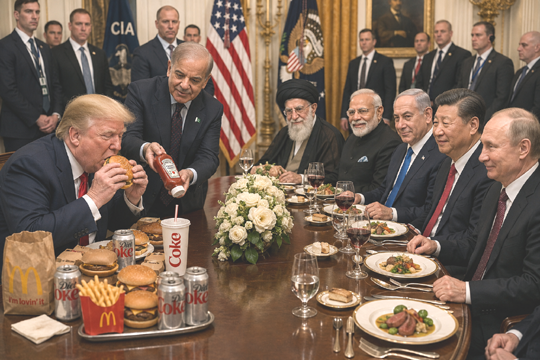
Whether one admires or opposes Trump politically, few would dispute that the responsibilities associated with managing a Gulf crisis are immense. Citizens naturally ask whether leaders maintain the energy and judgment necessary for high office. These questions become even more prominent when a leader is known for unconventional personal habits.
Trump’s lifestyle has attracted attention for decades. His preference for fast food, avoidance of alcohol, enthusiasm for soft drinks, and skepticism toward structured exercise have been extensively documented. These habits have become part of his public identity. Admirers interpret them as evidence of authenticity and resistance to elite expectations. Critics view them as indicators of poor health management. Regardless of political perspective, his dietary preferences are unusual for someone occupying one of the most stressful positions in the world.
Peace in the Gulf might begin with replacing hamburgers with salads and soda with water. Yeah! As simple as that. International conflicts may come closer to solution by just altering the lunch menu of a choleric dictator. The personal well-being of world leaders can influence the quality of decisions affecting billions of people. When the stakes involve military confrontation in a region central to global energy supplies, even small improvements in concentration, patience, resilience, and long-term health could potentially contribute to more measured decision-making.
Researchers have studied how illness affected monarchs, presidents, prime ministers, and military commanders. Some leaders concealed serious conditions from the public. Others continued governing despite debilitating diseases. In many cases, historians later concluded that health issues significantly shaped critical decisions. The lesson is not that illness automatically produces poor leadership, but rather that physical and cognitive well-being are relevant factors when evaluating the performance of any individual entrusted with extraordinary authority.
The fast-food presidency and the symbolism of diet
Donald Trump’s affinity for fast food has become one of the most recognizable aspects of his public persona. Throughout his political career he has openly expressed preference for familiar chain restaurant meals over gourmet cuisine. This preference has appeared during campaign tours, presidential travel, White House events, and even diplomatic engagements. Supporters often portray this behavior as evidence that he remains connected to ordinary Americans rather than elite social circles. Critics see something different: a refusal to adopt habits typically associated with long-term health and wellness.
One reason Trump has reportedly favored fast food is consistency. Chain restaurants offer standardized products prepared according to predictable procedures. Trump has frequently expressed appreciation for that predictability. There is also the frequently cited belief that mass-produced fast food reduces concerns about tampering because meals are prepared within highly structured systems rather than by unknown chefs. Whether or not such concerns are justified, they help explain his comfort with foods that many nutritionists would recommend consuming only occasionally.
Presidents routinely use food as a diplomatic tool. State dinners are carefully planned displays of culture, hospitality, and national identity. When a president visibly prefers hamburgers to elaborate culinary presentations, observers inevitably interpret the behavior through political and cultural lenses. Some see populism. Others see disregard for diplomatic tradition. Either way, the choices attract attention because they contrast sharply with expectations surrounding high office.
Nutrition experts have long warned about diets heavily dependent on processed foods rich in sodium, saturated fats, and refined carbohydrates. Such diets can contribute to weight gain, elevated blood pressure, metabolic disorders, and cardiovascular risks over time. The presidency imposes extraordinary physiological demands. Constant travel, irregular schedules, intense stress, and relentless public scrutiny challenge even younger individuals. Nutrition becomes more than a personal preference under such circumstances. It becomes a factor influencing energy levels, sleep quality, mood regulation, and overall resilience. Leaders operating under chronic stress may benefit disproportionately from habits that support physical health.
This is where salads becomes relevant. Healthier lifestyles are also about enhancing day-to-day performance. Better nutrition may contribute to steadier energy, improved concentration, and reduced fatigue. While no salad can transform foreign policy, a pattern of healthier choices could theoretically support the mental and physical capacities required for complex decision-making. It can make Trump less of a liar.
Many individuals with imperfect diets remain highly capable professionals but Trump is not one of them. Many argue that Trump would be as incompetent as he is today with salads and water. Healthy habits increase the likelihood of sustained performance but cannot substitute for intelligence, experience, character, or strategic insight. Well, Trump could be an exception either way.
Nevertheless, when evaluating leaders responsible for military and diplomatic decisions, questions about lifestyle remain legitimate. Citizens have a reasonable interest in understanding whether those entrusted with immense power are doing everything possible to maintain their health. This concern becomes particularly acute when the leader is eighty years old and facing challenges that require rapid responses under pressure.
Soda, hydration, and the demands of executive decision-making
If Trump’s relationship with fast food attracts attention, his relationship with soft drinks generates even more discussion. The image of a president consuming multiple cans of Diet Coke daily has become deeply embedded in public consciousness. Stories about a special button used to request soda have circulated widely, transforming a personal preference into a recurring cultural anecdote.
Trump’s avoidance of alcohol is generally viewed more positively. His abstinence is often linked to the struggles experienced by his brother, whose battle with addiction reportedly left a profound impression on him. In a political culture where alcohol consumption is frequently normalized, lifelong abstinence represents an unusual and, from many public health perspectives, commendable choice.
Water is the most obvious drink for most people. Yet Trump has become known for preferring soft drinks. Even mild dehydration from soda can affect concentration, mood, memory, and reaction times. For individuals operating in high-pressure environments, maintaining adequate hydration is widely regarded as essential. But who will tell Trump the Chump that? Hah?
When soft drinks largely replace water, questions arise regarding long-term health implications. For a world leader responsible for crisis management, such questions inevitably attract public attention.
The Hormuz example again illustrates why these concerns matter. Military crises often unfold over days or weeks. Leaders may receive briefings at unusual hours, endure sleep disruption, and confront rapidly changing circumstances. Under such conditions, maintaining cognitive sharpness becomes especially important. Small factors affecting concentration or stamina can assume greater significance.
There is also a symbolic dimension to hydration. Water represents moderation, balance, and basic self-care. Soda, fairly or unfairly, is often associated with indulgence and instant gratification. Public perceptions of leaders frequently draw upon such symbolism. A president photographed drinking water during a long meeting communicates a different image than one reaching repeatedly for sugary or artificially sweetened beverages.
Again, caution is necessary. It would be absurd to suggest that replacing soda with water would automatically resolve geopolitical tensions. International conflicts emerge from complex historical, strategic, and economic factors. However, the metaphor persists because it captures an intuitive truth: leaders are human beings whose physical habits influence their daily functioning. When their decisions affect global security, those habits become matters of public interest.
The discussion ultimately reflects society’s growing awareness that cognitive performance is not isolated from physical health. Nutrition, hydration, sleep, exercise, and stress management all contribute to overall functioning. Modern neuroscience increasingly emphasizes these connections. As populations age and political leaders remain active later in life, such considerations are likely to become even more prominent.
Aging, cognition, and the challenge of leadership at eighty
Age remains the most sensitive aspect of debates surrounding Donald Trump’s fitness for office. Turning eighty places him among the oldest individuals ever to hold the presidency. Age alone does not determine competence. Many people remain intellectually vigorous well into their eighties and beyond. Nevertheless, aging introduces statistical realities that cannot be ignored.
Medical science recognizes considerable variation among older adults. Some experience significant declines in mobility, memory, or endurance. Others continue functioning at remarkably high levels. This variability complicates public discussion because broad assumptions about aging often prove inaccurate when applied to specific individuals.
Official medical evaluations have consistently reported that Trump performs well on cognitive assessments and exhibits no evidence of significant impairment. Supporters cite these findings as proof that concerns about his mental fitness are politically motivated. Critics counter that brief screening tests cannot fully capture the demands of presidential decision-making. The disagreement illustrates the limitations of publicly available information.
The presidency requires far more than the ability to remember words or complete standard cognitive exercises. It demands sustained attention, strategic reasoning, emotional regulation, and the capacity to process enormous quantities of information. Evaluating these qualities from outside government is inherently difficult. Citizens must rely on public appearances, interviews, speeches, policy decisions, and medical disclosures, all of which provide incomplete pictures.
Age also affects physical stamina. Campaigning, international travel, crisis management, and ceremonial obligations create exhausting schedules. Even younger presidents have described the office as physically draining. Maintaining such a pace at eighty inevitably raises questions about recovery, endurance, and resilience.
The debate often becomes polarized because opponents portray every verbal mistake as evidence of decline while supporters dismiss all concerns as partisan attacks. Reality is usually more complicated. Human performance exists on a spectrum. Individuals may excel in some areas while facing challenges in others. Aging rarely produces uniform effects.
From a governance perspective, the key question is not whether an older leader occasionally misspeaks or appears tired. Such experiences are common across age groups. The more important issue is whether age-related factors materially affect judgment and decision-making. This question is difficult to answer conclusively without access to information unavailable to the public.
The significance of the issue becomes clear when considering potential military confrontations. Decisions involving the Strait of Hormuz could influence global energy supplies, international alliances, and regional stability. Such decisions require patience, careful analysis, and resistance to impulsive reactions. Citizens naturally want assurance that leaders possess the physical and cognitive resources necessary for these responsibilities.
The discussion therefore transcends Donald Trump as an individual. It raises broader questions about age limits, medical transparency, and democratic accountability. As life expectancy increases, societies will continue confronting these issues. The challenge lies in balancing respect for experienced older leaders with legitimate concerns about the demands of high office.
The modern world often assumes that wars are driven by grand strategy, military doctrine, ideology, economics, or geopolitics. The ongoing tensions surrounding the Strait of Hormuz, one of the most strategically important waterways on earth, appear at first glance to be a textbook example. The narrow maritime corridor through which a significant share of global oil exports passes has long been a flashpoint between Iran, the United States, and regional powers. Every confrontation in the Gulf immediately affects energy prices, financial markets, shipping routes, and diplomatic relations across continents. Yet history repeatedly demonstrates that the actions of nations are ultimately shaped by individuals. When a single individual occupies the most powerful political office in the world, questions about that person’s judgment, temperament, health, and decision-making become inseparable from questions about international stability.
This reality has reignited debate surrounding President Donald Trump as he enters his eighties. Supporters point to official medical evaluations that describe him as healthy, energetic, and mentally fit for office. Critics argue that the extraordinary demands of the presidency require standards far beyond merely passing medical examinations. They point to advancing age, dietary habits, sleep patterns, and public behavior as factors deserving scrutiny. In an era when a social media post, an off-the-cuff remark, or a sudden military order can influence markets and diplomacy within minutes, discussions about presidential health inevitably acquire geopolitical significance.
Health, geopolitics, and why personal habits become global concerns
The notion that a salad and a glass of water could help end a conflict in the Gulf is obviously metaphorical. Yet metaphors often reveal important truths. The central insight is that personal health and global politics are not entirely separate domains. Leaders carry their bodies and minds into every meeting, briefing, negotiation, and crisis.
History offers numerous examples. Medical conditions have influenced diplomatic negotiations, military campaigns, and governmental stability. Fatigue has contributed to mistakes. Illness has altered priorities. Physical limitations have shaped schedules and decision-making processes. None of these factors operate in isolation, but neither can they be ignored.
Donald Trump occupies a uniquely visible position within this historical pattern. His lifestyle choices are unusually public. His dietary preferences are widely known. His age is impossible to overlook. His personality generates intense reactions from both supporters and critics. Consequently, discussions about his health often become proxies for broader political arguments.
Some critics go too far, transforming legitimate questions into personal insults. Labels such as “demented” or other pejorative descriptions generally generate more heat than light. Serious discussions about leadership should focus on evidence rather than rhetoric. Medical assessments, observable behavior, policy outcomes, and expert analysis provide more useful foundations for evaluation than inflammatory language.
At the same time, supporters sometimes dismiss all scrutiny as illegitimate. That position is equally problematic. Citizens in democratic societies have every right to examine the health and fitness of leaders wielding immense power. Transparency and accountability are essential components of responsible governance.
The Strait of Hormuz serves as a reminder of what is at stake. A major conflict in the region could disrupt energy markets, damage economies, increase military expenditures, and threaten countless lives. Preventing such outcomes requires wise leadership from multiple governments, not merely one individual. Yet the quality of leadership matters. Calm judgment, strategic patience, and emotional discipline can help reduce risks during periods of tension.
Personal habits contribute to these qualities indirectly. Adequate sleep supports emotional regulation. Good nutrition supports sustained energy. Hydration supports cognitive performance. Physical activity supports overall health. None of these guarantees wise decisions, but they create conditions more favorable to effective leadership.
Leaders who command armies, oversee nuclear arsenals, and influence global markets bear obligations extending beyond ordinary expectations. Maintaining personal health is part of that responsibility because it supports the ability to serve effectively.
Whether one admires Donald Trump or opposes him politically, the principle remains the same. Citizens should hope that any president, Republican or Democrat, conservative or liberal, adopts habits that maximize health, clarity, and resilience. The benefits extend beyond the individual. They potentially affect national governance and international stability.
Global peace sometimes depends not only on treaties, military balances, or diplomatic negotiations, but also on the everyday choices of the individuals making history. The future of the Strait of Hormuz will ultimately be determined by the personal well-being of leaders like Trump who remain part of the equation.
Healthier leaders may be better equipped to navigate the crises that decide whether conflicts escalate or subside. In a world where the consequences of presidential decisions can reverberate across continents within hours, even that modest possibility deserves serious consideration.