
El Niño, a naturally occurring climate pattern characterized by the warming of surface waters in the central and eastern Pacific Ocean, has far-reaching consequences for weather patterns around the world. While some regions experience excessive rainfall and flooding, many others endure severe droughts, declining groundwater levels, crop failures, and water shortages
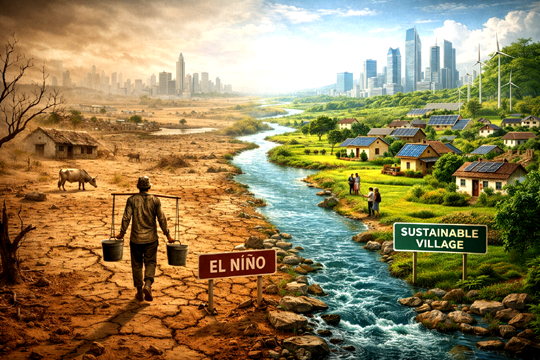
Water has always been the foundation of civilization. Every great city in history emerged beside a reliable source of water, whether a river, lake, spring, or coastline. Ancient settlements flourished because they could provide drinking water, irrigation, sanitation, transport, and food security to their inhabitants. Yet in the twenty-first century, humanity is confronting a paradox. Cities have become larger, wealthier, and technologically more advanced than ever before, but their dependence on distant water sources has increased dramatically. At the same time, climate variability and recurring weather phenomena such as El Niño are exposing the fragility of water systems across the globe.
El Niño, a naturally occurring climate pattern characterized by the warming of surface waters in the central and eastern Pacific Ocean, has far-reaching consequences for weather patterns around the world. While some regions experience excessive rainfall and flooding, many others endure severe droughts, declining groundwater levels, crop failures, and water shortages. Nations that appear water secure during normal years suddenly find reservoirs shrinking, rivers drying, and agricultural output collapsing. Urban populations, which depend on continuous water supplies, become particularly vulnerable when prolonged dry spells reduce available resources.
The challenge is not simply about the availability of water. It is also about how societies organize themselves around water resources. Modern development models have often encouraged rapid urbanization while neglecting rural areas. As people migrate from villages to cities in search of employment, education, healthcare, and better living standards, urban populations continue to expand. This growth places enormous pressure on city water systems. Municipal authorities frequently respond by extracting more groundwater, building longer pipelines, diverting rivers, or constructing expensive reservoirs. Such measures may temporarily solve shortages but often transfer environmental and social costs to surrounding rural regions.
The result is an unsustainable cycle. Villages lose population and investment while cities consume increasing quantities of water and resources. Rural communities that once maintained forests, wetlands, ponds, lakes, and watersheds often lack the infrastructure and economic opportunities needed to retain residents. As agricultural lands are abandoned or mismanaged, natural water recharge systems deteriorate. Groundwater tables fall, soil quality declines, and local ecosystems become less resilient to drought.
El Niño intensifies these weaknesses. During years of reduced rainfall, depleted watersheds and degraded rural landscapes are unable to capture and store sufficient water. Rivers that once flowed year-round become seasonal. Reservoirs receive less inflow. Groundwater recharge slows dramatically. Cities located hundreds of kilometers away begin to experience shortages because the villages and ecosystems that sustain their water sources have been neglected.
This reality highlights a fundamental truth often overlooked in urban planning. Sustainable cities cannot exist in isolation. A city’s long-term survival depends on the health and sustainability of the villages, forests, wetlands, rivers, and agricultural landscapes that surround it. Water security is not created within city boundaries alone. It emerges from an integrated regional system where rural and urban areas support one another. If nations hope to withstand increasingly severe climate shocks, including future El Niño events, they must rethink development strategies and recognize that sustainable villages are as important as sustainable cities.
The growing impact of El Niño on global water security
The effects of El Niño are felt across continents, influencing rainfall patterns, temperatures, agricultural productivity, and water availability. Countries in Asia, Africa, Australia, and parts of the Americas frequently experience drought conditions during strong El Niño years. These droughts can persist for months, reducing river flows and limiting groundwater recharge. The consequences ripple through entire economies, affecting food production, energy generation, industrial activity, and public health.
Agriculture is often the first sector to feel the impact. Reduced rainfall lowers crop yields and increases dependence on irrigation. Farmers pump more groundwater to compensate for insufficient precipitation, accelerating depletion of aquifers that may have taken centuries to fill. As water tables decline, pumping becomes more expensive and less sustainable. Small farmers are particularly vulnerable because they lack the financial resources needed to invest in deeper wells or advanced irrigation technologies.
Urban centers also suffer. Large cities require vast quantities of water every day for drinking, sanitation, industry, transportation, and recreation. During drought periods, reservoirs that supply metropolitan regions can fall to critically low levels. Governments may impose water restrictions, ration supplies, or initiate emergency measures to secure additional resources. Such actions reveal how dependent modern cities are on stable hydrological systems.
The economic costs of drought can be enormous. Reduced agricultural output contributes to higher food prices. Hydroelectric power generation may decline as reservoir levels fall, increasing dependence on fossil fuels. Industries that require significant amounts of water may reduce production or relocate operations. Tourism can also suffer when lakes, rivers, and natural attractions deteriorate.
Beyond economics lies the issue of social stability. Water scarcity often affects poorer communities most severely. Wealthier households may be able to purchase water, install storage systems, or access private supplies. Marginalized populations frequently have fewer options and may face longer periods without reliable access to clean water. This can increase inequality and place additional strain on public institutions.
Climate change is amplifying these concerns. Although El Niño itself is a natural phenomenon, rising global temperatures are increasing evaporation rates and altering rainfall patterns. This means that droughts associated with El Niño may become more intense in some regions. Communities that were already struggling with water management face even greater challenges under these changing conditions.
The lesson is clear. Water security cannot rely solely on engineering solutions. Dams, pipelines, and reservoirs are important, but they are not enough. Sustainable water management requires healthy watersheds, protected forests, restored wetlands, and resilient rural communities capable of maintaining the natural systems that capture, store, and release water. Without these foundations, cities remain vulnerable regardless of how sophisticated their infrastructure becomes.
Why villages are essential to urban sustainability
Many discussions about sustainability focus primarily on cities because urban areas generate most economic activity and house growing populations. However, cities are fundamentally dependent on rural regions for water, food, energy, labor, and ecological services. Villages play a crucial role in maintaining these connections.
Forests surrounding rural communities act as natural water regulators. They absorb rainfall, reduce erosion, improve soil moisture, and facilitate groundwater recharge. Wetlands filter pollutants and store excess water during rainy periods, releasing it gradually during dry seasons. Agricultural landscapes managed sustainably can contribute to water conservation and ecosystem health.
When villages decline, these functions often deteriorate. Migration to cities may leave fewer people available to manage traditional water bodies, maintain irrigation systems, or protect local ecosystems. Economic pressures can encourage unsustainable land-use practices such as excessive groundwater extraction, deforestation, or overgrazing. These activities reduce the landscape’s ability to retain water and increase vulnerability to drought.
Providing villages with adequate infrastructure is therefore not merely a matter of social justice. It is also a strategic investment in national resilience. Rural communities need access to quality education, healthcare, transportation, digital connectivity, energy, sanitation, and employment opportunities. When such facilities are available, residents are more likely to remain in their communities and contribute to local development.
Modern technology offers significant opportunities in this regard. Renewable energy systems, broadband internet, telemedicine, smart irrigation, and decentralized water treatment can improve rural living standards while reducing environmental impacts. Villages no longer need to be isolated or deprived of essential services. With appropriate investment, they can become vibrant centers of economic activity and environmental stewardship.
A sustainable village supports both its residents and the broader region. It helps protect watersheds, maintain agricultural production, conserve biodiversity, and preserve cultural heritage. In turn, these contributions enhance the sustainability of nearby cities. The relationship is reciprocal rather than competitive.
Urban planners increasingly recognize the importance of regional thinking. Rather than treating cities and villages as separate entities, policymakers are beginning to view them as components of interconnected systems. Water security, transportation networks, economic development, and environmental management all require coordinated approaches that span administrative boundaries.
El Niño provides a stark reminder of this interconnectedness. When drought strikes, the condition of surrounding rural landscapes often determines how well cities can cope. Healthy watersheds and resilient villages act as buffers against climatic shocks, reducing the severity of water shortages and supporting recovery efforts.
Building integrated rural-urban water systems for the future
Creating sustainable cities surrounded by sustainable villages requires a shift in development philosophy. Instead of concentrating resources exclusively in urban centers, governments must invest in balanced regional growth that strengthens both rural and urban communities. Such an approach recognizes that water security begins far upstream from the taps and reservoirs that city residents see every day.
Integrated water management should form the cornerstone of this strategy. Watersheds must be managed as complete ecological systems rather than fragmented administrative units. Forest conservation, wetland restoration, groundwater recharge projects, rainwater harvesting, and sustainable agriculture should be coordinated across entire regions. These measures increase water availability while improving resilience to drought.
Village infrastructure is equally important. Access to reliable roads, electricity, healthcare, schools, and digital services can reduce migration pressures and create economic opportunities closer to home. Rural industries, agro-processing facilities, and renewable energy projects can generate employment while supporting local economies. When villages prosper, they are better positioned to protect and manage the natural resources upon which cities depend.
Water-efficient technologies must also be widely adopted. Agriculture accounts for the majority of freshwater consumption in many countries. Drip irrigation, precision farming, drought-resistant crops, and improved soil management can significantly reduce water use while maintaining productivity. Urban areas can contribute through wastewater recycling, leak reduction, efficient appliances, and sustainable building design.
Public participation is another essential element. Communities often possess valuable local knowledge regarding water management and environmental stewardship. Policymakers should involve residents, farmers, scientists, and civil society organizations in planning and decision-making processes. Collaborative approaches tend to produce more durable and effective solutions.
Financial mechanisms can encourage sustainable practices. Payments for ecosystem services, watershed protection funds, and incentives for conservation can help align economic interests with environmental goals. Cities that benefit from rural water resources may contribute financially to the protection and restoration of the landscapes that sustain those resources.
Ultimately, the challenge posed by El Niño extends beyond meteorology. It exposes deeper weaknesses in development models that separate urban prosperity from rural well-being. Droughts reveal the hidden connections linking villages, watersheds, ecosystems, and cities. When these connections are neglected, entire nations become vulnerable.
The path forward requires recognizing that water is not merely a commodity to be extracted and distributed. It is part of a complex ecological cycle that depends on healthy landscapes and thriving communities. Sustainable cities cannot be built solely through skyscrapers, pipelines, and treatment plants. They require sustainable villages equipped with modern facilities, strong local economies, and the capacity to protect the natural systems that generate water security.
As El Niño continues to challenge nations around the world, the lesson becomes increasingly clear. The future of urban sustainability will be determined not only by what happens within city limits but also by the condition of the villages and ecosystems beyond them. Nations that invest in integrated rural-urban development will be better prepared to withstand droughts, adapt to climate change, and secure reliable water supplies for generations to come. Those that ignore this reality may discover that when El Niño arrives, their cities are only as resilient as the villages that surround them.