
A football fan may decide to watch one match, then stay awake for the second, and eventually continue into the third. What begins as a month-long celebration can quickly become a month-long assault on the body’s biological clock
The FIFA World Cup is one of the few events capable of bringing entire nations to a standstill. Streets become quieter, televisions glow deep into the night, and conversations in offices, schools, tea stalls, restaurants and social media revolve around goals, controversies and dramatic finishes. For football lovers across Asia, however, the 2026 FIFA World Cup presents a unique challenge. With the tournament being hosted across North America, many matches are likely to be played at times that fall in the middle of the night or the early hours of the morning in countries such as India, Bangladesh, Pakistan, Sri Lanka, Nepal, Thailand, Indonesia and much of East and Southeast Asia.
The temptation is obvious. A football fan may decide to watch one match, then stay awake for the second, and eventually continue into the third. What begins as a month-long celebration can quickly become a month-long assault on the body’s biological clock.
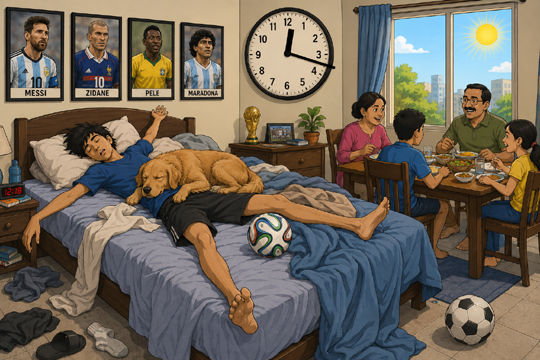
The image perfectly captures a scenario that may become common during the tournament. A young football enthusiast lies sprawled across his bed, exhausted after apparently staying awake through the night. Football posters of legendary players line the walls. Footballs are scattered around the room. A digital clock shows a time well past midnight. While the rest of the household gathers around the breakfast table, sharing food, conversation and family time, the football fan remains asleep, disconnected from the rhythms of normal life. Even the family dog has settled beside him, as if accepting that the young supporter is no longer operating on the same schedule as everyone else.
This image is not merely a humorous illustration. It symbolizes a growing public-health concern that accompanies major sporting events held in distant time zones. Watching three World Cup matches every night for several weeks can profoundly disrupt circadian rhythms, impair physical health, damage mental well-being, strain family relationships, alter eating habits and weaken social participation.
The human body evolved around the natural cycle of daylight and darkness. For thousands of years, sunrise signaled activity and sunset signaled rest. Modern technology allows people to ignore these biological signals, but the body itself never truly adapts. The brain’s master clock, located in the hypothalamus, regulates sleep, hormone release, body temperature, digestion and countless other physiological functions. When people repeatedly stay awake until dawn and then sleep during the day, this clock becomes confused.
Unlike occasional late nights, a month-long World Cup schedule involving multiple nightly matches creates chronic circadian disruption. The body begins receiving contradictory signals. Bright television screens suppress melatonin production. Emotional excitement raises adrenaline levels. Sleep becomes fragmented. Recovery becomes incomplete. As days pass, the effects accumulate.
The danger is often underestimated because football fandom feels harmless. Supporters see themselves as merely watching a game from the comfort of their homes. Yet the physiological consequences of repeatedly sleeping at abnormal times can resemble those experienced by night-shift workers. Medical research has repeatedly shown that chronic circadian disruption affects nearly every organ system.
The problem becomes even more severe when fans attempt to maintain their normal daytime obligations. Students continue attending classes. Office workers report to work. Shopkeepers open their businesses. Factory workers begin their shifts. Parents continue their household responsibilities. Rather than sleeping sufficiently during the day, many attempt to survive on four or five hours of rest while consuming increasing amounts of tea, coffee, energy drinks and sugary snacks.
As the tournament progresses, fatigue becomes the new normal. Individuals stop recognizing how impaired they have become because everyone around them appears equally sleep deprived. Families adapt temporarily. Workplaces tolerate reduced productivity. Schools notice declining concentration. Yet beneath the excitement of the tournament, significant damage may already be occurring.
Circadian rhythm disruption and the body’s internal clock
The most immediate consequence of watching three matches every night is the destruction of normal circadian rhythms.
Circadian rhythms operate on an approximately twenty-four-hour cycle. They regulate sleep and wakefulness, hormone secretion, metabolism, digestion, immune responses and cognitive performance. These rhythms depend heavily on exposure to natural light.
When a football fan stays awake until sunrise watching matches from North America, the body receives mixed signals. Darkness suggests sleep. Television screens suggest wakefulness. Excitement from goals and dramatic moments stimulates stress hormones. By the time the final whistle blows, birds may already be singing outside.
The fan then attempts to sleep during daylight hours when the body naturally wants to remain alert.
This mismatch creates a state similar to permanent jet lag.
Initially, symptoms may seem minor. People feel groggy in the morning. Concentration declines. Reaction times slow. Memory becomes less reliable. Mood becomes unpredictable.
After several weeks, however, the consequences become much more significant.
The body begins producing hormones at inappropriate times. Melatonin release becomes delayed. Cortisol patterns become disrupted. Appetite regulation becomes unstable. Blood sugar control may worsen. The immune system becomes less effective.
Many supporters convince themselves that they can “catch up” on sleep later. Unfortunately, sleep debt cannot be completely repaid through occasional long naps. The body’s biological systems continue experiencing stress even when total sleep hours appear adequate.
In Asian countries where work and school schedules generally begin early, fans face a particularly difficult challenge. Even if they sleep during the morning, environmental noise, sunlight and social obligations often prevent deep restorative sleep.
The result is chronic sleep deprivation disguised as entertainment.
Physical health consequences beyond simple tiredness
Sleep deprivation affects far more than energy levels.
One of the first victims is cardiovascular health. When sleep is shortened and circadian rhythms are disrupted, blood pressure tends to rise. Heart rate variability decreases. Inflammatory markers increase. Over time, these changes place additional strain on the cardiovascular system.
Although a single month of football viewing may not cause permanent heart disease, repeated tournaments and prolonged periods of disrupted sleep contribute to long-term health risks.
Weight gain is another common consequence.
Football viewing rarely occurs in isolation. Fans often consume snacks, sugary drinks, fried foods and late-night meals while watching matches. Because the body is not designed to digest large quantities of food during the middle of the night, metabolic efficiency declines.
Late-night eating can increase fat storage, impair insulin sensitivity and encourage overeating.
The problem becomes cyclical. Sleep deprivation increases hunger hormones such as ghrelin while reducing hormones associated with satiety. As a result, tired individuals often crave calorie-dense foods.
Many supporters therefore find themselves eating more while exercising less.
Physical activity also declines during major tournaments. Time previously spent walking, exercising or playing sports is replaced by hours sitting on couches or lying in bed watching screens.
Ironically, people celebrating football often become less physically active during football season.
The immune system also suffers.
Studies have consistently shown that inadequate sleep reduces immune effectiveness. Individuals become more susceptible to infections. Recovery from illness takes longer. Minor health problems linger.
During a month-long tournament, this weakened immunity may contribute to increased rates of colds, respiratory infections and general fatigue.
Eye strain and headaches become increasingly common as well. Watching bright screens throughout the night places stress on visual systems that evolved for darkness and rest.
Neck pain, back pain and poor posture frequently accompany marathon viewing sessions.
What appears to be harmless entertainment can therefore trigger a surprisingly broad range of physical health problems.
Mental health, mood and cognitive decline
Sleep is essential for emotional regulation and mental performance.
The brain uses sleep to consolidate memories, process emotions and restore cognitive function. When sleep becomes irregular or insufficient, mental performance deteriorates rapidly.
Football fans staying awake through three matches every night often experience declining concentration within days.
Students may struggle to remember lessons. Office workers make more mistakes. Drivers become less attentive. Decision-making quality declines.
The effects can be subtle yet significant.
People become more irritable. Small disagreements escalate into arguments. Patience decreases. Emotional resilience weakens.
The image of the sleeping football fan while his family shares breakfast reflects more than physical exhaustion. It symbolizes social and emotional disengagement. Sleep-deprived individuals frequently withdraw from normal interactions because they lack the energy to participate.
Mood disorders may also worsen.
Individuals already vulnerable to anxiety or depression often experience increased symptoms when sleep schedules become disrupted. Emotional reactions become exaggerated. Stress feels harder to manage.
Another concern is the stimulation associated with intense sporting events.
Football matches generate excitement, anticipation, frustration and euphoria. Watching these emotional swings repeatedly throughout the night keeps the brain in a heightened state of arousal.
Instead of preparing for rest, the nervous system remains activated.
Even after the television is switched off, many fans find themselves unable to sleep immediately because their minds continue replaying key moments from the matches.
This further reduces total sleep duration and worsens cognitive impairment.
Over time, the distinction between day and night becomes psychologically blurred, creating feelings of disorientation and chronic fatigue.
The collapse of family mealtimes and household routines
Perhaps the most visible social consequence of World Cup-induced sleep disruption is the breakdown of family routines.
Across Asia, shared meals remain an important cultural institution.
Breakfast, lunch and dinner are not merely opportunities to eat. They are occasions for conversation, bonding, guidance and emotional connection.
The image illustrates this perfectly.
While parents and siblings gather around the table enjoying breakfast together, the football enthusiast remains asleep.
This seemingly small separation can have surprisingly large consequences.
Family members lose opportunities to communicate. Parents become less aware of their children’s concerns. Children receive less guidance. Shared experiences diminish.
When one household member adopts a nocturnal lifestyle, the entire family schedule may become disrupted.
Televisions remain on late into the night. Noise levels increase. Household members alter their routines to accommodate football viewing.
Breakfast is often the first casualty.
Fans who sleep until late morning or early afternoon frequently skip breakfast altogether. Lunch becomes their first meal of the day.
Dinner schedules may also shift because supporters want to rest before late-night matches begin.
Over time, normal eating patterns disappear.
Families that once ate together may find themselves eating separately according to individual sleep schedules.
The social function of food gradually weakens.
For children and teenagers, this can be particularly harmful because family meals are associated with better academic performance, healthier diets and stronger emotional well-being.
The World Cup lasts only a few weeks, but habits developed during that period can persist long after the tournament ends.
Effects on friendships, community participation and social life
Human societies function through synchronized schedules.
Schools operate during the day. Offices open during daylight hours. Religious gatherings, community events, cultural programs and recreational activities generally occur according to shared time patterns.
When large numbers of people adopt nocturnal lifestyles during a World Cup, social synchronization begins to weaken.
People miss family functions because they are sleeping.
Friends find it difficult to arrange meetings.
Community activities experience reduced participation.
Religious observances may be neglected.
Weekend mornings, traditionally reserved for social interaction and community engagement, become recovery periods devoted to catching up on sleep.
Football itself becomes the dominant topic of conversation.
While shared enthusiasm can strengthen social bonds temporarily, excessive focus on a single event may narrow social interactions.
Instead of discussing personal goals, community issues or meaningful experiences, conversations revolve almost exclusively around match results.
The phenomenon is particularly noticeable among younger supporters.
School friendships may increasingly center on football debates while other interests receive less attention.
Digital engagement also replaces face-to-face interaction.
Many fans spend hours discussing matches on social media immediately after games conclude, further delaying sleep.
As a result, virtual participation increases while real-world participation declines.
The sleeping teenager in the image represents this isolation. Although surrounded by family and connected through football fandom to millions worldwide, he remains physically absent from the people closest to him.
Long-term consequences and the need for balance
The World Cup is meant to be a celebration.
Football inspires passion, joy, national pride and unforgettable memories. Watching great matches with friends and family can be one of life’s genuine pleasures.
The solution is not to avoid the tournament altogether.
Rather, supporters must recognize that their bodies are not designed to function indefinitely against natural biological rhythms.
Watching every single match may seem like a badge of dedication, but it often comes at a substantial cost.
Fans should prioritize sleep whenever possible. Choosing selected matches instead of all three nightly games can dramatically reduce health risks. Recording matches for later viewing allows supporters to enjoy football without sacrificing rest. Maintaining regular mealtimes helps preserve metabolic health and family cohesion.
Parents should pay particular attention to children and teenagers, whose developing brains require consistent sleep schedules. Schools and workplaces may also need to acknowledge the temporary challenges created by major international tournaments.
The image serves as a warning wrapped in humor. The sleeping football fan may appear content, dreaming perhaps of Messi, Zidane, Pelé and Maradona. Yet while he sleeps through the day, life continues around him. Family conversations occur without him. Meals are shared without him. Sunlight streams through the window while he remains disconnected from the rhythms that sustain physical and emotional health.
A month of staying awake through three World Cup matches every night may seem harmless in the moment. Yet the cumulative consequences can extend far beyond tiredness. Circadian rhythms become disrupted, metabolic health suffers, cognitive performance declines, emotional stability weakens, family meals disappear, social participation decreases and everyday life loses its natural structure.
Football is meant to enrich life, not replace it. The greatest victory during the World Cup may not be supporting the winning team but preserving the balance between sporting passion and healthy living. When the final trophy is lifted and the tournament ends, supporters must still return to their families, workplaces, communities and daily responsibilities. Those who protect their sleep, health and relationships during the tournament will ultimately enjoy both the football and the life that surrounds it.