
The challenges begin at India’s borders and multiply with every additional country along the route. Missing rail links, incompatible track systems, difficult terrain, insurgency-prone regions, unstable governments, sanctions regimes, and strategic rivalries have collectively transformed what appears to be a transportation project into one of the most complicated geopolitical undertakings imaginable
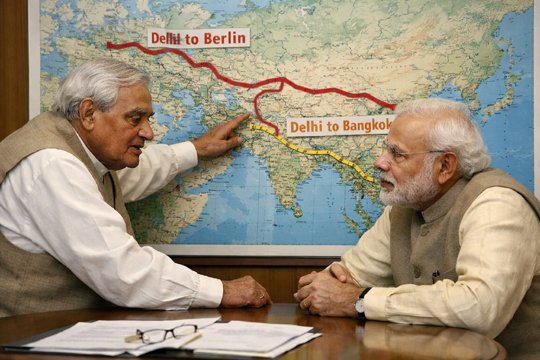
Atal Bihari Vajpayee’s dream of a direct train from Delhi to Bangkok and Delhi to Berlin remains one of the most ambitious yet unrealized visions of India’s connectivity strategy. It was a dream that went far beyond transportation. It represented the possibility of reconnecting India with the wider Asian and European landmass through seamless movement of people, goods, ideas, and cultures. In many ways, the vision was a modern revival of the ancient Silk Route, adapted for the twenty-first century. The idea fit naturally into Vajpayee’s broader strategic outlook, which emphasized regional integration, economic diplomacy, and the transformation of India from a geographically isolated subcontinental power into a central hub connecting East and West.
The concept gained momentum during the early years of India’s Look East Policy, later strengthened as the Act East Policy. Policymakers envisioned a future where passengers could board a train in Delhi and travel across South and Southeast Asia into Bangkok, or continue westward through Pakistan, Iran, Central Asia, and Europe to reach Berlin. Such rail corridors would dramatically reduce transportation costs, stimulate tourism, expand trade opportunities, and deepen geopolitical cooperation among participating nations.
At first glance, the proposal appears technically achievable. Modern railway engineering has conquered deserts, mountains, frozen tundra, and vast oceans through bridges and tunnels. Countries such as China have constructed rail networks through some of the world’s most challenging terrain. Europe enjoys extensive international rail connectivity that allows passengers to travel across multiple countries with minimal interruption. Even transcontinental freight services between China and Europe have become increasingly common.
Yet despite technological advances and decades of discussion, neither the Delhi-Bangkok nor the Delhi-Berlin railway corridor has materialized. The reasons are complex and interconnected. Unlike domestic railway projects, international railway corridors depend not only on engineering capabilities but also on political trust, diplomatic stability, economic viability, security considerations, and coordinated infrastructure development across multiple sovereign states.
The challenges begin at India’s borders and multiply with every additional country along the route. Missing rail links, incompatible track systems, difficult terrain, insurgency-prone regions, unstable governments, sanctions regimes, and strategic rivalries have collectively transformed what appears to be a transportation project into one of the most complicated geopolitical undertakings imaginable.
The Delhi-Bangkok route faces obstacles concentrated primarily in Northeast India and Myanmar. The Delhi-Berlin vision encounters even greater complications, requiring cooperation among countries whose political relations remain strained or hostile. In both cases, infrastructure deficiencies combine with geopolitical uncertainties to delay progress year after year.
Nevertheless, the dream has not entirely disappeared. Regional initiatives such as the Trans-Asian Railway Network, the India-Myanmar-Thailand Trilateral Highway, and newer economic corridors continue to keep alive the broader objective of continental connectivity. Understanding why Vajpayee’s vision remains unrealized offers valuable insights into the relationship between infrastructure, diplomacy, and grand strategy in the modern world.
The promise of a Delhi-Bangkok railway corridor
Among the two proposed routes, the Delhi-Bangkok railway appears significantly more achievable. India and Thailand maintain friendly diplomatic relations, growing trade ties, and shared strategic concerns regarding regional stability and economic development. Both nations support stronger connectivity between South Asia and Southeast Asia, making the political environment relatively favorable.
The foundation of this vision lies in India’s Act East Policy. The policy seeks to strengthen economic, strategic, and cultural engagement with Southeast Asian countries. Improved transportation links form a crucial component of this strategy because physical connectivity is often the first step toward deeper economic integration.
A direct rail connection between Delhi and Bangkok would transform regional commerce. Goods could move more quickly and cheaply than through many maritime routes. Tourists could undertake overland journeys across multiple countries, stimulating local economies along the corridor. Educational exchanges, business travel, and cultural interactions would increase significantly.
However, the route faces a fundamental problem: there is no continuous railway network connecting India and Thailand. The missing link lies primarily between India’s northeastern frontier and Myanmar. While India possesses an extensive railway network reaching deep into the Northeast, the infrastructure necessary to connect seamlessly with Myanmar remains incomplete.
The border region around Moreh in Manipur and Tamu in Myanmar represents one of the most critical gaps. Building railways through this area is not a simple matter of laying tracks. The region consists of rugged mountains, dense forests, fragile ecosystems, and areas with limited transportation infrastructure. Construction costs are therefore extraordinarily high.
The engineering challenge becomes even greater inside Myanmar. Large sections of the country’s railway network require modernization. New lines would need to be built to establish efficient international connections capable of supporting high volumes of passenger and freight traffic.
Political instability has emerged as an even bigger obstacle. Myanmar has experienced prolonged periods of internal conflict, military intervention, civil unrest, and armed insurgencies. Infrastructure projects require long-term stability because investors, governments, and contractors need confidence that construction can proceed uninterrupted for years. Frequent political disruptions make such confidence difficult to maintain.
Security concerns further complicate matters. Railway infrastructure is vulnerable to sabotage, insurgent attacks, and disruptions in conflict zones. Governments considering billions of dollars in investment must assess whether the corridor can operate safely and reliably over decades.
Financing remains another major hurdle. Large international railway projects require substantial capital commitments from participating countries and financial institutions. Given competing priorities such as healthcare, education, urban infrastructure, and domestic transportation needs, securing sufficient funding for a transnational railway becomes politically challenging.
Yet the Delhi-Bangkok vision remains alive because its strategic rationale remains strong. Southeast Asia represents one of the world’s fastest-growing economic regions. Improved connectivity could unlock enormous commercial opportunities for India’s northeastern states, many of which remain economically isolated despite their strategic location. If political conditions in Myanmar stabilize and infrastructure investments continue, the corridor could eventually become a reality.
Myanmar: the crucial missing link
Any discussion of the Delhi-Bangkok railway inevitably centers on Myanmar because the country serves as the geographical bridge between India and Southeast Asia. Without Myanmar’s participation, no practical overland route can connect India to Thailand.
Myanmar occupies a unique strategic position. It borders India, China, Thailand, Laos, and Bangladesh, making it one of Asia’s most important transit countries. Geographically, it should be a natural gateway connecting South Asia with Southeast Asia. Historically, however, political and economic circumstances have prevented it from fully playing this role.
For decades, Myanmar’s infrastructure development lagged behind that of neighboring countries. Railways, highways, ports, and telecommunications networks often received insufficient investment. Consequently, the country’s transportation system lacks the capacity required for large-scale international transit operations.
The railway sector illustrates this challenge clearly. Many existing railway lines rely on outdated infrastructure and technology. Modernizing them requires extensive investment in tracks, signaling systems, stations, rolling stock, and maintenance facilities. International railway corridors demand high standards of reliability and safety that many sections of Myanmar’s rail network currently struggle to meet.
Political instability has significantly worsened the situation. Periodic unrest, armed conflict, and governance challenges have created uncertainty regarding long-term infrastructure planning. International investors typically prefer stable environments where projects can proceed without major disruptions. Myanmar’s internal situation has often discouraged large-scale commitments.
Civil conflicts in various regions have also affected transportation development. Infrastructure projects passing through contested areas face security risks, increased costs, and implementation delays. Contractors may be reluctant to operate in regions where personnel and equipment could face threats.
Diplomatic considerations further complicate matters. International sanctions, shifting foreign policy priorities, and changing political circumstances can influence the availability of external funding and technical assistance. Large transportation corridors require cooperation among multiple governments and institutions, making stability an essential prerequisite.
The terrain itself presents formidable challenges. Mountain ranges, rivers, forests, and environmentally sensitive areas increase construction complexity. Building railways through such landscapes requires extensive surveying, tunneling, bridge construction, and environmental mitigation measures. Costs can escalate rapidly, particularly when combined with security-related expenditures.
Nevertheless, Myanmar remains indispensable to the Delhi-Bangkok dream. No alternative route offers comparable geographic efficiency. Consequently, regional planners continue exploring opportunities to improve transportation links despite ongoing challenges.
The future of trans-Asian connectivity may ultimately depend on Myanmar’s ability to achieve greater political stability and infrastructure modernization. If these conditions improve, the country could become one of Asia’s most important transportation hubs, transforming Vajpayee’s vision from aspiration into reality.
Why the Delhi-Berlin route faces even greater obstacles
If the Delhi-Bangkok railway appears difficult, the Delhi-Berlin proposal is exponentially more challenging. The route would cross thousands of kilometers, numerous sovereign states, multiple geopolitical fault lines, and several incompatible railway systems.
The most immediate obstacle is geography. Any practical overland rail route from India to Europe must pass through Pakistan or alternative pathways involving Iran, Afghanistan, Central Asia, or combinations thereof. Each option introduces significant political and security complications.
Relations between India and Pakistan remain the most obvious challenge. Although limited transportation links have existed at various times, broader political tensions have repeatedly disrupted connectivity initiatives. A direct Delhi-Berlin train would require sustained cooperation between the two countries, including agreements on transit rights, customs procedures, security protocols, immigration controls, and infrastructure standards.
Such cooperation remains difficult amid longstanding disputes and periodic diplomatic crises. Even when relations improve temporarily, investors may hesitate to commit billions of dollars to projects vulnerable to future political tensions.
Beyond Pakistan, the route encounters additional complexities. Afghanistan’s prolonged instability makes it an unreliable transit corridor. Alternative routes through Iran face challenges associated with sanctions, geopolitical tensions, and shifting international relationships.
Central Asia offers potential opportunities but also presents logistical difficulties. While several countries in the region possess railway networks, creating a seamless international corridor requires coordinated investments, regulatory harmonization, and extensive cross-border agreements.
The Middle East introduces another layer of uncertainty. Conflicts, rivalries, and changing alliances have historically complicated transportation planning across the region. Railway corridors require predictable operating environments that remain difficult to guarantee.
Even if political obstacles could somehow be overcome, technical issues remain substantial. Different countries employ varying railway standards, operating procedures, and regulatory frameworks. Coordinating these systems across an enormous geographic area represents a monumental undertaking.
The scale of investment required would also be enormous. Governments would need to justify expenditures based on projected passenger demand and freight volumes. While transcontinental freight services may generate economic benefits, the commercial viability of a direct passenger train spanning such distances remains uncertain.
These challenges explain why the Delhi-Berlin dream remains largely conceptual despite decades of discussion. The route depends on a level of regional cooperation and stability that has yet to emerge across much of the intervening geography.
The challenge of incompatible railway gauges
One of the least visible yet most significant barriers to international railway connectivity is the problem of track gauge incompatibility. While political conflicts often dominate public discussions, technical differences in railway systems create practical obstacles that are equally important.
Railway gauge refers to the distance between the two rails of a track. Different countries adopted different gauges during the nineteenth and twentieth centuries, often based on colonial influences, engineering preferences, or strategic considerations. As a result, the world today contains multiple railway standards.
India primarily uses broad gauge. Much of Europe operates on standard gauge. Several countries in Central Asia employ Russian gauge, which differs from both Indian and European systems. These variations prevent trains from moving seamlessly across borders.
When a train reaches a border where gauges change, passengers and cargo often face delays. Freight may need to be transferred between trains. Passenger services may require travelers to change trains. Alternatively, rolling stock may undergo bogie replacement, a time-consuming process involving the exchange of wheel assemblies.
Although modern technology offers solutions such as variable-gauge systems, implementing them across thousands of kilometers remains expensive and operationally complex. The challenge becomes particularly significant for long-distance routes crossing multiple gauge systems.
For the Delhi-Bangkok corridor, gauge compatibility issues are manageable but still significant. For the Delhi-Berlin route, they become much more severe because the journey would cross regions using several different standards.
Standardization appears attractive in theory but is difficult in practice. Converting existing national railway networks to a new gauge requires enormous investments and can disrupt transportation services for years. Most countries therefore prefer maintaining their existing systems.
The gauge issue highlights a broader reality about international infrastructure projects. Success requires not only physical construction but also harmonization of technical standards, operating procedures, safety regulations, and maintenance practices. These tasks often prove more complicated than building tracks themselves.
As transportation technology advances, solutions may become more practical. Yet gauge incompatibility will remain a major factor limiting the realization of truly seamless rail travel between Delhi and destinations such as Bangkok or Berlin.
Alternative corridors and the future of Vajpayee’s vision
Although direct railway links to Bangkok and Berlin remain unrealized, the broader objective of continental connectivity continues to evolve through alternative initiatives. Governments increasingly recognize that economic integration requires multiple transportation modes rather than reliance on a single rail corridor.
The India-Myanmar-Thailand Trilateral Highway represents one of the most important ongoing projects. By improving road connectivity, it seeks to achieve many of the same strategic objectives originally associated with railway proposals. Enhanced highway networks can stimulate trade, tourism, and investment while creating momentum for future rail development.
The broader Trans-Asian Railway concept also remains relevant. Rather than focusing exclusively on a single direct train service, planners increasingly emphasize interconnected regional networks capable of supporting both passenger and freight movement. Incremental progress in individual segments may eventually create the foundation for longer international routes.
Another significant development is the emergence of the India-Middle East-Europe Economic Corridor (IMEC). This initiative combines maritime, rail, and logistics infrastructure to improve connectivity between India, the Middle East, and Europe. By integrating multiple transportation modes, it may achieve many of the economic benefits envisioned by proponents of direct rail links.
Maritime transportation continues to dominate international trade because of its cost efficiency and scalability. Consequently, many modern connectivity strategies combine ports, railways, highways, and logistics hubs rather than relying on single-mode transportation systems.
Technological advances may also reshape future possibilities. High-speed rail, automated logistics systems, digital customs processing, and advanced freight management technologies could reduce some of the barriers currently hindering transnational transportation projects.
Most importantly, geopolitical conditions can change. Historical examples demonstrate that transportation corridors often emerge following periods of political reconciliation and economic cooperation. Regions once divided by conflict have successfully developed integrated infrastructure networks when strategic circumstances evolved.
Atal Bihari Vajpayee’s dream therefore remains unfinished rather than abandoned. The fundamental logic behind the vision remains compelling. India’s economic rise, Southeast Asia’s growth, and Europe’s continued importance as a trading partner all reinforce the value of improved connectivity.
What is holding back the dream today is not a lack of ambition or engineering capability. Rather, it is the combination of geopolitical rivalries, incomplete infrastructure, political instability, financial constraints, and technical incompatibilities that characterize the regions between Delhi and its intended destinations.
The road—or rail track—to Bangkok and Berlin remains long. Yet history suggests that transformative connectivity projects often take decades to materialize. Whether through direct railways, multimodal corridors, or future innovations, the aspiration of linking India more closely with Asia and Europe continues to guide regional infrastructure planning. Vajpayee’s vision endures because it reflects a larger idea: that geography should connect civilizations rather than divide them.