
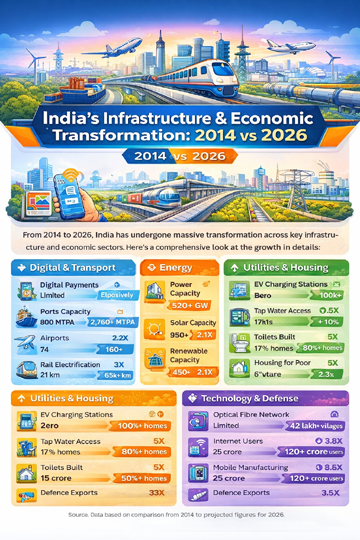
The transformation is particularly striking when one compares key indicators from 2014 with those of 2026. Ports capacity increased from around 800 million tonnes per annum to more than 2,760 million tonnes per annum. The number of airports more than doubled from 74 to over 160

India’s development journey between 2014 and 2026 represents one of the most ambitious periods of infrastructure expansion and economic transformation since independence. During these twelve years, the country witnessed significant growth across transportation, energy, digital connectivity, manufacturing, urban infrastructure, and public welfare. Supporters of the National Democratic Alliance (NDA) government argue that these years fundamentally altered the physical and economic landscape of India, creating the foundations for long-term growth and positioning the country as a major global economic power.
The changes are visible in multiple sectors. Airports have multiplied, highways have expanded rapidly, digital payments have become a daily reality for hundreds of millions of citizens, and renewable energy capacity has increased dramatically. Villages once disconnected from modern communications have been linked through optical fibre networks. Millions of homes have received electricity, tap water, toilets, cooking gas connections, and housing assistance. India’s manufacturing ambitions have broadened from assembling products to developing capabilities in sectors such as electronics and semiconductors.
The transformation is particularly striking when one compares key indicators from 2014 with those of 2026. Ports capacity increased from around 800 million tonnes per annum to more than 2,760 million tonnes per annum. The number of airports more than doubled from 74 to over 160. Rail electrification expanded from approximately 21,000 kilometres to more than 65,000 kilometres. The expressway network grew from about 1,000 kilometres to nearly 6,700 kilometres. Metro rail systems expanded from 250 kilometres to over 1,000 kilometres.
The digital revolution has perhaps been the most visible change in everyday life. In 2014, digital payments were limited to a relatively small segment of the population. By 2026, India was processing more than 18 billion digital payment transactions every month. Internet users increased from around 25 crore to more than 95 crore, making India one of the largest connected societies in the world. Mobile manufacturing grew from approximately six crore devices annually to more than thirty-three crore devices, transforming India into a significant electronics manufacturing hub.
The energy sector also experienced substantial growth. Power generation capacity increased from 249 gigawatts to more than 520 gigawatts. Solar power capacity expanded from a negligible 2.6 gigawatts to over 110 gigawatts, representing one of the fastest renewable energy expansions globally. Renewable energy capacity overall rose from roughly 32–76 gigawatts to more than 220–275 gigawatts. Ethanol blending in fuel increased from 1.5 percent to 20 percent, helping reduce dependence on imported crude oil.
Supporters of these achievements argue that infrastructure serves as the backbone of economic development. Roads, ports, railways, power systems, communication networks, and public utilities create the conditions necessary for industrial growth, investment, and employment generation. Unlike short-term welfare measures, infrastructure investments often yield benefits over decades by increasing productivity and reducing costs.
The period also coincided with major global disruptions. The COVID-19 pandemic disrupted economies worldwide, supply chains broke down, and geopolitical tensions affected trade. Despite these challenges, India continued investing in infrastructure. Government expenditure on capital projects became a central pillar of economic policy. Large-scale public investments were expected to stimulate demand, create jobs, and attract private sector participation.
Yet the transformation was not merely about concrete, steel, and technology. It was also about extending basic services to millions who had long been excluded from development. Rural electrification, sanitation, housing, drinking water, and cooking gas access were presented as efforts to improve quality of life and reduce poverty. Whether viewed through the lens of economic growth or social development, the years between 2014 and 2026 represent a period of significant change whose effects are likely to shape India for decades to come.
Building the foundations of modern infrastructure
One of the most visible aspects of India’s transformation has been the rapid expansion of physical infrastructure. Infrastructure development has traditionally been viewed as a weakness of the Indian economy. Poor logistics, congested roads, inadequate port facilities, and insufficient urban transportation systems often increased costs and reduced competitiveness. The years after 2014 saw a determined effort to address these shortcomings.
The expansion of airport infrastructure is a notable example. Increasing the number of airports from 74 to over 160 dramatically improved regional connectivity. Smaller cities that previously depended on long road or rail journeys gained direct air links. Improved aviation infrastructure not only supports passenger travel but also facilitates business activity, tourism, cargo transportation, and investment.
Similarly, port capacity expansion from 800 million tonnes per annum to more than 2,760 million tonnes per annum significantly enhanced India’s trade capabilities. Efficient ports reduce turnaround times, lower shipping costs, and improve competitiveness in international markets. As India seeks to become a manufacturing and export powerhouse, modern ports become essential economic assets.
The road sector experienced equally dramatic changes. The expressway network expanded nearly sevenfold. High-speed road corridors connect major economic centres, reduce travel time, improve logistics efficiency, and support industrial development. Modern expressways are increasingly becoming economic corridors that stimulate investment in surrounding regions.
Railway modernization emerged as another major focus. Rail electrification increased from approximately 21,000 kilometres to over 65,000 kilometres. Electrification reduces fuel costs, lowers emissions, improves efficiency, and decreases dependence on imported petroleum products. Combined with station modernization, dedicated freight corridors, and technological upgrades, railways became an important component of the government’s infrastructure strategy.
Urban transportation also witnessed remarkable growth through metro rail expansion. Metro networks increased from about 250 kilometres to more than 1,000 kilometres. Cities such as Delhi, Mumbai, Bengaluru, Hyderabad, Chennai, Pune, Ahmedabad, and several others expanded or developed metro systems. These projects helped reduce congestion, improve commuting efficiency, and support sustainable urban development.
Natural gas infrastructure also expanded considerably. Gas pipeline networks increased from approximately 15,000 kilometres to 26,000 kilometres. PNG connections rose from 25 lakh to 1.6 crore households. CNG stations expanded from 738 to more than 8,600. These developments supported cleaner energy use while improving accessibility to natural gas for transportation, industry, and households.
The cumulative impact of these projects extends beyond the infrastructure itself. Efficient transportation networks lower business costs, attract investments, and integrate regional economies. Improved connectivity encourages migration of industries to smaller cities and towns, reducing pressure on major metropolitan centres. Better logistics contribute directly to economic competitiveness and productivity.
Infrastructure development has also become a major source of employment. Construction projects generate jobs both directly and indirectly. Cement, steel, machinery, engineering services, transportation, and related industries benefit from increased demand. The resulting multiplier effect contributes to broader economic growth.
Critics often question the cost of large infrastructure projects and raise concerns regarding environmental impact, land acquisition, and financial sustainability. These concerns remain important and require careful policy management. However, even many critics acknowledge that India’s infrastructure deficit had become a significant obstacle to development and required substantial investment.
The emphasis on infrastructure reflects a broader development philosophy that prioritizes long-term capacity building. Rather than focusing exclusively on short-term consumption, the strategy seeks to create assets that support economic activity over generations. Whether measured through transportation, logistics, urban mobility, or energy networks, infrastructure expansion remains one of the defining features of India’s transformation during this period.
The digital revolution and economic modernization
Perhaps no transformation has touched ordinary citizens more directly than India’s digital revolution. The growth of digital payments from a limited presence in 2014 to more than 18 billion transactions per month by 2026 represents a profound shift in economic behaviour.
Digital payment systems changed how Indians shop, transfer money, pay bills, receive salaries, and conduct business. Small vendors, street hawkers, and neighbourhood shops adopted QR-code-based payment systems. Financial transactions became faster, more transparent, and more accessible. The digital economy expanded rapidly, creating opportunities for startups, fintech companies, and technology-driven businesses.
Internet penetration played a central role in this transformation. The number of internet users increased from approximately 25 crore to more than 95 crore. Affordable smartphones, lower data costs, and expanding telecommunications infrastructure enabled unprecedented connectivity. Rural populations that previously lacked access to information gained entry into the digital world.
The expansion of optical fibre networks to more than two lakh villages represented a critical step in bridging the digital divide. Broadband connectivity allows access to education, healthcare, government services, financial products, and employment opportunities. Digital infrastructure increasingly functions as an essential public utility comparable to roads or electricity.
Mobile manufacturing emerged as another major success story. Production increased from approximately six crore devices annually to more than thirty-three crore. Government initiatives encouraging domestic manufacturing attracted investments from global electronics companies. This expansion reduced import dependence while generating employment and industrial activity.
The emergence of a semiconductor ecosystem marked another milestone. In 2014, India had virtually no significant semiconductor manufacturing presence. By 2026, multiple major fabrication and OSAT facilities were under development. Although India remains far behind established semiconductor powers, the sector’s emergence represents an important strategic development.
Digital governance also expanded considerably. Government services increasingly moved online, reducing paperwork and improving efficiency. Digital identity systems, direct benefit transfers, and online service delivery transformed interactions between citizens and government institutions.
The broader economic implications are substantial. Digital technologies improve productivity, reduce transaction costs, increase transparency, and expand financial inclusion. They also create new opportunities for entrepreneurship and innovation. India’s startup ecosystem benefited significantly from improved digital infrastructure and widespread internet access.
At the same time, digital transformation presents challenges. Cybersecurity threats, data privacy concerns, misinformation, and digital literacy gaps remain significant issues. The benefits of technology are not distributed equally, and disparities in access persist across regions and social groups.
Nevertheless, the digital revolution stands as one of the most remarkable developments of the period. Few countries have achieved digital adoption at the scale witnessed in India. The integration of digital technology into daily life has fundamentally altered the country’s economic and social landscape.
Energy security, welfare expansion, and social infrastructure
Energy infrastructure formed another pillar of India’s transformation. The increase in power generation capacity from 249 gigawatts to more than 520 gigawatts reflects substantial investment across conventional and renewable energy sectors.
Solar energy expansion deserves special attention. Growing from 2.6 gigawatts to over 110 gigawatts represents one of the world’s most rapid renewable energy transitions. This growth supports climate goals, reduces dependence on fossil fuel imports, and enhances long-term energy security.
Renewable energy capacity more broadly increased to more than 220–275 gigawatts. Wind, solar, hydroelectric, and other renewable sources became increasingly important components of India’s energy mix. Simultaneously, coal production also increased significantly, reflecting the country’s continued reliance on conventional energy sources to meet growing demand.
Transmission infrastructure expanded from approximately 2.9 lakh circuit kilometres to more than 5 lakh circuit kilometres. Improved transmission networks enable efficient movement of electricity across regions, reduce losses, and enhance grid stability.
Alongside energy infrastructure, welfare-oriented initiatives focused on improving living standards. LPG coverage expanded from around 55 percent to nearly universal levels. Access to clean cooking fuel reduces indoor air pollution and improves health outcomes, particularly for women.
Tap water access increased from approximately 17 percent of households to over 80 percent. Safe drinking water has direct implications for public health, productivity, and quality of life. Sanitation infrastructure also expanded dramatically, with more than 11 crore toilets constructed across the country.
Housing programmes delivered more than four crore homes for economically weaker sections. Secure housing provides stability and contributes to social and economic advancement. Combined with electrification, sanitation, water access, and cooking fuel availability, these programmes aimed to improve basic living conditions for millions of citizens.
Rural electrification approached universal coverage, bringing electricity to villages that had remained underserved for decades. Access to electricity enables education, healthcare, communication, and economic activity, making it a foundational component of development.
Supporters argue that these initiatives represent a shift from entitlement-based welfare to infrastructure-based welfare. Instead of providing only subsidies, the government focused on creating physical assets and service delivery systems that generate lasting benefits.
However, debates continue regarding implementation quality, maintenance, service reliability, and actual usage levels. Building infrastructure is only the first step; ensuring effective operation and sustained benefits requires continuous effort. Nonetheless, the scale of expansion remains significant and has altered living conditions across many parts of the country.
The missing piece: School education and the road ahead
Despite extensive achievements in infrastructure, manufacturing, digitalization, and welfare delivery, one major area remains comparatively neglected: school-level education.
The NDA government introduced the National Education Policy 2020, widely regarded as one of the most comprehensive higher education reforms in independent India. The policy sought to modernize universities, encourage multidisciplinary learning, improve research capabilities, increase flexibility in academic programmes, and align higher education with global standards.
Universities and colleges received considerable attention under this framework. Institutional reforms, accreditation mechanisms, curriculum redesign, skill development initiatives, and research promotion became central policy themes. The government emphasized innovation, entrepreneurship, and employability in higher education.
However, critics argue that comparable transformation did not occur at the school level. While existing programmes continued and some improvements occurred in infrastructure, enrolment, and digital learning initiatives, there was no equivalent revolution in primary and secondary education.
India’s school education system continues to face challenges related to learning outcomes, teacher training, curriculum relevance, classroom quality, and foundational literacy and numeracy. International assessments and domestic surveys have repeatedly highlighted gaps between years spent in school and actual learning achieved.
The contradiction is striking. A nation aspiring to become a global manufacturing hub, technological leader, and knowledge economy requires a strong foundation in school education. Universities can only build upon the preparation students receive during their formative years. Weak foundations at the primary and secondary levels inevitably affect higher education outcomes and workforce quality.
The future competitiveness of India will depend not only on highways, airports, ports, and digital networks but also on the quality of human capital. Infrastructure can accelerate growth, but education determines how effectively a society uses that infrastructure.
India’s transformation between 2014 and 2026 demonstrates what focused policy execution can achieve. The country expanded transportation networks, modernized energy systems, connected millions through digital technologies, improved basic living conditions, strengthened manufacturing capabilities, and enhanced economic capacity. These achievements represent substantial progress and have changed the developmental trajectory of the nation.
Yet the next phase of India’s rise may depend less on physical infrastructure and more on educational transformation. Roads and railways connect cities; education unlocks human potential. Ports facilitate trade; schools create innovators. Digital networks transmit information; classrooms create understanding.
The story of India from 2014 to 2026 is therefore one of impressive infrastructure-led transformation, accompanied by a lingering challenge in school education. The foundations for economic growth have been laid on an unprecedented scale. Whether those foundations ultimately support a truly developed nation will depend on how effectively India addresses the educational needs of the next generation. Only then can the infrastructure revolution be matched by an equally powerful human capital revolution, completing the broader transformation of the country.