
Amul buys at the highest prevailing price to benefit cooperative member farmers and sells at the lowest price to beat competition. Can Kwality adopt such principles? Obviously not. Then are we looking at slowly increasing the palm oil content in ice cream again but retaining just about enough milk solids to qualify as a milk based ice cream? The usual corporate route?
The modern consumer marketplace exists in a perpetual tension between corporate profitability and public trust. For decades, global fast-moving consumer goods (FMCG) giants have mastered the art of semantic engineering—using clever nomenclature, vibrant packaging, and massive marketing budgets to shape consumer perception. In no sector is this tension more palpable than in the industrial food supply chain. Today’s food industry relies heavily on complex supply chains where factory production necessitates preservatives, synthetic additives, and chemical stabilizers to maintain shelf-life across vast geographic expanses. Within this landscape, the line between genuine agricultural products and highly engineered synthetic alternatives has frequently been blurred, leading to an environment where marketing prowess often overshadows manufacturing transparency.
A definitive case study of this corporate maneuvering unfolded in the Indian dairy and frozen desserts market over a span of more than three decades. The narrative centers on Hindustan Unilever Limited (HUL), its acquisition of the iconic domestic brand Kwality, and a subsequent thirty-year recipe modification that swapped traditional milk fat for inexpensive hydrogenated vegetable oils, primarily palm oil. This strategic decision maximized profit margins but sparked intense regulatory scrutiny, fierce legal battles with cooperative dairy giants like Amul and Mother Dairy, and deep-seated consumer skepticism. The discourse reached a boiling point following a major corporate restructuring and an admission by global leadership that the company would entirely abandon its vegetable-fat formulations in favor of 100% genuine milk solids by 2027.
However, this strategic pivot has raised significant questions regarding corporate accountability and consumer protection. After thirty-one years of defending the use of vegetable fats as a technologically superior and healthier alternative, the sudden corporate about-face has been met with profound skepticism. Critics and consumer advocacy groups ask a fundamental question: What is the true guarantee that a multinational conglomerate, bound by fiduciary duties to maximize shareholder value, will legitimately transition to 100% pure milk solids? Skeptics argue that without rigorous independent oversight, corporations remain incentivized to engage in tokenism—adding a nominal percentage of milk solids to meet the bare minimum of legal definitions while continuing to utilize cheap, industrially processed palm oil to maintain high margins. To understand the depth of this public distrust, one must analyze the historical trajectory of the Indian ice cream market, the economic mechanics of food formulation, the regulatory frameworks that govern it, and the geopolitical and corporate restructuring forces that ultimately compelled this shift.
The 1995 acquisition and the economics of recipe alternation
The origin of this market dynamics dates back to 1995, a period when India was rapidly transitioning through economic liberalization. During this era, Hindustan Unilever Limited sought to establish a dominant foothold in the nation’s nascent cold-chain and indulgence food sectors. To achieve immediate market penetration, HUL acquired Kwality, which was at the time India’s largest and most recognized domestic ice cream brand. The acquisition gave HUL an extensive distribution network, established manufacturing facilities, and a brand name deeply embedded in the consumer psyche. However, post-acquisition, the corporate strategy shifted from merely scaling an existing asset to fundamentally re-engineering the cost structure of the product.
The most consequential operational change was the quiet modification of the core recipe. Traditional ice cream manufacturing relies on dairy milk fat (cream and butterfat) to provide the characteristic creamy texture, mouthfeel, and flavor stability. Dairy fat, however, is an expensive and volatile commodity subject to seasonal agricultural fluctuations, cattle yield variances, and complex cold-storage requirements. To circumvent these economic challenges and optimize profit margins, the recipe was altered to replace real milk fat with vegetable fats, predominantly palm oil.
From a purely financial perspective, the substitution of palm oil for milk fat was an extraordinarily lucrative operational maneuver. Palm oil is highly efficient to produce, structurally stable at room temperature when hydrogenated, and available at a fraction of the cost of dairy fat. By utilizing emulsifiers and stabilizers, industrial food scientists could mimic the texture of traditional ice cream using a water, palm oil, and sugar emulsion. This recipe alteration decoupled HUL’s production costs from the volatile domestic dairy market, allowing the company to achieve massive economies of scale and highly competitive margins. However, this economic triumph came at the expense of product identity, setting the stage for a prolonged battle over nomenclature and consumer rights.
FSSAI’s 2011 regulatory categorization and legal semantic warfare
For sixteen years following the recipe modification, the products were marketed and consumed under the generic cultural umbrella of “ice cream.” The average consumer, relying on brand legacy and visual presentation, remained largely unaware that the physical composition of the product had fundamentally shifted from an animal-dairy base to a plant-vegetable base. This ambiguity persisted until 2011, when the Food Safety and Standards Authority of India (FSSAI) enacted a comprehensive set of regulations designed to bring standardization, clarity, and safety to the Indian food sector.
The FSSAI drew a clear, legally binding line between two distinct product categories based strictly on the source of fat utilized in manufacturing:
The regulator mandated that if a manufacturer substituted even a fraction of milk fat with vegetable oil, the product could no longer legally bear the name “Ice Cream” on its packaging or marketing materials. It had to be explicitly designated as a “Frozen Dessert” or “Frozen Dessert/Frozen Treat made with Vegetable Oil.”
This regulatory intervention presented a major marketing challenge for HUL’s Kwality Wall’s brand. The term “frozen dessert” carried a synthetic, less premium connotation in the minds of consumers compared to the nostalgic and wholesome image of “ice cream.” To comply with the letter of the law while preserving their market position, corporate marketing strategies underwent a sophisticated evolution. The words “Frozen Dessert” were printed on the physical packaging, but often in smaller, less prominent typography, positioned to satisfy regulatory inspectors without drawing immediate consumer attention.
Simultaneously, in television commercials, print advertisements, and the physical deep freezers provided to retail mom-and-pop stores across India, the formal legal terminology was minimized. Marketing campaigns focused heavily on emotional branding, visual depictions of melting scoops, and phrases like “frozen treats” or “creamy delights.” By ensuring the phrase “frozen dessert” remained functionally invisible within mass advertising, the brand successfully maintained its market share, and a significant portion of the Indian consumer base continued to refer to and purchase the vegetable-fat products as ice cream for another fifteen years.
Two Indias: Premium dairy vs. mass-market vegetable oil
The economic architecture of HUL’s portfolio during this era highlights a stark socio-economic division in product formulation, creating what analysts viewed as a two-tiered consumer strategy. While the mass-market portfolio under the Kwality Wall’s banner—such as popular cones, cups, and bricks consumed by middle- and lower-income demographics—was shifted to the palm-oil-based frozen dessert formulation, the premium segment was treated differently.
When HUL marketed its high-end, premium brand, Magnum, the product formulation adhered strictly to traditional standards. From day one of its launch in the Indian market, Magnum was formulated using 100% genuine dairy-derived milk fat. This created a dual-track manufacturing strategy within the same corporate entity:
This tiering reflects a calculated assessment of consumer behavior, price sensitivity, and regulatory exposure. Premium consumers, paying a significant price premium per unit, demanded an authentic sensory experience and were far more likely to scrutinize ingredient lists, nutritional panels, and legal descriptions. The mass market, conversely, was highly price-sensitive. By utilizing cheap palm oil for the masses and reserving real dairy fat for the affluent, the corporation maximized its market penetration and profitability across different economic strata. This strategy, however, left the brand vulnerable to competitive counter-attacks from domestic dairy cooperatives that leveraged their agricultural roots to wage an aggressive marketing war.
The corporate restructuring of 2025 and the global spin-off
The catalyst that disrupted this long-standing market equilibrium did not originate from a domestic regulatory crackdown or a sudden shift in consumer preferences, but rather from structural changes within global corporate finance. In December 2025, Unilever, the UK-based parent conglomerate of HUL, executed a massive global corporate restructuring. Facing pressure from activist institutional investors to streamline operations, reduce corporate bloat, and focus on high-margin personal care, beauty, and home-care segments, Unilever announced the global spin-off of its entire ice cream division.
The global ice cream business, which included iconic brands like Ben & Jerry’s, Magnum, and Wall’s, possessed an entirely different operational profile than Unilever’s core consumer goods. Ice cream manufacturing requires heavy capital expenditure in specialized, energy-intensive cold-chain logistics, sub-zero warehousing, and seasonal inventory management. By spinning this division off into an independent entity, the parent company sought to insulate its primary balance sheet from the cyclical earnings volatility associated with global frozen treats.
Following this global mandate, the newly carved-out ice cream entity was swiftly structured for localized capital access. In February 2026, the independent ice cream business was formally listed on the Indian stock exchanges (BSE and NSE). This public listing altered the strategic priorities of the business management. As a standalone listed entity in India, the company could no longer rely on the financial cushioning or the diversified revenue streams of HUL’s broader home and personal care portfolio. It was now directly accountable to Indian public shareholders, institutional funds, and market analysts who demanded sustainable volume growth, brand equity protection, and a clear defense strategy against aggressive domestic competitors like Amul and Mother Dairy.
The admission of defeat and the 2027 pivot
Only two months after the Indian public listing, in April 2026, the global Chief Executive Officer of the newly independent ice cream entity, Peter ter Kulve, issued a major strategic declaration. In a statement that contrast sharply with over three decades of corporate public relations, the CEO announced that Kwality Wall’s would completely dismantle its vegetable-fat formulation model. By the year 2027, the company committed to shifting its entire Indian product portfolio to 100% genuine, milk-based ice cream.
This announcement represented a significant turning point in the Indian consumer goods sector. For 31 years, the corporate apparatus had defended its formulation, but the new competitive landscape required an admission of strategic vulnerability. The company was facing slowing market share growth in urban centers and an inability to penetrate deeper rural and semi-urban markets where home-grown dairy cooperatives maintained an advantage. The strategic pivot outlined a multi-pronged market correction framework:
- Complete Ingredient Substitution: The systematic elimination of hydrogenated palm oil and the sourcing of 100% pure milk solids and dairy fat across all product tiers.
- Infrastructure Capital Expenditure: A comprehensive nationwide overhaul of cold-chain logistics, expanding sub-zero transport networks and retail deep-freezer distribution to handle real dairy formulations, which are more temperature-sensitive than vegetable-oil alternatives.
- Aggressive Price Correction: Implementing price reductions of up to 30% in select mass-market categories to directly challenge the pricing power of domestic dairy cooperatives.
- Hyper-Localization of Portfolio: Introducing traditional flavor profiles, such as Kulfi and Kesar Bhog, specifically engineered to appeal to regional Indian palates and counter the cultural positioning of domestic competitors.
Corporate skepticism: The 10% vs. 100% compliance dilemma
While the corporate press releases framed this transition as a progressive, consumer-centric evolution, the market response has been characterized by deep skepticism. After decades of utilizing alternative ingredients, consumer advocacy groups, agricultural economists, and retail analysts question the operational integrity of this promised shift. The core of this skepticism lies in the compliance dilemma: What independent mechanisms exist to ensure the corporation genuinely deploys 100% pure milk solids, rather than adopting a strategy of minimal compliance?
In the industrial manufacturing of dairy products, verifying exact ingredient percentages presents a difficult challenge for the average consumer. Without sophisticated laboratory analysis, distinguishing between an ice cream made with 100% genuine milk fat and a hybrid product containing 10% milk solids alongside 90% structured vegetable oil is nearly impossible by taste alone. Emulsifiers, artificial cream flavorings, and texturizers can easily replicate the rich mouthfeel of authentic cream.
The financial temptation to engage in minimal compliance remains high. If a corporation adds just 10% milk solids to its formula, it can technically satisfy basic legal thresholds or claim a “made with real milk” marketing angle, while continuing to rely on cheap palm oil to protect its profit margins. This approach would allow a company to lower retail prices by up to 30% without eroding its bottom line, executing a marketing shift while avoiding the high input costs of an authentic supply chain overhaul.
The Public Health Implications of Industrial Palm Oil in Confectionery
The skepticism surrounding the long-term use of vegetable oils in frozen desserts is further intensified by public health concerns regarding industrial palm oil consumption. While palm oil is a ubiquitous component of global packaged foods due to its stability and low cost, its physiological impact—particularly when hydrogenated or thermally processed at high temperatures—has been a subject of ongoing medical research.---------+
To render liquid palm oil suitable for structured food applications like frozen desserts, it often undergoes partial hydrogenation or high-heat refining processes. These industrial methods can lead to the formation of trans-fatty acids and unwanted chemical byproducts, such as glycidyl fatty acid esters and monochloropropanediol (MCPD) esters.
Clinical research indicates that the regular consumption of industrially processed vegetable fats containing trans-fats or high concentrations of saturated palmitic acids can negatively alter blood lipid profiles. These fats elevate low-density lipoprotein (LDL) cholesterol while lowering high-density lipoprotein (HDL) cholesterol, increasing the risk of atherosclerosis, arterial plaque accumulation, and cardiovascular diseases.
When these processed vegetable fats are combined with high refined sugar loads—a standard formulation template for mass-market frozen desserts—the metabolic impact is magnified. This combination can exacerbate insulin resistance, promote visceral fat deposition, and contribute to the rising incidence of metabolic syndrome and type-2 diabetes across urbanizing populations. The long-term marketing of these vegetable-fat compositions to children and mass-market consumers, under the visual guise of wholesome dairy treats, remains a primary point of criticism against the frozen dessert manufacturing model.
The competitive catalyst: How Amul and Mother Dairy forced a corporate retreat
The strategic retreat of a global FMCG giant cannot be understood solely through the lens of internal corporate decisions or regulatory updates; it was heavily accelerated by an aggressive, decades-long marketing and supply-chain campaign waged by India’s domestic dairy cooperatives. Foremost among these is the Gujarat Cooperative Milk Marketing Federation (GCMMF), which operates the Amul brand, alongside the National Dairy Development Board’s Mother Dairy.
Amul and Mother Dairy operate on a vertically integrated cooperative model, sourcing raw milk directly from millions of small-scale farmers across India. This structural setup provides them with an abundant, consistent supply of fresh dairy fat and milk solids. For these cooperatives, milk fat is not an expensive additive that needs to be engineered out of the product; it is a core agricultural asset that must be utilized and brought to market. Consequently, their ice cream formulations have historically remained 100% dairy-based.
Recognizing the vulnerability in their multinational competitor’s formulation, Amul launched a series of direct, aggressive comparative marketing campaigns starting in the late 2000s and intensifying over the next two decades. These campaigns directly educated the public on the difference between “Ice Cream” and “Frozen Dessert.”
Using stark visual imagery, print advertisements, and television spots, Amul explicitly informed consumers that while their products were made from pure milk cream, competing products contained vegetable oils and palm oil. HUL attempted to counter these campaigns through legal challenges in Indian courts, alleging trade disparagement and unfair comparison. However, the courts consistently upheld the core premise of the advertisements, provided they stated verified regulatory facts: under FSSAI law, vegetable-fat products were indeed classified as frozen desserts, not ice creams.
This sustained educational marketing campaign eroded the premium perception of vegetable-fat-based frozen desserts. As disposable incomes rose across India and health awareness grew, consumers increasingly scrutinized product labels. The cooperative model’s ability to offer authentic dairy ice cream at competitive prices squeezed HUL’s mass-market margins, ultimately forcing a re-evaluation of its long-term strategy.
Building the cold chain for real dairy
If the independent ice cream entity is to successfully execute its stated 2027 transition, it must overcome a complex logistical hurdle: transforming an asset-light, vegetable-fat supply chain into a highly sensitive, cold-chain infrastructure capable of handling authentic dairy products. The physical chemistry of dairy-fat ice cream requires much stricter temperature controls than vegetable-oil-based alternatives.
Vegetable fats, particularly structured or partially hydrogenated palm oils, possess higher melting points and greater thermal stability than delicate milk fats. A mass-market frozen dessert formulated with vegetable oil can withstand minor temperature fluctuations during transit or temporary electrical disruptions at rural retail touchpoints without completely losing its structural integrity. If a frozen dessert softens slightly due to ambient heat, it can often be refrozen with minimal phase separation or visible crystallization.
In contrast, authentic dairy ice cream is highly sensitive to thermal shocks. Even minor deviations from the ideal sub-zero storage temperature (typically $-18^\circ\text{C}$ or lower) trigger a physical phenomenon known as ice crystal propagation. When dairy fat melts slightly, the water molecules separate from the fat emulsion. Upon refreezing, they form large, jagged ice crystals that ruin the smooth, creamy texture of the product, resulting in an icy, unappealing mouthfeel. Furthermore, melted dairy fat is highly susceptible to rapid microbial spoilage and lipid oxidation, which can cause off-flavors and safety issues.
Consequently, shifting an entire national portfolio to real milk fat requires hundreds of millions of dollars in capital expenditure to build a continuous, unbroken cold chain. The corporation must invest in:
- Advanced Refrigerated Transport: Deploying a fleet of specialized secondary transport vehicles equipped with active, continuous telemetry monitoring to track transit temperatures in real time.
- High-Efficiency Retail Infrastructure: Replacing thousands of outdated, low-efficiency deep freezers at small retail shops with high-performance units capable of maintaining consistent sub-zero temperatures, even during India’s frequent summer power cuts.
- Regional Cold Storage Hubs: Constructing automated, temperature-controlled distribution hubs near major consumption centers to minimize transit times for sensitive dairy formulations.
Verifiable transparency: How consumers can enforce corporate accountability
In an era where marketing promises can change quickly, consumers cannot rely solely on corporate press statements or executive commitments. Ensuring a complete transition to genuine product formulations requires proactive consumer vigilance, regulatory pressure, and the consistent deployment of checking mechanisms. The public must learn to look past front-of-pack marketing claims and examine the formal, legally mandated disclosures.
The primary tool for verifying product authenticity remains the Ingredients List and the Nutritional Information Panel, typically located on the back or side of the packaging. Consumers must cultivate the habit of checking these panels for specific indicators.
Furthermore, organized consumer groups and independent research laboratories must conduct periodic, randomized testing of market samples. Using gas chromatography and mass spectrometry, independent labs can map the fatty acid profile of any given dessert sample. Because the fatty acid signature of dairy fat (rich in butyric acid) is completely different from that of palm oil (dominated by palmitic acid), lab testing can easily identify hidden vegetable oils. Publishing these independent findings creates a strong deterrent against corporate corner-cutting.
Structural Market Impact and the Future of the Indian Dairy Ecosystem
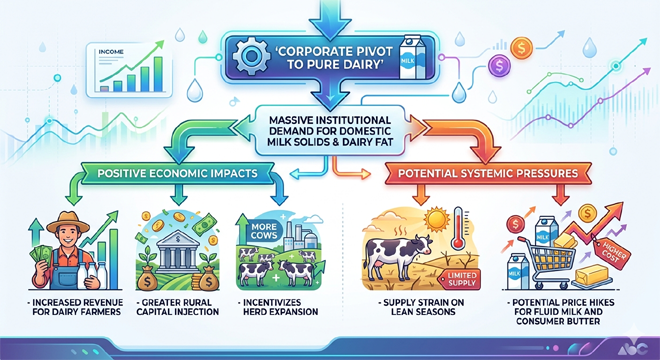
The complete transition of a major player like Kwality Wall’s into a pure dairy brand will ripple through the broader Indian agricultural economy. By abandoning palm oil and committing to milk solids, the corporation will shift from being an importer of global vegetable fats to becoming a major institutional buyer within the domestic agricultural market. This shift will significantly alter demand dynamics within the Indian dairy ecosystem.
This procurement pivot will inject significant capital directly into the rural economy, benefitting milk producers, local collection centers, and cooperative unions. The surge in institutional demand for high-quality milk fat will provide farmers with more stable procurement prices, encouraging herd expansion and infrastructure investments in mechanized milking and chilling units.
However, this massive spike in demand could also strain India’s dairy supply chain, particularly during the summer “lean season” when milk production naturally drops due to heat stress on cattle. With a major new player competing for liquid milk and milk fat reserves alongside established giants like Amul, Mother Dairy, Nandini, and Britannia, the market could see intense procurement competition. This could drive up raw material costs, potentially impacting consumer prices for other essential dairy commodities like fluid milk, butter, and ghee.
The path forward for corporate governance in the food industry
The thirty-year history of the Indian frozen dessert market serves as a clear reminder of how corporate self-interest, marketing creativity, and regulatory frameworks intersect. HUL’s 1995 strategy to substitute milk fat with palm oil was an effective margin-optimization play, but it ultimately collided with the realities of regulatory standardization and competitive pressure from domestic cooperatives. The planned 2027 transition to 100% milk solids represents a major corporate shift, but the skepticism it has generated highlights the enduring trust deficit between multinational conglomerates and the modern consumer base.
For this transition to be viewed as a genuine step forward rather than a calculated public relations exercise, the independent ice cream entity must embrace absolute operational transparency. This requires third-party supply chain audits, clear packaging disclosures, and a verifiable rejection of alternative vegetable oils across all product lines. At the same time, regulatory bodies like the FSSAI must remain vigilant, enforcing strict compliance and conducting regular testing to protect consumer interests. Ultimately, the long-term success of this corporate turnaround will not be determined by clever marketing campaigns or executive statements, but by the physical contents of the millions of scoops served to consumers across India every day.