
The communists just sat on Malda. Unlike Hasimara, Malda’s challenge is not military sensitivity but prolonged bureaucratic stagnation, encroachment, and infrastructure deterioration. The airport, though owned by the Airports Authority of India, was leased to the West Bengal government under a 2016 agreement aimed at reviving the airstrip under the Regional Connectivity Scheme (RCS-UDAN)
For decades, North Bengal has remained one of the most strategically important yet infrastructurally underleveraged regions in eastern India. Sitting at the crossroads of international borders, tea-producing belts, wildlife tourism circuits, and military transit corridors, the region possesses enormous economic potential. Yet large sections of North Bengal continue to suffer from weak transportation connectivity, uneven industrialization, and delayed infrastructure development. Against this backdrop, the proposed expansion of civilian aviation infrastructure at Malda Airport and Hasimara Air Force Station represents far more than a mere transportation initiative. These projects are increasingly being viewed as strategic economic interventions capable of reshaping the commercial geography of North Bengal.
Both Malda and Hasimara airports are currently non-operational for commercial passenger services, although both possess operational significance and long-standing proposals for civilian development. Hasimara already functions as a critical Indian Air Force base, while Malda retains the legacy infrastructure of an airstrip owned by the Airports Authority of India (AAI). Their revival under broader regional connectivity goals reflects the Indian government’s increasing focus on integrating remote and strategically sensitive regions with mainstream economic networks.
The proposed civilian enclave at Hasimara is particularly significant because of its location in the Alipurduar district near the Bhutan border and the Dooars region. The area is globally known for tea plantations, forests, wildlife tourism, and strategic military positioning near India’s vulnerable Siliguri Corridor, commonly referred to as the “Chicken’s Neck.” This narrow corridor connects mainland India with the northeastern states and has immense geopolitical importance. Consequently, every infrastructure project in this belt acquires both economic and national security dimensions.
Hasimara Air Force Station already houses important military assets, including advanced fighter aircraft deployments. The proposal to establish civilian air operations through a separate terminal adjoining the military runway indicates a dual-use infrastructure model increasingly being adopted across India. Under this framework, military airfields are partially opened for civilian aviation while retaining stringent defence controls. The West Bengal government has reportedly approved land acquisition processes for approximately 38 acres to facilitate the construction of a dedicated passenger terminal and associated facilities.
If operationalized efficiently, Hasimara could emerge as the second major aviation hub of North Bengal after Bagdogra. Such a development would dramatically improve accessibility to the Dooars region, Bhutan border trade points, tea garden clusters, and emerging eco-tourism circuits. Currently, tourists and business travelers heading toward Alipurduar, Jaigaon, or Bhutan are heavily dependent on Bagdogra Airport, followed by long road journeys extending several hours. A functional Hasimara civilian enclave could significantly reduce travel times while opening fresh commercial opportunities for hotels, transport operators, tea exporters, tour companies, and local entrepreneurs.
Malda Airport presents a different but equally compelling story. Unlike Hasimara, Malda’s challenge is not military sensitivity but prolonged bureaucratic stagnation, encroachment, and infrastructure deterioration. The airport, though owned by the Airports Authority of India, was leased to the West Bengal government under a 2016 agreement aimed at reviving the airstrip under the Regional Connectivity Scheme (RCS-UDAN). However, despite official announcements and periodic political assurances, tangible progress has remained minimal.
The Malda region occupies a unique economic position within West Bengal. It serves as a crucial agricultural and trading belt linking North Bengal with southern districts. The district is nationally known for its mango production, silk industry, and agricultural trade. Yet the absence of reliable aviation connectivity continues to constrain economic expansion. Business communities in the region have repeatedly argued that poor transport infrastructure increases logistics costs, discourages investment, and limits tourism development.
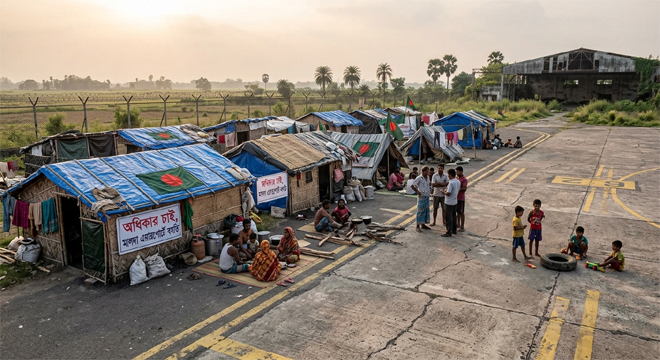
One of the major obstacles facing Malda Airport has been widespread encroachment on airport land. Reports indicate that unauthorized settlements, high-rise structures, and cellphone towers have emerged around the airstrip, creating serious aviation safety concerns. These developments complicate modernization efforts because runway expansion, navigation systems, and flight safety clearances require strict obstacle-free zones. Government records and local political discourse have also highlighted concerns regarding organized encroachments allegedly involving illegal immigrants from Bangladesh settling on sensitive land parcels.
The issue has transformed the airport debate into a politically sensitive matter involving not only infrastructure policy but also border management, demographic anxieties, and internal security considerations. Malda’s proximity to international borders and migration routes has long made it a focal point in discussions around illegal infiltration and land encroachment. Critics argue that years of administrative neglect enabled organized squatting on strategically important land, thereby complicating infrastructure development projects.
At the same time, there is also a larger developmental argument. Infrastructure experts often point out that transport hubs tend to attract encroachments when governments fail to rapidly operationalize or secure public assets. Idle land becomes vulnerable to illegal occupation, speculative real estate activity, and unregulated construction. In the case of Malda Airport, years of policy drift created conditions where the original aviation infrastructure steadily degraded while competing land-use pressures intensified around it.
The revival efforts being pushed by the BJP-led central government in coordination with sections of the state administration indicate a renewed political push to restore regional aviation connectivity. BJP leaders from North Bengal have repeatedly framed airport modernization as essential for regional economic transformation. They argue that better connectivity would stimulate investment in agro-processing, silk exports, tourism, and warehousing while integrating Malda more effectively into national supply chains.
Strategic importance of Hasimara and Dooars corridor
Among the two proposed aviation projects, Hasimara arguably carries the greatest strategic significance because of its unique geographic position. Located close to Bhutan and not far from the Siliguri Corridor, Hasimara sits within one of India’s most sensitive geopolitical zones. The corridor itself is a narrow stretch of land connecting the northeastern states to the Indian mainland. Any disruption in this area has implications for military logistics, trade routes, and national integration.
For this reason, the Indian Air Force has historically maintained a strong presence in Hasimara. The air base has evolved into a critical defence installation supporting eastern sector operations. The decision to permit a civilian enclave alongside such a sensitive military base reflects the government’s confidence in balancing national security requirements with developmental priorities.
Dual-use airport infrastructure has become increasingly common globally and within India. Civilian terminals operating adjacent to military airfields enable governments to optimize land use and infrastructure investment while improving regional connectivity. Examples across India show that such arrangements can succeed if there is robust coordination between defence authorities, aviation regulators, and state governments.
The economic possibilities surrounding Hasimara are substantial. North Bengal’s tea industry remains one of the largest employers and export generators in eastern India. Hundreds of tea gardens spread across the Dooars and Terai regions produce premium tea varieties that are exported worldwide. However, exporters often face logistical bottlenecks due to limited transport infrastructure. Faster air connectivity could help facilitate business travel, specialized cargo movement, and investor access to remote production zones.
Tourism is another sector poised for dramatic gains. The Dooars region possesses extraordinary natural assets including forests, wildlife sanctuaries, rivers, tea estates, and eco-tourism destinations. Yet tourism growth remains constrained by inadequate transport infrastructure. Travelers typically rely on Bagdogra Airport followed by lengthy road transfers. A civilian airport at Hasimara could fundamentally change tourist movement patterns, enabling shorter travel times and more diversified tourism circuits.
The Bhutan factor adds another layer of economic importance. Hasimara lies close to Jaigaon, the gateway town to Bhutan’s commercial capital Phuentsholing. Cross-border trade and tourism between India and Bhutan already generate significant economic activity. Improved air connectivity could further strengthen this corridor by facilitating business travel, logistics operations, and tourism inflows.
There is also growing interest in positioning North Bengal as a logistics and warehousing hub connecting eastern India with the Northeast and neighboring countries. Better airport infrastructure can complement highway and railway projects already underway in the region. Integrated connectivity networks are increasingly essential in modern economic development because businesses prioritize regions where multimodal transport systems reduce time and transaction costs.
However, infrastructure alone cannot guarantee transformation. This is perhaps the most important lesson policymakers must recognize. Airports are enablers, not automatic engines of prosperity. Around the world, many airports remain underutilized because surrounding economic ecosystems failed to develop. Sustainable growth requires synchronized investments in industry, hospitality, logistics, urban planning, skill development, and governance reforms.
West Bengal’s broader investment climate therefore becomes central to the long-term success of these aviation projects. Investors evaluating North Bengal will examine issues such as land acquisition efficiency, law and order, labor relations, industrial policy consistency, and bureaucratic responsiveness. Without improvements in these areas, airport expansion alone may not deliver the transformative economic impact envisioned by political leaders.
State-center coordination also remains a critical factor. Infrastructure projects in India frequently become trapped in political friction between state governments and the Union government. Land acquisition disputes, environmental clearances, funding disagreements, and administrative delays can derail even strategically important projects. In the case of Hasimara and Malda, cooperation between the West Bengal administration and the central government will be essential for timely execution.
The recent administrative approvals for land acquisition at Hasimara suggest that some degree of consensus has emerged regarding the importance of regional aviation expansion. Yet execution remains the true test. India has witnessed numerous infrastructure announcements that failed to materialize on schedule because implementation mechanisms remained weak.
Security considerations further complicate infrastructure planning in North Bengal. Border districts face persistent concerns related to smuggling, illegal migration, counterfeit currency networks, and demographic tensions. Any large infrastructure expansion must therefore incorporate robust security architecture including surveillance systems, land protection measures, and coordinated intelligence operations.
In Hasimara’s case, the coexistence of civilian and military operations will require highly sophisticated security management. Passenger screening, perimeter protection, restricted zones, and airspace coordination must operate seamlessly without compromising defence readiness. This will necessitate close collaboration between the Airports Authority of India, the Indian Air Force, intelligence agencies, and local administration.
Malda’s untapped economic potential, connectivity deficit
While Hasimara embodies strategic and geopolitical importance, Malda represents the developmental aspirations of a densely populated commercial region long constrained by infrastructure deficits. Historically, Malda occupied an important position along trade routes connecting Bengal with northern India and neighboring regions. The district developed reputations for silk production, mango cultivation, and agricultural trade. Yet modern transportation bottlenecks have limited its ability to fully capitalize on these strengths.
Road and rail connectivity in Malda remain overburdened. Seasonal congestion, long travel times, and inadequate logistics infrastructure continue to hamper economic efficiency. The absence of functional commercial aviation further isolates the region from major investment centers. Business travelers, exporters, and tourists often face inconvenient multi-stage journeys that discourage economic engagement.
Reviving Malda Airport could therefore generate substantial multiplier effects across multiple sectors. The district’s famous mango industry, for example, could benefit from improved access to premium domestic and export markets. Perishable agricultural products require rapid transportation systems to preserve quality and reduce spoilage. Aviation infrastructure can play a crucial role in supporting high-value agricultural supply chains.
Similarly, Malda’s silk industry could gain from better connectivity with textile hubs, export buyers, and trade exhibitions across India. Improved transportation often enhances competitiveness by reducing transaction costs and increasing market accessibility. Small and medium enterprises particularly benefit when connectivity gaps are reduced because they lack the logistical flexibility available to larger corporations.
Tourism possibilities in Malda are also frequently overlooked. The region possesses important historical and cultural assets including the ruins of Gour and Pandua, which were once major centers of medieval Bengal. Better air connectivity could help integrate these heritage sites into broader tourism circuits linking North Bengal, Murshidabad, and neighboring states.
Yet the airport project continues to face serious challenges. Encroachments remain one of the most politically sensitive and technically difficult issues. Unauthorized settlements on or near airport land complicate expansion plans because aviation safety regulations impose strict restrictions on structures surrounding runways. High-rise buildings and telecom towers create potential hazards during aircraft landing and takeoff operations.
Resolving these issues requires a combination of political will, administrative capacity, legal clarity, and rehabilitation planning. Forced eviction drives without adequate planning often trigger social tensions and prolonged litigation. On the other hand, failure to act decisively can indefinitely stall infrastructure projects. Governments therefore face the difficult task of balancing developmental priorities with humanitarian and political considerations.
The allegations regarding organized encroachments linked to illegal immigration add another layer of controversy. Border districts in West Bengal have long witnessed intense political debates over migration patterns, voter demographics, and land occupation. Infrastructure projects situated within such environments inevitably become entangled in broader ideological and electoral conflicts.
From a governance perspective, the Malda case also highlights deeper structural problems affecting infrastructure planning in India. Many regional airports became defunct not because aviation demand disappeared but because long-term maintenance, land protection, and modernization efforts were neglected. Once infrastructure deteriorates and encroachments spread, revival costs rise dramatically.
The Regional Connectivity Scheme (RCS-UDAN) was designed precisely to address such gaps by improving air connectivity to underserved and unserved regions. The scheme aims to make regional flying affordable while stimulating economic development in smaller cities. If implemented effectively, Malda could become a strong candidate for successful regional aviation revival because of its sizable population base and economic relevance.
Political competition itself may paradoxically accelerate development. Both the BJP and regional political actors increasingly recognize the symbolic and practical importance of infrastructure expansion in North Bengal. Aviation projects are being framed not merely as transport upgrades but as indicators of developmental commitment to historically underserved regions.
North Bengal has often perceived itself as relatively neglected compared to Kolkata-centric development patterns. Investments in airports, highways, railways, and logistics hubs therefore carry political significance beyond their immediate economic utility. Governments that successfully deliver visible infrastructure improvements may strengthen their electoral standing across the region.
Can airports transform North Bengal into a business hub?
The larger question, however, is whether expanded airport infrastructure at Malda and Hasimara can genuinely transform North Bengal into a major business hub. The answer is complex. Airports can catalyze growth, improve investor confidence, and stimulate economic activity, but they are only one component within a much broader developmental ecosystem.
Globally, successful business hubs emerge through the convergence of multiple factors including industrial capacity, human capital, governance quality, logistics networks, financial ecosystems, urban planning, and regulatory efficiency. Airports support these systems by enabling faster mobility and trade, but they cannot substitute for deeper structural reforms.
For North Bengal, the opportunity lies in developing a diversified regional economy built around tourism, agro-processing, tea exports, logistics, cross-border trade, warehousing, and small-scale manufacturing. Improved aviation connectivity can strengthen each of these sectors by reducing travel times and improving market access.
Hasimara could evolve into a gateway for eco-tourism, tea business travel, and Bhutan-linked commerce. Malda could become an important agricultural and logistics node connecting North and South Bengal. Together, the two airports could contribute to a more balanced regional development model that reduces excessive concentration around Kolkata.
However, the success of such ambitions will depend heavily on complementary investments. Industrial parks, cold storage chains, urban infrastructure, hospitality ecosystems, and digital connectivity must expand simultaneously. Skill development initiatives will also be essential to ensure that local populations benefit from emerging economic opportunities.
Environmental sustainability represents another important consideration. North Bengal contains ecologically sensitive zones including forests, river systems, and wildlife habitats. Airport expansion and associated urbanization must therefore incorporate careful environmental planning. Unregulated development could damage fragile ecosystems that themselves constitute valuable tourism assets.
Urban planning will become increasingly critical if airport projects move forward successfully. Around the world, airports often stimulate rapid real estate growth, commercial clustering, and peri-urban expansion. Without proper regulation, this can lead to chaotic urbanization, environmental degradation, and infrastructure stress. Authorities must therefore proactively prepare master plans governing land use around these emerging aviation hubs.
The political dimension cannot be ignored either. Infrastructure projects frequently become symbolic battlegrounds between competing political narratives. Different parties may claim credit, assign blame for delays, or frame projects through ideological lenses involving nationalism, development, or regional identity. In North Bengal, where political competition has intensified sharply in recent years, airport development is likely to remain politically charged.
Yet despite these complexities, the revival of Malda Airport and the civilian expansion of Hasimara reflect a broader recognition that connectivity matters profoundly in modern economic geography. Regions disconnected from efficient transport networks struggle to attract investment, integrate supply chains, or compete effectively in national markets.
For decades, North Bengal’s immense strategic and economic potential remained partially constrained by weak infrastructure integration. The proposed airport developments indicate an attempt to correct this imbalance. If executed efficiently and supported by wider policy reforms, they could help unlock new pathways for regional growth.
The ultimate challenge lies not merely in constructing terminals or extending runways, but in building an integrated development vision that combines connectivity with industrial strategy, security management, environmental sustainability, and administrative efficiency. Airports can open doors, but long-term prosperity depends on what governments, businesses, and communities build once those doors are opened.
In that sense, Malda and Hasimara are not simply aviation projects. They are tests of whether infrastructure planning in eastern India can finally move beyond announcements and political rhetoric toward sustained regional transformation.