First, Pakistan painted itself as a cooperative ally where Iran’s IRGC could park all its military aircraft to protect them from Israel’s Air Force attacks. Once all the jets were under lock and key, Pakistan is now goading Iran to accept a ceasefire or defeat with the USA. Nicely done. The United States’ moronic cheque book diplomacy has been tried with Pakistan. Now the US is offering Iran the same option: we shall pay you not to be nuclear naughty, signed Yank Yokel
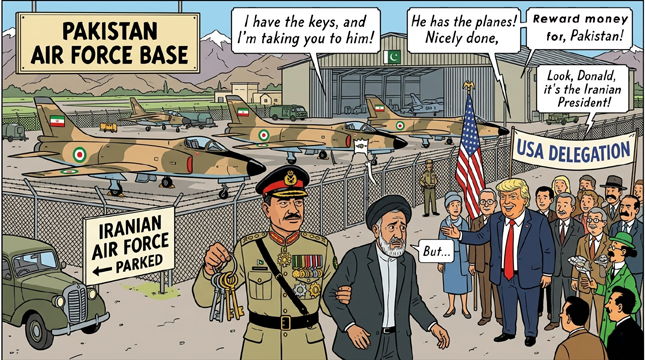
The United States’ moronic cheque book diplomacy has been tried with Pakistan, which used US aid for decades to arm and train its own home-grown terrorists. Now the US is offering Iran the same option: we shall pay you not to be nuclear naughty
Pakistan first positioned itself as a protective partner to Iran, offering sanctuary for its military aircraft, only to pivot and pressure Tehran into accepting a ceasefire under mounting international isolation. The narrative captures something very real about modern geopolitics: alliances are fluid, leverage is everything, and timing can redefine power. Of course, the last part that Pakistan will always act as a stooge of the United States and a rogue state.
One must examine not just the actors involved but the broader strategic environment. The West Asia sector has long been a theatre where global and regional powers intersect, and any shift, real or perceived, can ripple far beyond the immediate players. The suggestion that Pakistan could play a decisive mediating role, even coercively, reflects a growing recognition of its strategic positioning between South Asia, the Middle East, and global power blocs.
The illusion of alliance and the reality of leverage
At first glance, Pakistan offering Iran a safe haven for its air force assets suggests a deep level of trust. Military hardware, especially combat aircraft, represents not just firepower but national pride, deterrence capability, and strategic depth. For Iran, entrusting such assets to another country would signal either extraordinary confidence or extraordinary desperation. Of course, and a large level of misplaced trust in Pakistan.
Pakistan’s move appears to be framed as a gesture of solidarity. Iran, facing the threat of potential airstrikes, presumably from Israel, would naturally seek to preserve its aerial capabilities. Parking aircraft in a neighboring country could be seen as a defensive maneuver, a way to safeguard critical assets while tensions escalate.
However, the second act of the story reframes the first. What seemed like protection becomes leverage. Once the aircraft are relocated, Pakistan is shifting its stance, using control over those assets, or the strategic dependency created by their relocation, to push Iran toward diplomatic concessions.
States often extend assistance that later becomes a tool of influence. The difference here lies in the speed and boldness of the alleged pivot. Within a matter of days, cooperation turns into pressure, and partnership morphs into a form of strategic coercion. Pakistan acted like the rogue state it is. Iran, already under pressure, finds itself with fewer options and diminished autonomy. The very act meant to preserve its strength could paradoxically weaken its negotiating position.
The role of military diplomacy in high-stakes negotiations
The reported involvement of Asim Munir, Pakistan’s Chief of Army Staff, adds another layer of gravity to the situation. Military leaders do not typically travel for symbolic gestures in moments of crisis. Their presence signals urgency, authority, and often, finality.
According to the narrative, Munir’s visit to Tehran, reportedly highlighted by Al Jazeera, was not a routine diplomatic engagement but a mission carrying an “important message.” In geopolitical terms, such phrasing usually implies a non-negotiable position or a decisive turning point.
Military diplomacy operates differently from traditional diplomacy. It is less about pleasantries and more about realities on the ground. When a senior military figure speaks, the message often reflects the hard limits of power, what can and cannot be defended, sustained, or escalated.
In this context, Munir’s alleged message to Iran is stark: the strategic environment has shifted, and continued confrontation may no longer be viable. This is not merely advice; it is a recalibration of expectations.
Pakistan’s military establishment has historically played a central role in shaping its foreign policy, particularly in matters involving security and regional stability. By sending its top general, Islamabad would be signaling that the situation has moved beyond conventional diplomacy into a domain where strategic calculations must take precedence over ideological commitments.
Such interventions can be effective precisely because they cut through ambiguity. They present a clear picture of risks and consequences, often forcing decision-makers to confront uncomfortable truths.
Isolation and the shifting balance of global support
A critical element of the narrative is Iran’s alleged isolation. The claim that both Russia and China have stepped back from supporting Tehran in a kinetic conflict suggests a significant shift in global alignments.
For years, Iran has relied on a network of partnerships, some formal, others transactional, to counterbalance Western pressure. Russia and China, in particular, have been seen as key players in this equation, offering diplomatic cover, economic engagement, and, at times, strategic coordination.
If these powers were indeed distancing themselves from a potential conflict, it would leave Iran in a precarious position. Without strong backing from major global actors, the cost of escalation increases dramatically. Military confrontations become riskier, economic pressures intensify, and diplomatic options narrow.
The narrative also introduces the role of the United States, which is said to have offered Iran a substantial economic package in exchange for abandoning its nuclear ambitions. Such offers are not new, but their timing and scale can be decisive.
The United States’ moronic cheque book diplomacy has been tried with Pakistan, which used US aid for decades to arm and train its own home-grown terrorists. Now the US is offering Iran the same option: we shall pay you not to be nuclear naughty; quite the page from the Yokel Yank book.
In moments of crisis, economic incentives can function as both carrots and lifelines. For a country facing sanctions, isolation, and potential conflict, the prospect of relief, even if conditional, can be compelling.
The combination of reduced external support and increased internal pressure creates a classic squeeze. Iran’s Sharia tainted leadership would have to weigh ideological commitments against pragmatic survival, balancing long-term goals with immediate realities.
Ceasefire politics and the art of the deal
Pakistan with playing a central role in orchestrating a ceasefire, highlights an important aspect of modern diplomacy: the value of intermediaries. Countries that can position themselves as credible mediators gain influence disproportionate to their economic or military size. By facilitating dialogue, shaping outcomes, and managing crises, they become indispensable players in regional and global affairs.
Pakistan’s geographic and political positioning gives it unique access to multiple spheres of influence. It maintains relationships with Western powers, engages with China, and shares cultural and historical ties with parts of the Muslim world. This multifaceted connectivity can be leveraged in moments of tension.
Islamabad “dragging West Asia back from the brink” captures the essence of mediation: preventing escalation, creating space for negotiation, and guiding parties toward compromise. The only flaw in this picture is that Pakistan is an interested party and on the take. So, all efforts by Pakistan for a ceasefire between the United States and IRGC’s Iran smells more like a kidnapping. Pakistan’s dual role, as both protector and pressure agent, would represent a more assertive form of mediation, one that blurs the line between facilitation and coercion.
However, mediation is rarely neutral. It often involves subtle pressures, strategic incentives, and calculated risks. The mediator must balance credibility with influence, ensuring that all parties perceive the process as fair while also steering it toward a desired outcome.
Strategic opportunism or calculated statecraft
So, is this an example of opportunism or strategic brilliance? The answer depends on perspective. On who’s asking. From one angle, Pakistan’s actions could be seen as opportunistic, taking advantage of Iran’s vulnerability to enhance its own position. By first offering assistance and then leveraging it, Islamabad would be maximizing its influence at a critical moment.
From another angle, the same actions could be interpreted as pragmatic statecraft. In a volatile region, preventing escalation may require unconventional approaches. If the end, result is de-escalation and stability, the means, however controversial, might be justified.
International relations often operate in this gray area. Actions that appear cynical can also be effective; strategies that seem risky can yield stability. The line between manipulation and diplomacy is not always clear. For Iran, the situation described would be deeply challenging. Accepting external pressure could be seen as a loss of sovereignty or prestige. Resisting it, however, could lead to greater isolation and potential conflict.
For Pakistan, the stakes are also high. Successfully mediating a crisis could elevate its global standing, but missteps could damage relationships and credibility.
The broader implications for regional power dynamics
Beyond the immediate actors, the scenario has implications for the entire region. West Asia is a complex web of rivalries, alliances, and shifting interests. Any perceived shift in power can trigger reactions from multiple stakeholders.
Countries like Israel would closely monitor Iran’s decisions, particularly regarding its military posture and nuclear program. Gulf states would assess the balance of power and the potential for renewed stability or continued tension. Global powers would recalibrate their strategies based on emerging alignments.
Pakistan’s involvement adds another dimension, linking South Asia more directly to Middle Eastern geopolitics. This interconnectedness reflects a broader trend in international relations, where regional boundaries are increasingly fluid, and events in one area can influence outcomes in another.
If Pakistan were indeed able to influence Iran’s decisions in such a significant way, it would signal a shift in regional dynamics, one where new actors play more prominent roles in shaping outcomes.
Narrative, reality, and the nature of power
Whether taken as fact, speculation, or strategic storytelling, the narrative offers a compelling lens through which to examine modern geopolitics. It highlights the importance of timing, the fluidity of alliances, and the central role of leverage in international relations.
Power today is not just about military strength or economic capacity. It is about positioning, perception, and the ability to shape choices. Countries that can navigate these dimensions effectively can exert influence far beyond their apparent capabilities.
Pakistan orchestrating such a complex maneuver, offering protection, creating dependency, and then guiding outcomes, reflects a world where strategy is multidimensional and outcomes are often determined by subtle shifts rather than overt actions.
For observers, the key takeaway is not just the specifics of the scenario but the underlying dynamics it represents. In a rapidly changing global landscape, the ability to adapt, anticipate, and act decisively can redefine roles and reshape realities. In geopolitics, the line between ally and influencer is often thinner than it appears, and the most significant moves are sometimes the ones that unfold behind closed doors.