
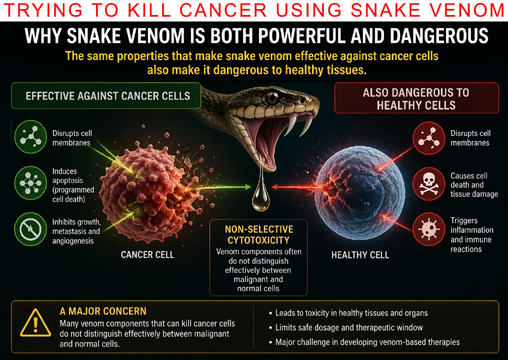
The same properties that make snake venom effective against biological targets such as cancerous cells also make it dangerous to healthy tissues. Non-selective cytotoxicity is a major concern. Many venom components that can kill cancer cells do not distinguish effectively between malignant and normal cells
Scientists are beginning to see snake venom as a complex biochemical library filled with molecules that could be harnessed for therapeutic purposes. Substances such as cryotoxin from rattlesnake venom and contortrostatin from copperhead snakes have demonstrated the ability to interact with cancer cells in ways that conventional therapies often struggle to achieve. These components can trigger apoptosis, or programmed cell death, which is a critical mechanism in stopping the uncontrolled proliferation that defines cancer. At first glance, this may seem paradoxical, using poison to heal, but history has repeatedly shown that many potent medicines originate from toxic natural substances when refined and properly controlled.
The promise of snake venom lies in its highly specialized proteins and peptides, which have evolved over millions of years to interact precisely with biological systems. Venom is not a single substance but a complex cocktail containing enzymes, peptides, and proteins, each with specific biochemical roles. In the context of cancer, some of these molecules appear capable of targeting tumor cells, interfering with their growth, and even preventing their spread. This has sparked intense interest among researchers who are seeking alternatives or complements to traditional cancer therapies such as chemotherapy and radiation, both of which often come with severe side effects. However, despite the excitement, the journey from laboratory discovery to clinical application is fraught with challenges, many of which stem from the very properties that make venom so potent.
The paradox of toxicity and therapy in venom research
One of the most fundamental challenges in using snake venom as a cancer treatment is its inherent toxicity. Venom evolved as a weapon for predation or defense, meaning its primary function is to incapacitate or kill. This creates a paradox: the same properties that make venom effective against biological targets also make it dangerous to healthy tissues. Non-selective cytotoxicity is a major concern. Many venom components that can kill cancer cells do not distinguish effectively between malignant and normal cells. As a result, administering these substances in their crude form can lead to widespread damage throughout the body, causing severe systemic side effects.
These toxic effects can manifest in multiple ways. Neurotoxicity can disrupt nerve signaling, leading to paralysis. Hemotoxicity can interfere with blood clotting, causing hemorrhaging or dangerous clot formation. Myotoxicity can result in the breakdown of muscle tissue. These risks make it clear that any therapeutic application of venom must involve precise modification, isolation, and delivery of specific components rather than the use of whole venom.
Another layer of complexity arises from pharmacokinetics, the way a substance behaves within the body over time. Venom-derived peptides often have low bioavailability, meaning they do not easily reach the bloodstream in effective concentrations. Even when they do, they may be rapidly degraded by enzymes or cleared from the body before they can reach tumor sites. This instability significantly limits their effectiveness as drugs. Researchers are therefore faced with the challenge of modifying these molecules to enhance their stability without compromising their anticancer properties.
Molecular mechanisms that make venom a cancer targeter
Despite these obstacles, the molecular sophistication of snake venom continues to captivate scientists. Certain classes of proteins found in venom have shown remarkable specificity in targeting cancer cells. Disintegrins, for instance, are small proteins that can bind to integrins, receptors on the surface of cells that play a key role in cell adhesion and communication. Cancer cells often rely on these receptors to spread and invade other tissues. By interfering with integrin function, disintegrins can effectively inhibit metastasis, which is one of the most dangerous aspects of cancer.
Another important group of molecules is L-amino acid oxidases (LAAOs). These enzymes generate reactive oxygen species, including hydrogen peroxide, which can induce oxidative stress within cells. Cancer cells, due to their altered metabolism, are often more vulnerable to oxidative damage than normal cells. LAAOs exploit this vulnerability, triggering apoptosis selectively in malignant cells. This selective mechanism is particularly appealing because it suggests the possibility of targeting tumors while sparing healthy tissue.
Phospholipases A2 represent yet another class of venom components with anticancer potential. These enzymes can disrupt cell membranes, leading to cell death. In cancer cells, which often have altered membrane compositions, this effect can be particularly pronounced. Lectins, on the other hand, can bind to specific carbohydrate structures on cell surfaces, potentially allowing for targeted interactions with tumor cells.
Contortrostatin and other promising venom-derived compounds
Among the various venom-derived molecules under investigation, contortrostatin has emerged as one of the most promising. Isolated from the venom of the southern copperhead snake, this protein has demonstrated potent anti-tumor activity, particularly in breast cancer models. Contortrostatin works by binding to integrins on the surface of cancer cells, thereby disrupting processes such as cell adhesion, migration, and angiogenesis, the formation of new blood vessels that tumors need to grow.
What makes contortrostatin especially interesting is its apparent ability to target cancer cells without causing extensive damage to normal cells in preclinical studies. This suggests a level of specificity that is highly desirable in cancer therapy. However, it is important to note that most of this evidence comes from laboratory experiments and animal models. Translating these findings into effective human treatments requires extensive clinical testing, which has yet to be completed.
Cryotoxin, another venom-derived compound, has also shown potential in targeting cancer cells. Like contortrostatin, it can induce apoptosis and interfere with tumor growth. However, its mechanisms of action are less well understood, and further research is needed to determine its safety and efficacy in humans.
The challenge of delivery and formulation in venom therapies
Even when a venom-derived compound shows promise in targeting cancer cells, delivering it safely and effectively to the tumor site remains a major hurdle. Because of their toxicity and instability, these molecules often require sophisticated delivery systems. One approach that has gained attention is nanoparticle encapsulation. By packaging venom-derived peptides within nanoparticles, researchers can protect them from degradation, improve their circulation time in the bloodstream, and enhance their ability to reach tumors.
Nanotechnology also offers the possibility of targeted delivery. By attaching specific ligands to nanoparticles, it may be possible to direct them to cancer cells while avoiding healthy tissues. This could significantly reduce side effects and improve therapeutic outcomes. However, these approaches add complexity and cost to the drug development process. Manufacturing such systems at scale, ensuring their safety, and obtaining regulatory approval are all significant challenges.
Another issue is dosing. Determining the correct dose of a venom-derived compound is particularly difficult because of its narrow therapeutic window, the range between an effective dose and a toxic one. Too little may be ineffective, while too much could be dangerous. This requires precise calibration and extensive testing.
Scientific gaps and the need for clinical validation
While laboratory studies have provided valuable insights into the anticancer potential of snake venom, there remains a significant gap between these findings and real-world clinical applications. Most research has been conducted in vitro, using cancer cell lines, or in animal models. While these studies are essential, they do not fully replicate the complexity of human biology.
Large-scale clinical trials are necessary to determine whether venom-derived therapies are safe and effective in humans. These trials must address a range of questions, including optimal dosing, potential side effects, interactions with other treatments, and long-term outcomes. Conducting such trials is time-consuming and expensive, which partly explains why progress in this field has been relatively slow.
Standardization is another critical issue. Snake venom composition can vary widely depending on species, geographic location, diet, and even the age of the snake. This variability makes it difficult to produce consistent and reproducible results. Isolating specific bioactive components and ensuring their purity and stability is a complex technical challenge that must be overcome before these substances can be developed into reliable drugs.
Resistance, evolution, and the future of venom-based oncology
Even if these challenges are addressed, another concern looms on the horizon: the potential for cancer cells to develop resistance to venom-derived therapies. Just as tumors can become resistant to chemotherapy drugs through genetic mutations, they may also adapt to evade the effects of venom-based treatments. This underscores the need for combination therapies that use multiple mechanisms to target cancer cells simultaneously.
Despite these hurdles, the future of venom-based oncology remains promising. Advances in biotechnology, molecular biology, and drug delivery systems are opening new avenues for harnessing the therapeutic potential of snake venom. Techniques such as recombinant DNA technology allow scientists to produce venom proteins in controlled laboratory environments, reducing reliance on natural extraction and improving consistency.
Furthermore, the growing understanding of cancer biology is enabling researchers to identify specific targets that venom-derived molecules can exploit. This could lead to highly personalized treatments tailored to the unique characteristics of an individual’s tumor.
In the broader context of medicine, the study of snake venom highlights the importance of looking beyond conventional sources for new therapies. Nature has evolved an extraordinary array of biochemical tools, many of which remain untapped. By studying these systems and learning how to adapt them for human use, scientists may uncover new strategies for combating some of the most challenging diseases.
Ultimately, the use of snake venom in cancer treatment represents both an opportunity and a challenge. It is an opportunity to develop novel therapies that could complement or even surpass existing treatments. At the same time, it is a challenge that requires careful navigation of complex scientific, medical, and ethical considerations. As research continues, the hope is that what was once feared as a deadly toxin may one day become a life-saving medicine.
Even HOMEOPATHY struggles to find a cure for cancer using snake venom
Homeopathy, a system of medicine founded in the late 18th century, approaches snake venom not as a poison to be neutralized, but as a substance whose energetic imprint, retained through a process known as potentization, can stimulate healing. This process involves serial dilution combined with vigorous shaking, or succussion, which practitioners believe transfers the medicinal essence of the original substance into the solution. The result is a preparation that contains little to no measurable toxin but is thought to retain therapeutic properties. While controversial within mainstream science, this approach has generated ongoing interest, particularly as researchers attempt to examine high dilutions using modern tools such as molecular biology and systems-level “omics” technologies.
Snake venom has evolved into a serious area of scientific and alternative medical inquiry. Among the most intriguing approaches is homeopathic research into snake venom, which explores how these toxic substances, when subjected to extreme dilution and preparation techniques, might be transformed into therapeutic agents. This perspective differs sharply from conventional pharmacology, yet it intersects in surprising ways with modern biochemical research that isolates venom components for targeted medical use, including cancer therapy and immune modulation.
Principles of similarity and potentization in venom therapy
At the heart of homeopathic use of snake venom lies the principle of “similia similibus curentur,” or “like cures like.” This idea suggests that a substance capable of producing certain symptoms in a healthy individual can, when appropriately prepared, treat similar symptoms in someone who is ill. Snake venoms are complex mixtures of enzymes, peptides, and proteins that produce distinct physiological effects, ranging from hemorrhage and tissue destruction to neurotoxicity and inflammation. Homeopaths match these effects with clinical symptoms, prescribing diluted venom remedies to address corresponding disorders.
For example, hemotoxic venoms, which disrupt blood clotting and cause bleeding, are used in homeopathy to treat circulatory disorders and hemorrhagic conditions. Neurotoxic venoms, which affect the nervous system, are associated with treatments for neuralgia, chronic pain, and certain neurological disturbances. This symptom-based matching forms the core of homeopathic prescribing, distinguishing it from the target-specific approach of modern pharmacology.
Potentization, meanwhile, is the defining preparation method. Remedies are diluted in a stepwise fashion, often reaching levels such as 30CH or 200CH, where the original substance is statistically absent. Despite this, proponents argue that the process alters the structure of the solvent in ways that can influence biological systems. Recent exploratory studies have attempted to detect changes in gene expression, protein signaling, and cellular responses following exposure to such high dilutions. While findings remain inconclusive and debated, they have opened a niche area of interdisciplinary research seeking to bridge traditional practices with contemporary scientific frameworks.
Major snake-derived remedies in homeopathy
Several snake venoms have become central to homeopathic practice, each associated with specific symptom profiles and therapeutic indications. Among the most prominent is Lachesis mutus, derived from the bushmaster snake. This remedy has historically been used to address menopausal symptoms such as hot flashes, as well as circulatory disturbances and septic conditions. Its symptom picture includes heightened sensitivity, circulatory congestion, and a tendency toward hemorrhage, which guides its application in clinical settings.
Another widely studied remedy is Naja tripudians, derived from cobra venom. This preparation is associated with the nervous system and cardiovascular function. It has been explored for potential use in chronic pain conditions, neuralgia, and inflammatory diseases affecting the lungs. The remedy’s profile includes symptoms such as constriction, emotional sensitivity, and cardiac irregularities, making it relevant in cases where these features are prominent.
Crotalus horridus, sourced from rattlesnake venom, is typically indicated for severe infectious diseases characterized by hemorrhagic tendencies and systemic toxicity. It is also associated with congestive headaches and conditions involving impaired blood flow. Its use reflects the broader homeopathic strategy of matching intense pathological states with remedies derived from similarly potent natural substances.
More recently, Bothrops lanceolatus, the venom of the Martinique viper, has attracted attention for its potential role in addressing thromboembolic conditions. Some research has suggested molecular parallels between this venom and targets involved in certain viral pathologies, including complications seen in advanced respiratory infections. While still in early stages, such findings illustrate how traditional remedies are being re-examined through the lens of modern biomedical science.
Emerging research on immune modulation and pain relief
Beyond traditional applications, contemporary research into snake venom, both in homeopathic and biochemical contexts, has revealed intriguing effects on the immune system. Studies involving cobra venom components, for instance, have demonstrated the ability to modulate immune responses. Certain compounds appear to enhance innate immunity while suppressing overactive T-cell responses, suggesting potential applications in autoimmune diseases where immune balance is disrupted.
This dual action, stimulating protective mechanisms while dampening harmful overreactions, has made venom-derived substances a subject of interest in immunotherapy research. Although most findings are preliminary and derived from laboratory or animal studies, they point to a complex interplay between venom molecules and immune signaling pathways.
Pain management is another area where snake venom has shown promise. Experimental studies and some clinical observations have indicated that specific venom components possess analgesic properties. These substances can interact with nerve receptors, modulating pain signals and providing relief in conditions such as chronic pain, cancer-related pain, and neuralgia. In some cases, venom-derived compounds have been found to be more potent than traditional analgesics, though their safety and delivery remain key challenges.
In homeopathy, these findings are interpreted through the lens of energetic stimulation rather than direct biochemical action. Practitioners argue that diluted venom remedies can trigger the body’s own regulatory mechanisms, leading to pain relief without the risks associated with pharmacological doses. While this perspective is not widely accepted in conventional medicine, it continues to inspire research aimed at understanding how subtle biological signals might influence health.
Anti-cancer potential of venom components
One of the most compelling areas of snake venom research lies in its potential application in cancer treatment. Modern biochemical studies have identified several classes of venom-derived molecules with cytotoxic effects on cancer cells. These include phospholipases A2, disintegrins, L-amino acid oxidases, and C-type lectins, each of which interacts with cellular processes in distinct ways.
Phospholipases A2 are enzymes that can disrupt cell membranes and induce oxidative stress, leading to programmed cell death, or apoptosis. Disintegrins, on the other hand, interfere with integrin receptors, which are crucial for cancer cell adhesion and metastasis. By blocking these receptors, disintegrins can inhibit the spread of tumors and the formation of new blood vessels that support tumor growth.
L-amino acid oxidases generate hydrogen peroxide as a byproduct, creating a localized oxidative environment that can damage cancer cells and halt their proliferation. C-type lectins bind to specific sugar residues on the surfaces of cancer cells, triggering pathways that lead to cell death. Together, these mechanisms represent a multifaceted attack on tumor biology, making snake venom a rich source of potential anticancer agents.
In the homeopathic context, these properties are not harnessed through direct biochemical action but are instead viewed as part of the remedy’s energetic profile. Some clinical case reports have described improvements in patients with advanced cancers who used snake venom remedies as part of a broader treatment plan. However, such reports are anecdotal and are generally considered complementary rather than curative within mainstream oncology.
Challenges in translating venom research into clinical practice
Despite its promise, the use of snake venom in medicine faces significant challenges. One of the primary obstacles is toxicity. Venom components are inherently dangerous and ensuring that they selectively target diseased cells without harming healthy tissue is a complex task. This issue is particularly critical in cancer therapy, where the margin between effective and harmful doses can be narrow.
Another challenge is the early stage of research. Much of the current evidence for venom-derived therapies comes from in vitro studies or animal models. While these studies provide valuable insights, they do not always translate directly into human clinical outcomes. Large-scale clinical trials are needed to establish safety, efficacy, and optimal dosing, but such trials are costly and time-consuming.
Innovative delivery systems are being explored to address these challenges. Nanoparticle-based approaches, for example, aim to encapsulate venom components and deliver them directly to target cells, reducing systemic toxicity and improving therapeutic precision. These technologies represent a convergence of biotechnology and pharmacology, offering new ways to harness the power of natural toxins.
In the realm of homeopathy, the challenges are of a different nature. The primary issue is scientific validation. The concept of potentization and the efficacy of high dilutions remain subjects of debate, with critics arguing that they lack a plausible mechanism of action. Supporters, however, point to emerging research suggesting that ultra-diluted substances may influence biological systems in subtle ways, warranting further investigation.
Integrating traditional and modern perspectives
The study of snake venom in medicine highlights a broader theme: the potential for integration between traditional healing systems and modern scientific research. While homeopathy and biochemistry operate on fundamentally different principles, they share a common interest in the therapeutic potential of natural substances. This convergence has led to a growing field of interdisciplinary research that seeks to understand how ancient practices might inform contemporary medical innovation.
For example, the identification of specific venom components with anticancer properties has parallels with the homeopathic use of whole venoms based on symptom similarity. Both approaches recognize the biological potency of these substances, albeit in different ways. By studying these connections, researchers may uncover new insights into how complex natural compounds interact with human physiology.
At the same time, it is important to maintain a critical perspective. Not all claims associated with venom therapy are supported by robust evidence and distinguishing between scientific findings and anecdotal reports is essential for responsible medical practice. This balance between openness and rigor will shape the future of venom research and its potential applications.
Future directions and ethical considerations
Looking ahead, the future of snake venom research is likely to be shaped by advances in biotechnology, molecular science, and systems biology. These tools will enable more precise identification of active compounds, better understanding of their mechanisms, and the development of targeted therapies with improved safety profiles. As this field evolves, it may lead to new treatments for conditions ranging from cancer and chronic pain to autoimmune diseases.
Ethical considerations will also play a significant role. The sourcing of venom, the welfare of animals, and the equitable distribution of resulting therapies are all issues that must be addressed. Additionally, the integration of traditional knowledge with modern science raises questions about intellectual property and cultural respect.
In conclusion, snake venom represents a fascinating intersection of danger and therapeutic potential. Whether approached through the lens of homeopathy or modern biomedical research, it offers a rich field for exploration. While challenges remain, the ongoing study of these complex natural substances continues to push the boundaries of what is possible in medicine, reminding us that even the most feared elements of nature may hold the key to healing.