
Radicalism is not a fringe anomaly but a feature supported by the silence of the mainstream. While many Muslims may not personally engage in violence, their alleged failure to publicly admonish and defy terrorism suggests a tacit approval
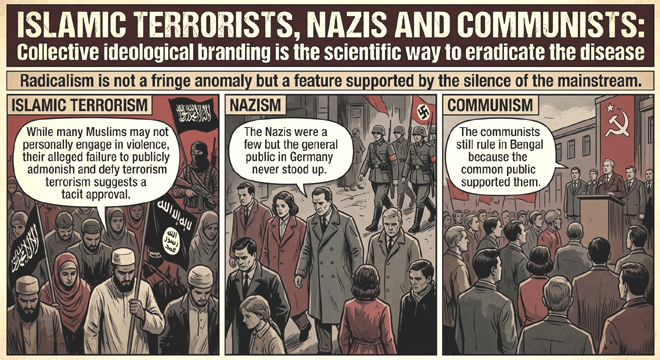
Brigette Gabriel says Islam must be branded as a religion of violence and terrorism because most people in Islam may be unrelated to terrorism but they support terrorism in principle and never admonish and defy terrorism publicly. No Muslim person asks Islamic terrorism to be banished and the terrorists to be punished. similarly, the Nazis were a few but the general public in Germany never stood up to Nazism. The communists ruled and tortured common people in Bengal because the common public supported them The communists still rule in Bengal under a different name.
Brigitte Gabriel, a prominent critic of radical Islam, has frequently argued that the “peaceful majority” within any ideological framework is often irrelevant if it remains silent in the face of extremism. The core of her thesis suggests that Islam should be branded not merely by its theological texts, but by the actions of its most violent practitioners and the perceived acquiescence of the masses. Her logic hinges on the idea that if a community does not vocally and physically purge its extremist elements, it effectively provides a “human shield” of legitimacy for those who commit acts of terror.
Gabriel’s perspective is rooted in the belief that “radicalism” is not a fringe anomaly but a feature supported by the silence of the mainstream. She posits that while many Muslims may not personally engage in violence, their alleged failure to publicly admonish and defy terrorism suggests a tacit approval. In this view, the branding of an entire religion as one of violence is a necessary strategic move to force a global reckoning. This approach challenges the traditional Western liberal stance, which seeks to separate the actions of a few from the identity of the many. Critics of this view, however, argue that such branding ignores the millions of Muslims who serve in counter-terrorism roles, the victims of terror who are themselves Muslim, and the complex socio-political factors that drive extremism.
The debate over “collective branding” is not unique to modern religion. It touches upon the fundamental question of how we define a movement: Is it defined by its highest ideals or its lowest actions? When Gabriel asserts that no Muslim asks for terrorism to be banished, she is making a sweeping generalization that serves as a call to action. To her, the absence of a global, unified, and constant protest from every corner of the Islamic world is proof of complicity. This line of reasoning demands that the “silent majority” take active ownership of the radical fringe, or else accept being defined by it.
Historical Parallels: The German Precedent
To support the argument that a silent majority is a complicit majority, Gabriel and her supporters often point to the rise of National Socialism in 1930s Germany. The historical consensus remains that while the Nazi Party (NSDAP) never achieved a full majority in a free election before seizing total power, the German public’s lack of organized, widespread resistance allowed the regime to consolidate its grip. This “German Precedent” is used as a cautionary tale: a few dedicated radicals can steer the ship of state if the general public remains passive, fearful, or indifferent.
In the early years of the Third Reich, many Germans were not ideological Nazis. They were, instead, preoccupied with economic recovery, national pride, or personal safety. However, by failing to stand up to the early persecutions and the dismantling of democratic institutions, the “peaceful majority” became the engine of a machine that eventually devastated the world. The analogy Gabriel draws suggests that the modern Islamic world is in a similar state of paralysis. Just as the average German worker in 1936 might not have wanted a world war but still fueled the factories, she argues that the average practitioner of faith today might not want a caliphate but still provides the cultural oxygen for it to exist.
However, historians often warn against oversimplifying the German situation. Resistance did exist—from the White Rose movement to the July 20 plot—but it was met with a level of state-sponsored terror that made public defiance a death sentence. When drawing parallels to modern religious groups, one must ask if the “silence” is a product of agreement or a product of fear. If the majority is silent because they are also targets of the radicals, the “branding” of that majority as part of the problem becomes a complex moral dilemma. Yet, for Gabriel, the distinction is moot: the result of the silence is the same regardless of the motivation.
The Mechanics of Political Dominance in West Bengal
The article’s prompt further extends this logic to the political landscape of West Bengal, India. It suggests that the long-standing rule of the Communist Party of India (Marxist) [CPI(M)] was made possible because the common public supported their ideology, or at least failed to provide a viable alternative for decades. The Left Front ruled West Bengal for an uninterrupted 34 years, one of the longest democratically elected communist reigns in history. The argument here is that the ideology of the ruling party became the identity of the state because the populace assimilated into the system.
The “Communist Rule” in Bengal is often analyzed through the lens of grassroots organization and institutional control. The prompt suggests that even after the official fall of the Left Front in 2011, the underlying structure of governance remained. The assertion that “the communists still rule in Bengal under a different name” implies that the political culture—characterized by cadre-based mobilization and localized control—was simply inherited by the successor government, the All India Trinamool Congress (TMC). This perspective views political change as merely cosmetic; the “spirit” of the previous regime persists through the people who grew accustomed to its methods.
This phenomenon is often described as “ideological inertia.” When a society is governed by a specific set of rules for generations, the public becomes an active participant in that system’s survival. In Bengal, the CPI(M) integrated themselves into the daily lives of villagers and urbanites alike, mediating disputes and managing resources. This deep integration meant that the public didn’t just “support” the communists; they lived within a communist-designed reality. The transition of power, therefore, did not necessarily mean a transition of political philosophy. It suggests that once a radical or specific ideology takes root with the help of a compliant public, it becomes nearly impossible to extract, even when the name on the ballot changes.
The Psychology of the Silent Majority
The recurring theme in these examples—from religion to the Nazis to West Bengal—is the psychological state of the “silent majority.” Why do large groups of people fail to “stand up” or “publicly defy” movements that are ostensibly radical? Sociologists often point to the “Spiral of Silence” theory, which suggests that individuals fear social isolation. If they perceive that a vocal minority represents the “new normal,” they will withhold their dissenting opinions to avoid being ostracized or attacked.
In the context of the Islamic world, Gabriel’s assertion that “no Muslim person asks for terrorism to be banished” is a provocative claim designed to break this spiral. By demanding public condemnation, she is asking for a visible counter-weight to the extremists. However, this demand often ignores the reality of internal dissent. There are thousands of scholars, activists, and ordinary citizens within Islamic societies who do speak out, but their voices are often drowned out by the sensationalism of the radicals or suppressed by authoritarian regimes. The “silent” majority may not be silent by choice, but because the platforms for their defiance are controlled by the very forces they are expected to oppose.
Furthermore, the “bystander effect” plays a significant role in large-scale social movements. When a problem is perceived as being “systemic” or “religious,” individuals often feel that their single voice will make no difference. In the case of the Nazis, many Germans believed that the momentum of the party was an unstoppable force of nature. In West Bengal, many citizens felt that the “Party” was the state itself. Gabriel’s argument is that this psychological surrender is exactly what allows radicalism to thrive. To her, branding the entire group as “violent” is an attempt to shock the silent majority out of their bystander status and force them to choose a side.
The Risks and Rewards of Collective Branding
Branding a world religion or a massive political demographic as inherently violent carries significant risks. The primary danger is the “Self-Fulfilling Prophecy.” If a large, moderate population is told that they are viewed as terrorists or enemies of civilization regardless of their personal conduct, they may feel they have no stake in the existing global order. This can lead to radicalization rather than reformation. If the “middle ground” is removed, individuals are forced toward the extremes.
On the other hand, proponents of Gabriel’s view argue that the reward for such blunt honesty is “Clarity.” They argue that decades of “political correctness” and nuanced diplomacy have failed to stop the spread of extremist ideologies. By calling for a brand of violence to be applied to the parent ideology, they aim to strip away the “mask” of moderation that they believe provides cover for radicals. In their view, if the “peaceful majority” is truly peaceful, they will be motivated by this branding to finally organize and reclaim their identity from the extremists.
This brings us to the “Bengal Paradox” mentioned earlier. If the public continues to support a system “under a different name,” it suggests that the branding of the party (Communist) didn’t matter as much as the methodology of the rule. If the goal is to change the behavior of a society, one must decide whether to target the labels or the underlying structures. Gabriel targets the label (Islam), believing it is the source of the behavior. Others argue that the behavior is a result of socio-economic and historical factors that the label merely facilitates.
The Responsibility of the Individual
The arguments presented by Brigitte Gabriel raise profound questions about collective responsibility in the 21st century. Whether discussing the rise of the Nazis, the persistence of political structures in West Bengal, or the global perception of Islam, the central conflict remains: how much blame does a “silent” person carry for the actions of their “vocal” peers?
Gabriel’s stance is one of zero tolerance. She views silence as a form of participation. To her, the “peaceful” status of an individual is forfeited the moment they fail to publicly and aggressively distance themselves from the violence committed in their name. This is a harsh, uncompromising worldview that rejects the nuance of individual struggle in favor of a broad, strategic “branding.” It assumes that the public has more power than they often do, and that public defiance is the only metric of morality. Ultimately, the history of the 20th and 21st centuries shows that while radical minorities often drive the headlines, the “silent majority” is the foundation upon which those minorities stand. Whether through support, fear, or indifference, the mass of the people determines the direction of a culture. The challenge for the modern world is how to empower that majority to speak without alienating them through the very branding that seeks to save them. The lesson of Bengal and Germany is that once an ideology captures the public imagination—or at least its compliance—the name of the party or the religion becomes secondary to the power of the movement itself.