
Raghav Chaddha’s association with Parineeti Chopra has further amplified his visibility. While celebrity connections in politics are not new, the intersection of entertainment and governance in this case contributes to a broader appeal that transcends conventional voter bases. Chopra’s popularity introduces Chaddha to audiences who may not otherwise engage deeply with political discourse, thereby expanding his reach and strengthening his brand recall
Raghav Chaddha’s political journey in recent years reflects a deliberate and carefully constructed approach to personal brand-building within the high-stakes arena of Indian politics. From the moment Raghav Chadha secured a foothold in the Parliament of India, his actions began to align with a broader strategy—one that extended beyond traditional party politics into the domain of individual visibility, credibility, and influence. In a political landscape often dominated by party identities, Chaddha appears to have recognized early that personal branding can serve as a parallel engine of power. Rather than remaining a faceless representative of a larger political machinery, he steadily cultivated an independent persona that resonates across demographics, particularly among younger, urban, and digitally engaged audiences.
This strategy becomes clearer when viewed in the context of the evolving nature of political communication. Today, influence is not confined to parliamentary speeches or press conferences. Platforms such as YouTube, Instagram, and X (formerly Twitter) have become arenas where narratives are shaped and reputations are forged. By building a recognizable and relatable identity, Chaddha has positioned himself to operate effectively within this ecosystem. His communication style—measured, articulate, and often policy-focused—adds to his credibility, allowing him to engage directly with the public without relying entirely on traditional media intermediaries.
At the same time, his association with Parineeti Chopra has further amplified his visibility. While celebrity connections in politics are not new, the intersection of entertainment and governance in this case contributes to a broader appeal that transcends conventional voter bases. Chopra’s popularity introduces Chaddha to audiences who may not otherwise engage deeply with political discourse, thereby expanding his reach and strengthening his brand recall.
The evolution of political branding in India
The emergence of personal branding as a central element of political strategy marks a significant shift in Indian politics. Historically, political leaders derived their legitimacy primarily from party affiliation, ideological commitment, and grassroots mobilization. However, the rise of digital media has altered this equation. Leaders are now expected to maintain a constant presence, communicate directly with constituents, and project a distinct personality that differentiates them from their peers.
In this environment, Chaddha’s approach appears particularly relevant. By focusing on issues that resonate with urban voters—such as governance efficiency, economic policy, and institutional accountability—he aligns his messaging with the concerns of a demographic that is both influential and highly active online. This alignment is crucial because it ensures that his content is not only consumed but also shared, discussed, and amplified across networks.
Moreover, his ability to simplify complex policy discussions into accessible narratives enhances his appeal. In an age where attention spans are limited, the capacity to communicate effectively in short, engaging formats becomes a valuable asset. Chaddha’s speeches and online content often reflect this understanding, combining clarity with conviction to create a compelling public image.
The broader implication of this strategy is that it allows him to operate with a degree of autonomy that is not always available to politicians who rely solely on party structures. By building a personal following, he reduces his dependence on organizational hierarchies and gains the flexibility to shape his own political trajectory. This autonomy can be particularly advantageous in a dynamic political environment where alliances, priorities, and public sentiments can change rapidly.
The role of digital platforms in shaping influence
The increasing importance of digital platforms cannot be overstated in understanding Chaddha’s rise. YouTube, in particular, has emerged as a powerful tool for political communication, enabling leaders to bypass traditional media filters and engage directly with audiences. For someone like Chaddha, who has invested in building a personal brand, this platform offers an opportunity to consolidate and expand his influence.
By creating content that addresses public concerns, explains policy decisions, and critiques opponents, he can position himself as both a communicator and a thought leader. This dual role is significant because it enhances his credibility while also increasing his visibility. When audiences perceive a leader as knowledgeable and articulate, they are more likely to trust and support them.
Furthermore, the interactive nature of digital platforms allows for real-time engagement. Comments, shares, and discussions provide immediate feedback, enabling leaders to gauge public sentiment and adjust their messaging accordingly. This feedback loop is a powerful tool for refining communication strategies and maintaining relevance in a rapidly changing environment.
In addition, digital platforms democratize access to information. Unlike traditional media, which often operates within specific editorial frameworks, platforms like YouTube allow leaders to present their narratives without significant external constraints. This freedom can be leveraged to build a consistent and coherent brand identity, which is essential for long-term political success.
The potential for independent political ventures
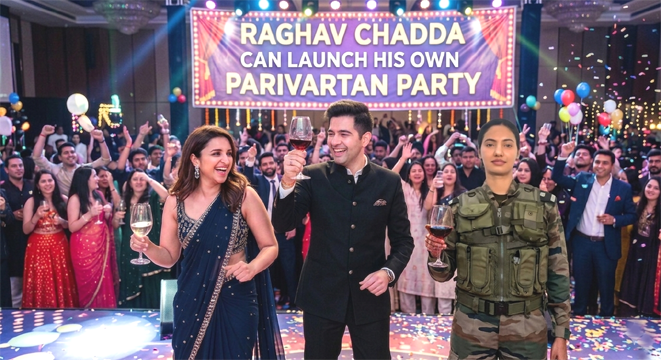
One of the most intriguing aspects of Chaddha’s strategy is the possibility that it could eventually support an independent political venture. By building a strong personal brand, he creates a foundation that could be leveraged to launch a new political entity if circumstances demand it. While such a move would involve significant challenges, including organizational development and resource mobilization, the existence of a loyal and engaged following would provide a valuable starting point.
The involvement of Parineeti Chopra in this context adds another dimension. Celebrity influence can play a crucial role in attracting attention and generating initial momentum for new initiatives. While political success ultimately depends on policy, governance, and credibility, the ability to capture public imagination is an important first step. In this regard, the combined visibility of Chaddha and Chopra could prove to be a powerful asset.
However, it is important to note that the transition from personal branding to political organization is not straightforward. Building a party requires not only public support but also a robust infrastructure, clear ideology, and effective leadership at multiple levels. While Chaddha’s brand may provide a strong foundation, the success of any independent venture would depend on his ability to translate this brand into a cohesive and sustainable political movement.
The contrasting trajectory of Arvind Kejriwal
In contrast to Chaddha’s rising personal brand, the trajectory of Arvind Kejriwal presents a different narrative. As one of the founding figures of contemporary Indian political disruption, Kejriwal initially built his reputation on anti-corruption activism and grassroots mobilization. His early success was driven by a combination of public dissatisfaction with existing political structures and his ability to articulate an alternative vision.
Over time, however, maintaining and expanding this brand has proven to be a complex challenge. Political leadership at the highest levels involves navigating a wide range of issues, including governance, policy implementation, and public perception. Each of these factors can influence brand equity, sometimes in unpredictable ways.
The perception of consistency and credibility plays a crucial role in shaping public trust. When leaders are seen as aligning their actions with their stated principles, their brand tends to strengthen. Conversely, any perceived gaps between rhetoric and reality can lead to erosion of trust. In the case of Kejriwal, the demands of governance and the pressures of political competition have created situations where maintaining this alignment becomes increasingly difficult.
This dynamic highlights the broader challenge of sustaining political brand equity over time. While it is possible to build a strong initial following, maintaining that support requires continuous engagement, effective communication, and tangible results. Leaders must adapt to changing circumstances while remaining true to their core values—a balancing act that is often easier said than done.
The interplay of perception, performance, and power
The comparison between Chaddha and Kejriwal underscores the importance of perception in politics. While performance and policy outcomes are critical, the way these elements are communicated and perceived by the public can significantly influence political fortunes. In many cases, perception can amplify or diminish the impact of actual achievements.
For Chaddha, the focus on communication and branding ensures that his actions are consistently framed in a positive light. By proactively shaping narratives, he can influence how his performance is interpreted by the public. This proactive approach contrasts with a more reactive style of communication, where leaders respond to events rather than shaping them.
At the same time, it is important to recognize that branding alone cannot sustain political success indefinitely. Ultimately, leaders are judged by their ability to deliver results. While a strong brand can create opportunities and enhance visibility, it must be supported by effective governance and meaningful contributions to public welfare.
The interplay between perception and performance also extends to power dynamics within political organizations. Leaders with strong personal brands often have greater leverage in decision-making processes, as their popularity can translate into electoral advantage. This leverage can influence party strategies, candidate selection, and policy priorities.
The future of political leadership in a digital age
Looking ahead, the trajectory of leaders like Raghav Chaddha offers insights into the future of political leadership in India. As digital platforms continue to evolve, the importance of personal branding is likely to increase. Leaders who can effectively combine policy expertise with communication skills will be better positioned to navigate this landscape.
At the same time, the expectations of the electorate are also changing. Voters are increasingly seeking transparency, accountability, and direct engagement from their leaders. This shift creates both opportunities and challenges. While it allows leaders to build closer connections with constituents, it also requires a higher level of responsiveness and consistency.
In this context, Chaddha’s strategy appears to align well with emerging trends. By investing in his personal brand, leveraging digital platforms, and maintaining a focus on communication, he positions himself as a leader who understands the dynamics of modern राजनीति. Whether this strategy will translate into long-term political success remains to be seen, but it undoubtedly provides a strong foundation.
Ultimately, the evolution of political branding reflects a broader transformation in the relationship between leaders and the public. As the boundaries between politics, media, and entertainment continue to blur, the ability to navigate these intersections will become an increasingly important skill. Leaders who can do so effectively will not only shape their own careers but also influence the direction of political discourse in the years to come.