
Unlike the towering personas of mainstream stars, Rakesh Bedi represented the everyday man, the friend next door, the slightly goofy but lovable companion. Audiences saw themselves in him, and that identification translated into genuine affection. His comic timing, natural delivery, and ability to blend into the narrative without overshadowing it made him an integral part of the film’s success
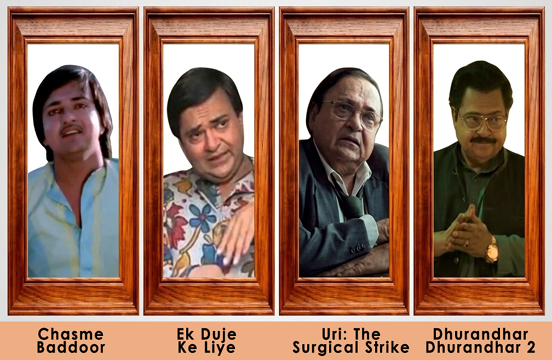
The story of Rakesh Bedi offers a fascinating lens through which to understand the complex relationship between popularity, audience perception, and cinematic credit in Indian cinema. It is a story about one actor’s journey, about how the film industry, and more importantly, its audience, assigns value, recognition, and memory. The contrast between Bedi’s breakout success in Chashme Buddoor and his minor presence in Ek Duuje Ke Liye reveals a deeper truth: success in cinema is not merely about being present in a hit film, but about being meaningfully remembered in it.
By the early 1980s, Hindi cinema was undergoing a transition. The dominance of larger-than-life heroes was being complemented, if not challenged, by a wave of middle-class storytelling that focused on relatability, humor, and slice-of-life narratives. It was in this milieu that Sai Paranjpye crafted Chashme Buddoor, a film that would go on to become a cult classic. Released on May 8, 1981, it was not a conventional blockbuster in the commercial sense, but its impact on audiences was profound and enduring.
For Rakesh Bedi, Chashme Buddoor was a defining moment. His portrayal of Omi, one of the three friends navigating the humorous and often awkward terrain of young adulthood, struck a chord with audiences. Alongside actors like Farooq Shaikh and Ravi Vaswani, Bedi became part of an ensemble that felt real, unpretentious, and deeply relatable.
This relatability was key to his popularity. Unlike the towering personas of mainstream stars, Bedi represented the everyday man, the friend next door, the slightly goofy but lovable companion. Audiences saw themselves in him, and that identification translated into genuine affection. His comic timing, natural delivery, and ability to blend into the narrative without overshadowing it made him an integral part of the film’s success.
The rise of a relatable star
What made Chashme Buddoor particularly significant was that it created stars out of its ensemble rather than relying on pre-existing stardom. Rakesh Bedi’s popularity after the film was not manufactured through marketing or hype; it was organic, born out of audience connection. This kind of popularity is rare and often more durable than the fleeting fame associated with big-budget spectacles.
In contrast, Ek Duuje Ke Liye, also released in 1981, was a massive commercial success. Directed by K. Balachander and starring Kamal Haasan and Rati Agnihotri, the film became a cultural phenomenon. Its tragic love story resonated deeply with audiences across the country, and its music further amplified its reach.
Rakesh Bedi had a role in this film as well, but it was a minor one, a fleeting presence in a narrative dominated by its lead pair. Despite the film’s enormous success, Bedi did not gain significant recognition from it. The audience, while celebrating the film, did not associate its success with him.
This discrepancy highlights a crucial aspect of cinematic fame: visibility does not automatically translate into recognition. An actor may be part of a blockbuster, but unless their role leaves a lasting impression, they remain peripheral in the audience’s memory.
The illusion of shared success
The tendency to conflate a film’s success with the success of everyone involved in it is a common misconception. While it is true that a hit film can elevate the careers of its cast and crew, this effect is not uniform. In the case of Ek Duuje Ke Liye, the spotlight was firmly on its lead actors and its emotionally charged narrative. Supporting and minor roles, no matter how well performed, were overshadowed.
Rakesh Bedi himself has often pointed out that Ek Duuje Ke Liye was a bigger superhit than other films of that period. From a purely commercial standpoint, this is accurate. However, the question is not about the film’s success, but about the distribution of credit within that success.
Audiences do not engage with films as comprehensive analyses of every performance. Instead, they latch onto characters and moments that resonate with them. In Chashme Buddoor, Bedi’s character was central to the narrative’s humor and charm. In Ek Duuje Ke Liye, his presence, though part of the film, did not occupy a similar emotional or narrative space.
This difference underscores the idea that cinematic credit is selective and subjective. It is shaped by the audience’s emotional engagement rather than the objective contribution of each actor.
The anatomy of audience memory
To understand why Rakesh Bedi’s popularity soared after Chashme Buddoor but not after Ek Duuje Ke Liye, one must examine how audience memory works. Memory in cinema is not a faithful record of all that is seen; it is a curated collection of what is felt.
In Chashme Buddoor, Bedi’s character was a constant presence, contributing to the film’s humor and emotional texture. His interactions, expressions, and timing created moments that audiences remembered long after the film ended. These moments became part of the collective cultural memory associated with the film.
In contrast, Ek Duuje Ke Liye was driven by its central love story. The emotional intensity of the narrative left little room for peripheral characters to make a lasting impact. As a result, even though Bedi was part of the film, he was not part of its enduring memory.
This phenomenon is not unique to Rakesh Bedi. It is a recurring pattern in cinema worldwide. Actors who play minor roles in major films often find themselves unrecognized, while those who shine in smaller, character-driven films achieve lasting fame.
Stardom beyond box office numbers
The comparison between these two films also challenges the conventional metrics of success in the film industry. Box office numbers, while important, do not fully capture the essence of an actor’s impact. True stardom is about being remembered, celebrated, and associated with that film in a meaningful way.
Rakesh Bedi’s career illustrates this distinction beautifully. His popularity after Chashme Buddoor was not tied to the film’s commercial performance alone. It was rooted in the audience’s affection for his character and their appreciation of his performance.
This kind of stardom is more personal and more enduring. It is built on connection rather than spectacle, on relatability rather than grandeur. It is the kind of stardom that allows an actor to remain relevant and beloved even as trends in the industry change.
The role of narrative centrality
One of the key factors that determine whether an actor receives credit for a film’s success is narrative centrality. In simple terms, this refers to how central a character is to the story being told.
In Chashme Buddoor, Rakesh Bedi’s character was integral to the narrative. The film revolved around the lives and interactions of the three friends, making each of them essential to the story. This centrality ensured that audiences paid attention to Bedi’s performance and remembered it.
In Ek Duuje Ke Liye, the narrative was tightly focused on the lead pair. Supporting characters, including Bedi’s, existed primarily to serve the central storyline. As a result, they did not receive the same level of attention or recognition.
This distinction highlights the importance of choosing roles that offer visibility and also significance. For actors, especially those not playing lead roles, the challenge is to find characters that allow them to make a meaningful impact within the narrative.
The paradox of actor perception
There is also an interesting paradox in how actors perceive their own careers versus how audiences perceive them. From an actor’s perspective, being part of a major hit like Ek Duuje Ke Liye is undoubtedly significant. It represents professional success and association with a landmark film.
However, from the audience’s perspective, the significance of that association depends on the visibility and impact of the actor’s role. This disconnect can lead to differing interpretations of what constitutes a “big” film in an actor’s career.
Rakesh Bedi’s references to Ek Duuje Ke Liye as a bigger superhit reflect this professional perspective. Yet, for audiences, his defining moment remains Chashme Buddoor, where his contribution was both visible and memorable.
The enduring legacy of chashme buddoor
Decades after its release, Chashme Buddoor continues to be celebrated as a classic of Hindi cinema. Its charm lies in its simplicity, its humor, and its authentic portrayal of middle-class life. For Rakesh Bedi, the film remains a cornerstone of his legacy.
The affection that audiences continue to feel for his character is a testament to the power of meaningful storytelling and strong performances. It is also a reminder that true success in cinema is not measured solely by box office numbers, but by the lasting impact on audiences.
In the end, the story of Rakesh Bedi is a story about the nuances of fame and recognition. It challenges the simplistic equation of success with popularity and highlights the importance of narrative significance and audience connection.
While Ek Duuje Ke Liye may have been a bigger commercial success, it is Chashme Buddoor that defined Rakesh Bedi’s place in the hearts of audiences. And in the world of cinema, that kind of enduring affection is perhaps the greatest success of all.