
Indian Home Minister, Amit Shah, wants to introduce crocodiles and river snakes in rivers on Indo-Bangla border, wherever it cannot be concertina fenced, but how will river snakes deter poisonous illegal immigrant snakes from Bangladesh? They can even feed one wife, (the oldest and ugliest) to the crocodiles, so that they can cross with the other three and re-marry in India
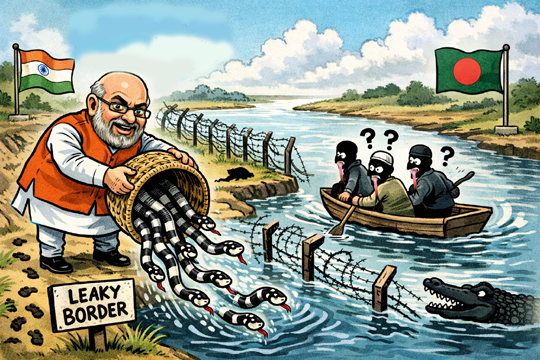
The idea attributed to Indian Home Minister Amit Shah of introducing crocodiles and river snakes into rivers along the Indo–Bangladesh border where physical barriers like concertina fencing are difficult to deploy immediately captures attention because of its stark imagery and unconventional nature. It reflects a broader frustration with the persistent challenges of securing a long, porous, and geographically complex border that stretches across plains, wetlands, and an intricate network of rivers. However, beyond its shock value, the proposal raises serious questions about practicality, legality, ethics, environmental impact, and long-term effectiveness. More importantly, it invites deeper reflection on the nature of border management in regions where human movement, ecology, and livelihoods are deeply intertwined.
The Indo–Bangladesh border, extending over 4,000 kilometers, is one of the most densely populated and dynamic border regions in the world. Unlike high-altitude or desert borders where natural barriers limit movement, this border cuts across villages, farmlands, and rivers that are shared ecosystems rather than rigid dividing lines. In many stretches, especially in West Bengal and Assam, rivers change course frequently due to monsoon flooding, erosion, and sediment deposition. This makes it difficult to erect and maintain permanent fencing. Even where fences exist, they are often set back from the actual boundary line due to geographical constraints, leaving gaps that are vulnerable to unauthorized crossings.
In this context, the suggestion to use natural predators as a deterrent seems to stem from the idea of leveraging the environment itself as a security mechanism. Yet, the metaphor embedded in the question—how river snakes would deter “poisonous illegal immigrant snakes”—highlights a deeper irony. Human challenges cannot be resolved through simplistic analogies drawn from the animal kingdom. People are not deterred by the same instincts that govern wildlife. Migration, whether legal or illegal, is driven by economic need, social networks, political pressures, and sometimes desperation. Addressing it requires a nuanced understanding of these drivers rather than symbolic gestures.
The geography and complexity of the Indo–Bangladesh border
To understand why unconventional ideas occasionally surface in discussions about this border, one must appreciate its unique geography. Large portions of the boundary run through riverine areas such as the Brahmaputra basin and the Sundarbans delta. These regions are characterized by shifting channels, seasonal flooding, and fragile ecosystems. The Sundarbans, in particular, is a vast mangrove forest shared by India and Bangladesh, home to diverse wildlife including the Bengal tiger, saltwater crocodiles, and numerous species of fish and birds.
In such areas, constructing traditional fencing is either technically unfeasible or environmentally damaging. Floating barriers, surveillance boats, and patrol units are often used, but these require constant monitoring and significant resources. Moreover, the livelihoods of local populations—fishing, farming, and small-scale trade—depend on access to these waters. Any attempt to militarize the environment too aggressively risks disrupting these livelihoods and creating resentment among border communities.
The introduction of crocodiles or snakes into these ecosystems would not occur in a vacuum. These species already exist in certain parts of the region, particularly in the Sundarbans. However, artificially increasing their population or relocating them to specific areas for security purposes would raise ecological concerns. Predators play a delicate role in maintaining the balance of ecosystems. Altering their distribution could have unintended consequences, such as increased attacks on local residents or disruptions to existing food chains.
Furthermore, rivers are not static barriers. They are fluid, interconnected systems. Crocodiles and snakes do not recognize political boundaries; they move according to ecological conditions. Attempting to use them as “living barriers” assumes a level of control over nature that is neither realistic nor sustainable. It also ignores the fact that such measures could pose risks to Indian citizens living near these rivers, potentially creating new problems rather than solving existing ones.
Security concerns and the narrative of infiltration
The idea of deterrence through natural predators also reflects broader anxieties about illegal immigration and cross-border infiltration. These concerns are not new. For decades, political discourse in parts of India has focused on the movement of people across the Bangladesh border, often framing it as a threat to national security, economic stability, or cultural identity. While there have been documented cases of illegal crossings, the scale, nature, and impact of such movements are frequently debated among policymakers, scholars, and civil society groups.
It is important to distinguish between different types of cross-border movement. Some individuals may cross the border in search of work, driven by economic disparities between regions. Others may be involved in smuggling goods such as cattle, textiles, or contraband. There are also cases of trafficking, which involve serious human rights violations. Each of these issues requires targeted interventions, ranging from economic development and legal migration pathways to law enforcement and international cooperation.
Reducing these complex phenomena to a simplistic narrative of “poisonous snakes” risks dehumanizing individuals and obscuring the underlying causes of migration. It also diverts attention from more effective and humane solutions. Border security is not just about preventing movement; it is about managing it in a way that balances national interests with human rights and regional stability.
From a strategic perspective, deterrence works best when it is predictable, controlled, and aligned with legal frameworks. The use of animals as a deterrent introduces unpredictability and raises ethical questions. For instance, if a person is harmed by a crocodile in a border river, who bears responsibility? How would such incidents be investigated and addressed? These are not merely theoretical concerns; they have real implications for governance and accountability.
Environmental and ethical implications of using wildlife as deterrents
The environmental dimension of this proposal cannot be overlooked. The Indo–Bangladesh border regions include some of the most ecologically sensitive areas in South Asia. The Sundarbans, for example, is a UNESCO World Heritage Site and a critical buffer against cyclones and rising sea levels. Any intervention that alters the balance of this ecosystem must be carefully evaluated.
Introducing or concentrating predators in specific areas could disrupt existing ecological relationships. For instance, an increase in crocodile populations could affect fish stocks, which in turn would impact the livelihoods of fishermen. Similarly, the presence of more snakes could alter the balance of smaller animal populations. These changes could ripple through the ecosystem in ways that are difficult to predict.
There are also ethical considerations related to animal welfare. Using animals as tools of deterrence raises questions about their treatment and the intent behind their deployment. Wildlife conservation efforts typically focus on protecting species and their habitats, not using them as instruments of policy. Blurring this line could set a problematic precedent.
Moreover, the safety of local communities must be a priority. People living along the border already face challenges such as flooding, erosion, and limited access to services. Adding the risk of increased encounters with dangerous wildlife could exacerbate their vulnerability. In many cases, these communities have little say in policy decisions that directly affect their lives, making it essential to consider their perspectives and rights.
Alternative approaches to riverine border management
Given the limitations and risks associated with unconventional ideas like using crocodiles and snakes, it is worth exploring more practical and sustainable approaches to managing riverine borders. Advances in technology offer several promising solutions. Surveillance systems such as drones, thermal imaging cameras, and radar can monitor large areas with relatively low environmental impact. These tools can detect movement in real time and enable rapid response by security forces.
Floating border outposts and patrol boats are already used in some areas and can be expanded and modernized. These platforms allow for continuous presence in riverine zones and can be equipped with communication and surveillance equipment. Collaboration with local communities is also crucial. Residents often have intimate knowledge of the terrain and can provide valuable information about unusual activities. Building trust and ensuring that communities benefit from security measures can enhance their effectiveness.
On the diplomatic front, cooperation between India and Bangladesh has improved significantly in recent years. Joint border management initiatives, information sharing, and coordinated patrols can help address cross-border issues more effectively than unilateral measures. Both countries have a shared interest in maintaining stability and preventing illegal activities along their border.
Economic development in border regions is another key factor. When local populations have access to livelihoods, education, and services, the incentives for illegal activities decrease. Investments in infrastructure, such as roads, schools, and healthcare facilities, can improve living standards and reduce the appeal of cross-border migration driven by necessity.
Legal migration frameworks can also play a role. By creating regulated pathways for labor movement, governments can reduce the incentives for illegal crossings while meeting economic needs. This approach requires careful planning and bilateral agreements but offers a more humane and sustainable solution.
The role of rhetoric in shaping policy debates
The imagery of crocodiles and snakes also highlights the role of rhetoric in political discourse. Strong, vivid statements can capture public attention and signal a tough stance on security issues. However, they can also oversimplify complex problems and create unrealistic expectations. Policymaking requires moving beyond rhetoric to develop solutions that are grounded in evidence, feasibility, and respect for legal and ethical norms.
In democratic societies, public debate is an essential part of the policymaking process. Proposals, even unconventional ones, can serve as starting points for discussion. They can draw attention to neglected issues or highlight the urgency of certain challenges. However, it is important that such discussions are informed by facts and consider the broader implications of proposed measures.
Media coverage and public perception also play a role in shaping these debates. Sensational ideas tend to attract more attention, but they do not always translate into effective policy. It is the responsibility of policymakers, experts, and civil society to critically evaluate such ideas and ensure that decisions are based on sound reasoning.
Balancing security, humanity, and sustainability
Ultimately, the question of how to secure the Indo–Bangladesh border, particularly in riverine areas, is not just a technical challenge but a moral and strategic one. It requires balancing the legitimate need for national security with the rights and well-being of individuals and communities. It also demands an understanding of the interconnectedness of human and natural systems.
Using wildlife as a deterrent may appear innovative on the surface, but it does not address the root causes of cross-border movement or the practical realities of border management. Instead, it risks creating new problems while diverting attention from more effective solutions.
A comprehensive approach to border security should include a combination of technology, infrastructure, diplomacy, and community engagement. It should be flexible enough to adapt to changing conditions, such as shifting river courses and evolving migration patterns. Most importantly, it should be guided by principles of humanity, legality, and environmental stewardship.
The metaphor of “snakes” on both sides of the border underscores the dangers of dehumanizing language. People crossing borders, regardless of their legal status, are human beings with stories, motivations, and challenges. Addressing migration issues requires empathy as well as enforcement. It involves creating conditions where people do not feel compelled to move illegally and ensuring that those who do are treated with dignity and fairness.
In conclusion, while the idea of deploying crocodiles and river snakes as border guards may capture the imagination, it is neither a practical nor a responsible solution. The complexities of the Indo–Bangladesh border demand thoughtful, multi-dimensional strategies that respect both human and environmental realities. By focusing on sustainable and humane approaches, policymakers can work towards a border management system that is effective, just, and resilient in the face of ongoing challenges.