What brand of weed does the roster guy at Air India smoke? Will Air India compensate its customers for the waste of time in that joyride? One of the biggest mysteries in life is that why does Air India still exist and why do people still buy Air India tickets?
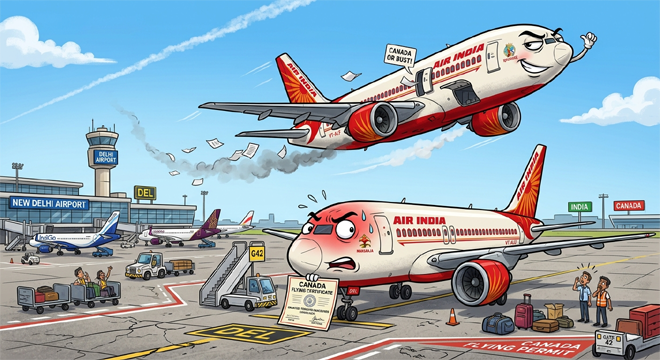
There are moments in life when you check your pockets, pat yourself down, and realise you’ve left your wallet at home. Mild inconvenience. Then there are moments when you drive halfway to a wedding before realising you’re in the wrong car. Mild embarrassment. And then, towering above these everyday human errors like a majestic, fuel-burning monument to bureaucratic chaos, comes the recent episode involving Air India, which managed to take off for Canada in the wrong aircraft and only realised it somewhere over China.
Yes, you read that correctly. Not the wrong gate. Not the wrong meal. Not even the wrong movie selection. The wrong plane. This is not merely a logistical hiccup. This is not a “we forgot to pack extra peanuts” situation. This is the aviation equivalent of showing up to your in-laws’ house in a tractor when you were supposed to arrive in a sedan, and then discovering this only after crossing state lines. Somewhere in the heavens, the ghost of common sense quietly packed its bags and asked for an aisle seat far away from this situation.
Boarding pass: destiny. Aircraft: not approved
The story begins innocently enough. Passengers boarded Flight AI185 in Delhi, presumably excited about long-haul travel, duty-free shopping fantasies, and the comforting thought that their biggest problem would be whether to watch two movies or three. The aircraft in question was a Boeing 777-200LR, a perfectly respectable, long-range machine capable of flying across continents. No complaints there. Except for one tiny, almost comically crucial detail: it was not approved to operate this particular route to Canada. The route required a different aircraft: the Boeing 777-300ER.
Now, for the uninitiated, this might sound like arguing over whether to bring a blue pen or a black pen to an exam. But in aviation, this is less “pen colour” and more “you brought a spoon to a sword fight.” Different aircraft types require specific regulatory approvals depending on the destination country, the airline’s certifications, and sometimes even the individual aircraft’s paperwork. In other words, this is not optional reading. This is the exam.
Seven hours into enlightenment
The flight took off at 11:34 am from Delhi. Everything was going smoothly. Seatbelt signs dinged off. Meals were served. Passengers reclined into that uniquely uncomfortable position known as “long-haul optimism.” The aircraft cruised eastward, slicing through the skies like a confident student who has absolutely not studied for the test. And then, about four hours in, somewhere near Kunming, deep inside Chinese airspace, someone, somewhere, presumably looked at a screen, squinted, and said something along the lines of:
“Wait a minute… are we… allowed to be doing this?”
You can almost picture the scene. A spreadsheet. A checklist. A sudden silence. The slow, creeping horror of realisation. The collective intake of breath.
And then the inevitable conclusion:
“Oh no.”
The world’s most expensive U-turn
At this point, the aircraft had two options: continue forward and hope Canada would appreciate the bold improvisation or turn back like a teenager caught sneaking out after curfew.
They chose the latter.
And so began the aviation equivalent of a sheepish retreat. The plane turned around mid-air and headed back to Delhi, completing a grand total of nearly eight hours in the sky, only to land exactly where it had started.
This was not a journey. This was a very elaborate loop.
Passengers who had mentally arrived in Vancouver found themselves instead arriving back in Delhi, possibly questioning not just their travel plans but the very nature of reality itself.
The silent hero: fuel, burning steadily
Let us take a moment to appreciate the unsung protagonist of this story: aviation fuel.
A Boeing 777 typically burns about eight to nine tonnes of fuel per hour. Multiply that by nearly eight hours, and you have a quantity of fuel that could power a small town, or at least several thousand frustrated tweets.
This was not just a logistical misstep. This was a high-altitude bonfire of operational efficiency.
Somewhere, a fuel accountant gently fainted.
The statement that said everything yet nothing
In the aftermath, Air India issued a statement citing an “operational issue.”
Now, “operational issue” is one of those phrases that does an incredible amount of work while saying almost nothing. It’s the corporate equivalent of “things happened.”
It covers everything from “we misplaced a spoon” to “we accidentally flew the wrong aircraft halfway across Asia.”
Passengers were assured that the aircraft landed safely. Which, to be fair, is the one part of this entire saga that absolutely had to go right.
Enter the watchdog
Naturally, the Directorate General of Civil Aviation stepped in.
The DGCA asked for corrective measures. This is regulatory language for “please ensure you do not do this again,” delivered with the calm restraint of someone who has seen things.
Action was reportedly taken against an airline official. One can only imagine the conversation:
“So, tell us about your week.”
“Well, I accidentally sent a plane to Canada that wasn’t allowed to go to Canada.”
“Ah.”
The roster guy and his mysterious inspiration
Now we arrive at the most pressing philosophical question of our time: what exactly happened inside the airline’s planning and rostering systems?
Because this is not a single-point failure. This is a symphony of oversights. A chorus of missed checks. A full orchestra of “how did nobody notice this?”
Somewhere along the chain, a decision was made. Or perhaps not made. A box was not ticked. A list was not updated. A system did not scream loudly enough.
And thus was born one of the most spectacularly avoidable aviation bloopers in recent memory.
Passengers: the real frequent flyers of irony
Let us not forget the passengers, the involuntary participants in this airborne comedy.
They boarded a flight to Vancouver and instead got:
- Eight hours of flying
- Zero kilometres of progress
- A story they will tell at every social gathering for the rest of their lives
“Yeah, I once flew to China and back without getting off the plane.”
There is a certain dark humour in this. A kind of cosmic joke. A reminder that even in an age of precision technology and global connectivity, humans remain gloriously, stubbornly fallible.
Customer service: damage control at 30,000 feet
To its credit, the airline arranged accommodations, rebooked passengers, and eventually sent them on their way the next day.
But let’s be honest: no amount of hotel vouchers can quite compensate for the experience of flying for eight hours and ending up exactly where you started.
This is not a delay. This is existential.
The broader lesson: systems, not just people
It’s easy to laugh, and we should, because this is objectively hilarious, but there’s also a serious point buried beneath the humour.
Modern aviation is built on layers upon layers of checks, approvals, and redundancies. When something like this happens, it’s rarely just one person’s mistake. It’s a systems failure.
A missing update. A miscommunication. A gap between departments. A checklist that didn’t catch what it was supposed to catch.
In other words, this is what happens when complexity meets complacency.
A uniquely modern kind of absurdity
There is something profoundly modern about this incident. It could not have happened in the early days of aviation, when everything was simpler and less regulated.
Today, aircraft are marvels of engineering, capable of flying halfway around the world with astonishing precision. And yet, the decision about which aircraft to use still depends on humans, and the systems they build.
Which means that, occasionally, you get a situation where a plane is perfectly capable of making the journey… but is not allowed to.
And nobody realises this until it’s already halfway there.
The comedy of competence
What makes this story so compelling is not just the mistake, but the scale of competence surrounding it.
The aircraft flew flawlessly. The crew operated professionally. Air traffic control coordinated seamlessly across international boundaries.
Everything worked, except the one thing that mattered.
It’s like watching a perfectly choreographed dance where one dancer is accidentally on the wrong stage.
Will passengers be compensated?
This is the million-rupee question.
Airlines typically offer compensation depending on the circumstances, regulations, and internal policies. In this case, passengers received accommodations and were rebooked.
But whether that fully compensates for lost time, disrupted plans, and the psychological impact of an eight-hour non-journey is another matter entirely.
Time, after all, is the one thing you can’t refund.
The legacy of Flight AI185
Every industry has its stories. The moments that become legends. The cautionary tales whispered in training sessions and boardrooms.
Flight AI185 is destined to become one of those stories.
Not because anything catastrophic happened, thankfully, it didn’t, but because it represents a perfect storm of human error, systemic oversight, and sheer improbability.
It is the kind of story that makes you laugh, shake your head, and double-check your own work just a little more carefully.
Final boarding call for common sense
In the end, this episode is a reminder of something deeply human: we are capable of extraordinary things, and equally extraordinary mistakes.
We can build aircraft that cross oceans with ease. We can coordinate global air traffic with breathtaking precision.
And yet, sometimes, we still manage to take off in the wrong plane.
So the next time you misplace your keys or send an email to the wrong person, take heart. At least you didn’t fly seven hours in the wrong aircraft.
Unless, of course, you were on that flight.
In which case, welcome back to Delhi. Hope you enjoyed the scenic route.