
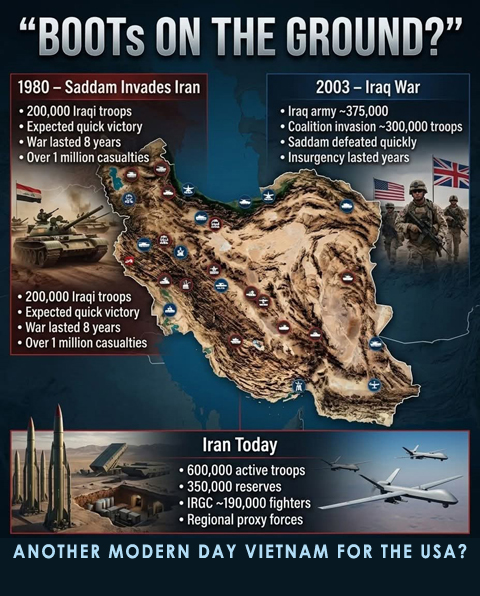
Iran is not a small or fragile state that can be easily overwhelmed through conventional force. Its military structure alone presents a formidable challenge. With approximately 600,000 active personnel and an additional 350,000 reserves, Iran possesses nearly a million trained individuals before accounting for auxiliary forces and militias. This scale matters because modern warfare, particularly ground warfare, is as much about endurance and manpower as it is about technology
The phrase “boots on the ground” has a seductive simplicity. It sounds decisive, forceful, almost reassuring in its clarity. When people say it, they often mean that the only way to resolve a conflict is through direct, overwhelming military force, soldiers physically occupying territory, controlling cities, and dismantling an adversary’s capacity to resist. Yet beneath that seemingly straightforward idea lies one of the most complex, dangerous, and unpredictable undertakings in modern geopolitics. Calls for a ground invasion of Iran, delivered casually in public discourse, reveal a profound underestimation of both the scale of the challenge and the consequences that would follow.
The reality is that a full-scale invasion of Iran would not resemble a swift campaign or a limited intervention. It would be one of the largest and most intricate military operations attempted in the contemporary era, involving vast troop deployments, extended supply lines, and a confrontation with a state that has spent decades preparing precisely for such a scenario. To understand what “boots on the ground” would actually entail, one must move beyond rhetoric and examine the hard realities of military capacity, geography, history, and strategy.
The scale of Iran’s military machine
Iran is not a small or fragile state that can be easily overwhelmed through conventional force. Its military structure alone presents a formidable challenge. With approximately 600,000 active personnel and an additional 350,000 reserves, Iran possesses nearly a million trained individuals before accounting for auxiliary forces and militias. This scale matters because modern warfare, particularly ground warfare, is as much about endurance and manpower as it is about technology.
Unlike smaller states that rely heavily on external support, Iran has built a self-reliant defense posture. Its forces are dispersed, layered, and designed to absorb and respond to sustained attacks. A ground invasion would not face a single, unified front that collapses upon initial impact; instead, it would encounter multiple defensive lines, regional commands, and decentralized resistance networks.
Any invading force would need to match or exceed this scale, not just in initial deployment but over time. Occupation, stabilization, and counterinsurgency would require continuous troop presence, potentially stretching into the hundreds of thousands for years. The logistical burden alone, fuel, food, ammunition, medical support, equipment maintenance, would be staggering.
The parallel army: a state within a state
Compounding the challenge is the existence of Iran’s parallel military structure: the Islamic Revolutionary Guard Corps (IRGC). With an estimated 190,000 personnel, the IRGC operates independently of the regular armed forces and is deeply embedded in the country’s political, economic, and security architecture.
This is not merely an auxiliary force. The IRGC maintains its own naval units, missile systems, drone capabilities, and elite expeditionary formations. It has spent decades refining asymmetric warfare tactics, strategies specifically designed to counter technologically superior adversaries. These include guerrilla warfare, cyber operations, proxy networks, and unconventional naval tactics.
The IRGC’s Quds Force, in particular, extends Iran’s strategic reach beyond its borders, building alliances and influence across the region. In the event of an invasion, these networks could activate simultaneously, turning a localized conflict into a broader regional confrontation. This would stretch any invading force thin, forcing it to manage multiple fronts and threats simultaneously.
Geography as a force multiplier
Iran’s geography is one of its greatest defensive assets. The country’s terrain is vast and varied, consisting of rugged mountains, expansive deserts, dense urban centers, and narrow chokepoints. Unlike relatively flat or easily navigable regions, Iran’s landscape naturally complicates large-scale military movements.
Mountain ranges provide ideal conditions for defensive warfare, allowing smaller units to hold off larger forces. Urban areas, with their dense populations and complex infrastructure, can become prolonged battlegrounds where conventional advantages are diminished. Deserts, while open, pose logistical challenges related to supply lines and environmental conditions.
In addition, Iran has invested heavily in underground infrastructure, including missile bases and storage facilities. These hardened sites are designed to survive aerial bombardment and remain operational even under sustained attack. This means that air superiority, often seen as a decisive factor in modern warfare, would not guarantee the neutralization of Iran’s capabilities.
Lessons from history
History offers sobering insights into the risks of underestimating such a conflict. In 1980 Saddam Hussein invaded Iran with approximately 200,000 troops, supported by tanks and artillery. The expectation was a swift victory, capitalizing on perceived instability within Iran following its revolution.
Instead, the conflict devolved into an eight-year war of attrition. Casualties exceeded one million, and neither side achieved a decisive victory. Iran, despite initial setbacks, demonstrated resilience, mobilizing its population and leveraging its terrain to resist a better-equipped adversary.
More recently, the 2003 invasion of Iraq provides another cautionary tale. Although coalition forces rapidly dismantled Saddam’s military, the aftermath proved far more complex. An insurgency emerged, lasting for years and destabilizing the region. The initial success of the invasion did not translate into long-term stability or strategic victory.
Iran presents an even more challenging scenario. Its population is larger, its military more robust, its terrain more difficult, and its strategic preparations more advanced. Any assumption of a quick or clean conflict would ignore these critical differences.
The complexity of modern warfare
Modern warfare is not defined solely by battlefield engagements. It encompasses economic disruption, cyber operations, information warfare, and global supply chain impacts. An invasion of Iran would trigger consequences far beyond the immediate theater of conflict.
One of the most significant factors is the Strait of Hormuz, a narrow waterway through which approximately 20 percent of the world’s oil supply passes. Iran has the capability to disrupt this chokepoint through mines, missiles, and small, fast-attack vessels. Even a partial closure would have immediate and severe effects on global energy markets.
Shipping insurance rates would skyrocket, tankers would avoid the region, and oil prices would surge. This would ripple through global economies, driving inflation, increasing transportation costs, and affecting everything from food prices to industrial production.
The limits of air power
There is a persistent belief that modern air power can neutralize an adversary before ground forces are even required. While air strikes can degrade military capabilities, they rarely eliminate them entirely, especially against a prepared and resilient opponent. Iran’s decentralized command structure and underground facilities are specifically designed to withstand such attacks. Even if key installations are destroyed, the country retains the ability to adapt and continue operations. Moreover, air campaigns often have unintended consequences, including civilian casualties and infrastructure damage, which can fuel resistance and prolong conflict. Without a ground component, air power alone cannot achieve lasting control. But introducing ground forces opens the door to the very complexities that make such operations so difficult to sustain.
The political dimension
War is not just a military endeavor; it is a political act with far-reaching implications. Decisions to invade are influenced by alliances, public opinion, and international law. In a hypothetical scenario where a major power initiates a conflict without broad consultation or support, it risks alienating its allies. Alliances are built on trust and shared interests. When those foundations are undermined, cooperation becomes more difficult. Requests for support, whether in the form of troops, naval assets, or logistical assistance, may be met with hesitation or outright refusal. This dynamic, highlights a critical aspect of modern conflict: no nation operates in isolation. Even the most powerful countries depend on networks of allies and partners. Straining those relationships can have long-term strategic consequences that extend beyond the immediate conflict.
The challenge of reopening global trade routes
Even after a successful initial campaign, the task of stabilizing critical infrastructure remains. Reopening a disrupted trade route like the Strait of Hormuz would require extensive naval operations, including mine clearance, convoy escorts, and continuous surveillance. These operations are resource-intensive and time-consuming. They also expose naval forces to ongoing threats from missiles, drones, and small craft. Ensuring the safe passage of commercial shipping would demand sustained international cooperation, something that cannot be assumed in a fractured geopolitical environment.
Economic shockwaves
The economic impact of such a conflict would not be confined to the Middle East. Countries around the world would feel the effects almost immediately. Energy-importing nations would face rising costs, while industries dependent on stable fuel supplies would struggle to maintain operations. Agriculture, manufacturing, transportation, and retail, all sectors that rely on fuel, would experience disruptions. Inflationary pressures would increase, potentially leading to higher interest rates and slower economic growth. In some regions, shortages could emerge, exacerbating social and political tensions. These consequences underscore the interconnected nature of the global economy. A conflict in one region can have cascading effects that reach every corner of the world.
The human cost
Amid discussions of strategy and logistics, it is essential not to lose sight of the human dimension. Ground wars are fought by individuals, soldiers and civilians alike, who bear the physical and psychological burdens of conflict. Casualties are an inevitable part of such operations. Beyond the immediate loss of life, there are long-term effects, including injuries, trauma, displacement, and the destruction of communities. Reconstruction efforts can take decades, and the scars of war often persist across generations. Understanding this reality is crucial when evaluating calls for military action. The decision to deploy “boots on the ground” is not just a strategic calculation; it is a commitment to a course of action with profound human consequences.
The myth of quick victories
One of the most persistent misconceptions about modern warfare is the idea that it can be resolved quickly through decisive action. While initial phases of a conflict may unfold rapidly, the aftermath often proves far more complex. Insurgencies, power vacuums, and regional instability can extend conflicts for years or even decades. The resources required to manage these challenges can exceed those needed for the initial invasion. Moreover, the political will to sustain such efforts may wane over time, leading to incomplete or unsatisfactory outcomes. Iran, with its size, population, and strategic depth, would likely present an even more prolonged and multifaceted challenge.
Strategic miscalculations
Misjudging an adversary’s intentions or resilience can have significant consequences. Assuming that economic incentives or limited concessions will alter a nation’s strategic posture may lead to flawed policies. Nations that perceive themselves to be under existential threat are unlikely to compromise easily. Their decisions are shaped by long-term considerations, historical experiences, and internal dynamics. Attempts to influence such actors through short-term measures may not achieve the desired results. This highlights the importance of understanding the broader context in which decisions are made. Simplistic approaches often fail to account for the complexities of international relations.
The fragility of alliances
Alliances are not static; they evolve based on shared interests and mutual trust. Actions that disregard the perspectives of partners can weaken these relationships, making future cooperation more difficult. In times of crisis, the ability to rely on allies can be a decisive factor. However, this requires consistent engagement, transparency, and respect for collective decision-making processes. When these elements are absent, alliances may falter, leaving nations to navigate challenges on their own.
A world watching closely
Global powers closely monitor such developments, assessing both the immediate situation and its broader implications. Strategic rivals may view divisions among alliances as opportunities to advance their own interests. This dynamic adds another layer of complexity to any potential conflict. It is not just about the immediate actors involved but also about how the situation reshapes the global balance of power.
Soldier feign illness; put their foot down
The call for “boots on the ground” in Iran is not a simple policy option; it is a proposal for a massive, high-risk undertaking with far-reaching consequences. It involves confronting a well-prepared adversary, navigating challenging terrain, managing complex logistics, and addressing the political, economic, and human dimensions of war.
History, geography, and strategy all point to the same conclusion: such an operation would be anything but quick or straightforward. It would demand sustained commitment, significant resources, and a willingness to accept uncertain outcomes.
In an interconnected world, the effects would extend far beyond the battlefield, influencing global markets, alliances, and the lives of millions. Recognizing this reality is essential for any meaningful discussion about the use of force.
Before invoking the phrase “boots on the ground,” it is worth asking whether the full scope of its implications is truly understood.

