
In cities like Mumbai or Delhi, rent or home loan EMIs can easily consume 30 to 50 percent of monthly income. Add to that the rising costs of education, healthcare, transportation, and lifestyle expectations, and the margin for savings shrinks dramatically
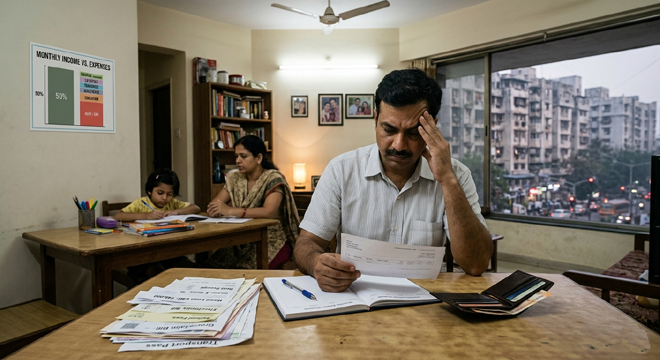
At first glance, being counted among the top 1 percent of income earners in India sounds like the ultimate financial milestone. It conjures images of luxury apartments, international vacations, financial security, and a life insulated from everyday economic anxieties. Yet, when one looks closely at the numbers and the lived realities behind them, a striking contradiction emerges. In India, being in the top 1 percent does not necessarily guarantee comfort, stability, or freedom from financial stress. In many cases, it barely ensures a middle-class existence in urban centers.
According to data highlighted by Finshots, the average income required to enter India’s top 1 percent is around ₹22 lakh per year. That translates to roughly ₹1.8 lakh per month. For many outside the country—or even within it—this might sound like a substantial income. But the context of where and how that income is earned changes everything.
This is the story of modern India’s economic paradox: a nation where statistical affluence often masks lived financial strain.
When ₹22 lakh a year doesn’t feel like enough
To understand the paradox, one must begin with a simple question: what does ₹22 lakh per year actually buy in India today?
In smaller towns or rural areas, such an income can indeed provide a comfortable life. Housing is affordable, daily expenses are manageable, and social expectations are relatively modest. But in India’s major metropolitan regions—Mumbai, Bengaluru, Delhi, and Gurgaon—the story is entirely different.
Consider housing alone. In cities like Mumbai or Delhi, rent or home loan EMIs can easily consume 30 to 50 percent of monthly income. Add to that the rising costs of education, healthcare, transportation, and lifestyle expectations, and the margin for savings shrinks dramatically.
A family earning ₹1.8 lakh per month might spend:
- ₹50,000–₹80,000 on housing
- ₹20,000–₹40,000 on children’s education
- ₹15,000–₹25,000 on groceries and essentials
- ₹10,000–₹20,000 on transport and fuel
- ₹10,000–₹30,000 on healthcare, insurance, and contingencies
What remains is often insufficient to build meaningful wealth, invest aggressively, or secure a stress-free future. The result is a constant balancing act—one that feels far removed from the idea of being “rich.”
The state-wise income divide, and the idea of multiple Indias
The ₹22 lakh figure is a national average, but averages can be deceptive in a country as diverse as India. The income threshold for entering the top 1 percent varies dramatically across states.
In wealthier, urbanized states and regions:
- Delhi: ~₹42 lakh
- Maharashtra: ~₹35 lakh
- Karnataka: ~₹32 lakh
- Gujarat: ~₹30 lakh
In less economically developed states:
- Bihar: ~₹13 lakh
- Assam: ~₹14 lakh
- Jharkhand: ~₹16 lakh
These variations reveal a deeper truth: India is not a single economic entity. It is a collection of vastly different economic ecosystems coexisting within one political boundary.
In Delhi, earning ₹22 lakh annually may not even place someone comfortably within the middle class. In Bihar, the same income could position a household among the economic elite. This disparity shapes everything—from consumption patterns to aspirations, from business models to political narratives.
The psychological burden of being “statistically rich”
One of the most overlooked aspects of this discussion is psychological. Being told you are in the top 1 percent creates an expectation—both internal and external—that you should be financially secure and prosperous.
But when reality does not match this expectation, it creates stress.
This manifests in several ways:
- Fear of job loss due to lack of financial cushion
- Anxiety about children’s education and future
- Pressure to maintain a certain lifestyle
- Guilt over not saving or investing enough
- Constant comparison with peers who seem more successful
In essence, the label of “top 1 percent” becomes meaningless when it does not translate into real financial freedom. Instead, it can amplify insecurity.
The vast income gap shaping Indian society
The data also highlights another stark reality: the enormous gap between the top earners and the rest of the population.
While someone earning ₹1.8 lakh per month is in the top 1 percent, millions of Indians still earn between ₹10,000 and ₹20,000 per month. For them, basic necessities—food, shelter, healthcare—remain daily struggles.
This gap is not just economic; it is experiential.
For one segment of society:
- Dining out, online shopping, and travel are routine
- Private education and healthcare are accessible
- Digital services and convenience define daily life
For another:
- Income is uncertain and often insufficient
- Public infrastructure is heavily relied upon
- Savings are minimal or non-existent
Understanding this divide is crucial for interpreting consumer behavior in India. It explains why luxury brands can thrive alongside ultra-low-cost products, why premium housing booms coexist with informal settlements, and why digital adoption varies so widely across regions.
Why chasing the top 1 percent may be the wrong goal
Given this context, aspiring merely to enter the top 1 percent income bracket may not be the most meaningful financial goal.
The number itself is arbitrary. It does not account for:
- Cost of living differences
- Family size and responsibilities
- Geographic location
- Lifestyle expectations
- Long-term financial security
More importantly, it does not guarantee what most people actually seek: peace of mind.
A more useful goal might be financial independence—the ability to meet expenses, save adequately, invest wisely, and withstand economic shocks without stress.
The rise of personal brands and independent income streams
This is where the narrative begins to shift. Increasingly, individuals in India are recognizing that relying solely on a salary—even a high one—is not enough.
The solution lies in diversification of income.
Personal brands and personal businesses are emerging as powerful tools for this purpose. Unlike traditional employment, they offer:
- Scalability
- Multiple revenue streams
- Greater control over income growth
- Reduced dependence on a single employer
Examples include:
- Content creation (YouTube, blogging, podcasts)
- Consulting and freelancing
- Online courses and digital products
- E-commerce ventures
- Coaching and mentorship
The digital economy has lowered barriers to entry, allowing individuals to monetize skills, knowledge, and creativity in ways that were not possible a decade ago.
The economics of leverage in a digital age
At the heart of this shift is the concept of leverage.
A salaried job typically offers linear income growth: more time equals more money. But personal brands and businesses introduce non-linear growth. A single piece of content, product, or service can generate income repeatedly without proportional increases in effort.
For example:
- A well-made online course can sell thousands of times
- A YouTube channel can generate recurring ad revenue
- A strong personal brand can attract high-value consulting opportunities
This leverage is what enables individuals to move beyond the limitations of fixed salaries.
Redefining what wealth means in modern India
The discussion ultimately leads to a broader question: what does it mean to be wealthy in India today?
Is it:
- Being in the top 1 percent by income?
- Owning assets and investments?
- Having freedom from financial stress?
- Living in a particular city or lifestyle bracket?
For many, true wealth is increasingly being defined not by income alone, but by a combination of factors:
- Financial security
- Time freedom
- Health and well-being
- Ability to pursue interests and passions
By this definition, someone earning less than ₹22 lakh per year but living in a low-cost environment with strong savings and minimal stress may be “wealthier” than someone earning more but constantly anxious about finances.
The role of inflation and lifestyle creep
Another factor complicating the picture is inflation—both economic and lifestyle-driven.
Economic inflation increases the cost of goods and services over time, eroding purchasing power. Lifestyle inflation, on the other hand, occurs when higher income leads to higher spending.
In urban India, lifestyle creep is particularly pronounced:
- Upgrading to larger homes
- Choosing premium schools
- Dining out more frequently
- Spending on gadgets, travel, and experiences
While these choices are not inherently negative, they can trap individuals in a cycle where increased income does not translate into increased savings or security.
Policy, perception, and the narrative gap
There is also a disconnect between policy narratives and lived realities.
When policymakers or commentators cite figures like ₹22 lakh as the threshold for the top 1 percent, it can create misleading perceptions about inequality and prosperity. It may suggest that a large segment of the population is doing well, when in reality, financial vulnerability remains widespread—even among higher earners.
This gap between perception and reality has implications for:
- Tax policy
- Welfare programs
- Economic planning
- Public discourse
A more nuanced understanding of income distribution and cost of living is essential for effective policymaking.
The opportunity hidden within inequality
While the income gap presents challenges, it also creates opportunities—particularly for entrepreneurs and businesses.
India’s multi-layered economy means there are markets at every price point:
- Ultra-affordable products for mass consumption
- Mid-range offerings for the growing middle class
- Premium and luxury segments for high-income consumers
Businesses that understand these segments can tailor their offerings effectively. For individuals, this means opportunities to build ventures that cater to specific niches.
For example:
- Affordable digital services for small-town users
- Premium experiences for urban professionals
- Educational products targeting aspirational youth
The diversity of the Indian market is both a challenge and an advantage.
Moving from income to assets
One of the key lessons from this discussion is the importance of shifting focus from income to assets.
Income is temporary; assets are enduring.
Assets can include:
- Real estate
- Equity investments
- Businesses
- Intellectual property
- Digital assets
Building assets creates long-term stability and reduces dependence on active income. It is this transition—from earning to owning—that ultimately defines financial success.
Looking beyond the top 1 percent
The idea that ₹22 lakh per year places someone in India’s top 1 percent is both surprising and revealing. It challenges assumptions about wealth and forces a re-evaluation of financial goals.
But the deeper insight is this: income alone is not a reliable indicator of well-being.
In a country as complex and diverse as India, financial reality is shaped by geography, lifestyle, expectations, and structural inequalities. Being in the top 1 percent may offer advantages, but it does not guarantee comfort or security.
The real path forward lies in:
- Building multiple income streams
- Leveraging digital opportunities
- Controlling lifestyle inflation
- Investing in assets
- Redefining wealth in personal terms
Ultimately, the goal should not be to chase a statistical label, but to create a life that is financially stable, personally fulfilling, and resilient to uncertainty.
Because in modern India, being “rich” on paper is easy. Feeling secure in real life is the true challenge.