
The underdog mythos is woven into the American self-conception. From frontier settlers to civil rights marchers, from small-town entrepreneurs to immigrant families, the country’s political rhetoric celebrates those who rise from obscurity to challenge concentrated power. Politicians across ideological lines have learned that victory often belongs to whoever most convincingly claims that mantle. Trump too was poised for the underdog but turned turtle when elected President
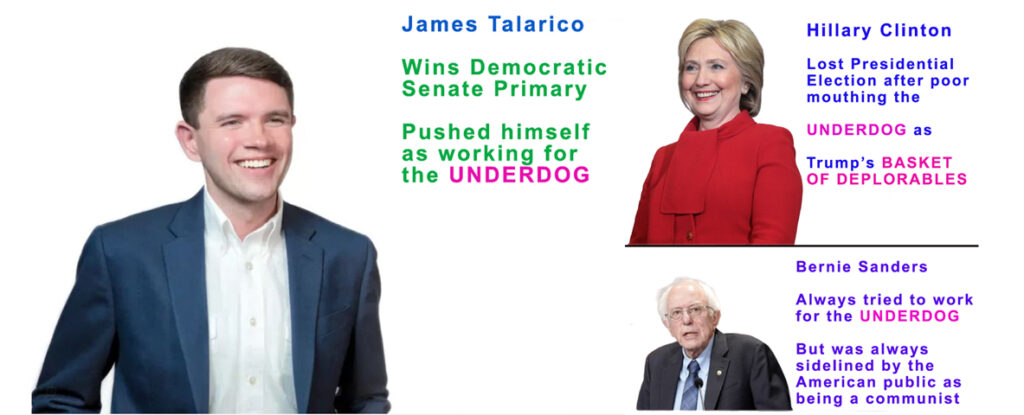
When James Talarico claimed victory in the Democratic Senate primary in Texas, he stepped into one of the most enduring and emotionally powerful narratives in American politics: the rise of the underdog against entrenched power. In a political season defined by polarization, culture wars, and the looming dominance of Donald Trump over the national conversation, Talarico cast himself not simply as a Democrat, but as the tribune of those who feel economically squeezed, culturally dismissed, and politically voiceless.
The Associated Press called the race in his favor after a contest marked by record early turnout and confusion in Dallas County over Election Day rule changes. His opponent, Jasmine Crockett, alleged that voters had been disenfranchised in her base of support. On the Republican side, Senator John Cornyn and Attorney General Ken Paxton advanced toward a runoff, underscoring that Texas remains one of the most fiercely contested arenas in American politics.
Yet beyond the mechanics of turnout and legal disputes, the deeper story of the primary was narrative. Talarico did not run merely as a candidate with policy proposals. He ran as an embodiment of a theme that has animated American democracy for centuries: the small against the mighty, the overlooked against the elite, the “bottom” against the “top.”
The enduring power of the underdog story
The underdog mythos is woven into the American self-conception. From frontier settlers to civil rights marchers, from small-town entrepreneurs to immigrant families, the country’s political rhetoric celebrates those who rise from obscurity to challenge concentrated power. Politicians across ideological lines have learned that victory often belongs to whoever most convincingly claims that mantle.
Even candidates who later command vast fundraising networks begin by portraying themselves as outsiders battling a corrupt establishment. The narrative works because it taps into a cultural reflex: Americans distrust entrenched authority and instinctively root for the challenger.
Talarico’s rhetoric draws directly from that well. “There’s something broken in America,” he declares. “Our economy is broken. Our politics are broken. Even our relationships with each other feel broken.” This is not technocratic language. It is moral language, diagnosing a system captured by “the most powerful people in the world” who, in his telling, benefit from division.
Top versus bottom, not left versus right
Central to Talarico’s message is a reframing of the country’s deepest divide. “The biggest divide in this country is not left vs. right. It’s top vs. bottom,” he argues. Billionaires, he says, want Americans “looking left and right at each other instead of looking up at them.”
This formulation deliberately sidesteps partisan trench warfare. Rather than attacking conservative voters, he attacks concentrated wealth and influence. In doing so, he attempts to learn from a moment in Democratic history that proved politically costly: the “basket of deplorables” remark by Hillary Clinton during the 2016 campaign. Her description of “half” of Trump’s supporters as racist, sexist, homophobic, xenophobic, or Islamophobic became a rallying cry for the right. Trump’s campaign weaponized it. Supporters reappropriated the term “deplorable” as a badge of pride, emblazoning it on hats and T-shirts.
Clinton later acknowledged in her book What Happened that the remark hurt her electorally. The episode revealed a hard truth: voters who feel scorned by cultural elites often respond not with retreat but with defiant solidarity.
Talarico’s rhetoric is built to avoid that trap. His message insists that division by race, party, gender, or religion is the product of elite manipulation. He is not running against “deplorables.” He is running against oligarchs.
Religion, morality, and populist language
Unlike many progressive politicians, Talarico openly integrates Christian imagery into his stump speech. He references his grandfather, a Baptist preacher in South Texas, and speaks of “a barefoot rabbi who gave us two commandments: love God and love neighbor.” He insists that “there is no love of God without love of neighbor” and that every person “bears the image of the sacred.”
This is not incidental. In a state where evangelical Christianity shapes much of the political landscape, moral language can bridge ideological gaps that policy jargon cannot. Talarico’s invocation of Jesus flipping the tables of injustice in the temple transforms economic critique into spiritual mission. “It’s time to start flipping tables,” he proclaims.
The imagery echoes biblical admonitions such as Micah 6:8 — to “do justly, love mercy, and walk humbly with God.” Conservative writer David Murray once described the widening gulf between elites and working-class Americans in terms reminiscent of Charles Murray’s book Coming Apart, contrasting affluent Belmont, Massachusetts, with blue-collar Fishtown, Pennsylvania. The sense that America has become “two Americas” — one secure and credentialed, the other precarious and resentful — fuels both right-wing and left-wing populisms.
Talarico’s wager is that a faith-inflected economic populism can reclaim some of that terrain for Democrats.
The shadow of Bernie Sanders
Any contemporary discussion of left-populist politics inevitably invokes Bernie Sanders. Sanders spent decades warning about billionaire influence, corporate consolidation, and rigged systems. Many supporters argue that he was the rare politician genuinely focused on structural inequality. Critics contend that his democratic socialist label limited his broader appeal.
Now 84, Sanders remains an influential voice but no longer the insurgent force he was in 2016 and 2020. Some of his admirers believe the party sidelined him; others argue that primary voters made pragmatic choices. Regardless, the hunger for an economic message that transcends cultural polarization persists.
Talarico’s approach mirrors Sanders’ emphasis on class without adopting his ideological branding. By rooting his critique in Christian ethics and Texas identity rather than democratic socialism, he seeks to localize and soften the populist edge.
Trump and the politics of crushing the underdog
The national backdrop to Talarico’s rise is the continuing dominance of Donald Trump within Republican politics. Trump himself mastered the underdog narrative in 2016, portraying himself as a billionaire outsider battling a corrupt establishment. His rallies became cultural events, where supporters reveled in media scorn and reclaimed insults like “deplorable.”
Yet once in power, Trump inverted the narrative. To his critics, he ceased to be the outsider and became the system. To his supporters, he remained the embattled champion fighting entrenched bureaucracies, hostile media, and globalist elites.
Talarico’s framing — “top vs. bottom” — implicitly challenges Trump’s claim to represent the forgotten. If billionaires are the problem, then a billionaire president becomes part of the elite structure. In this sense, Talarico’s narrative attempts to seize the underdog mantle from the right.
Texas as testing ground
Winning a Democratic Senate primary in Texas is not the same as winning a general election in a state that has leaned Republican for decades. Yet demographic shifts, urban growth, and generational change have made Texas increasingly competitive.
Record early turnout suggests heightened engagement. Confusion in Dallas County over rule changes introduced controversy, highlighting how election administration disputes can shape perceptions of legitimacy. Crockett’s claim that voters were disenfranchised underscores how fragile trust in institutions has become.
For Talarico, the challenge will be expanding his coalition beyond primary voters to independents and moderate Republicans disillusioned with hard-right politics. His identity as a former middle school teacher may humanize him; his theological language may resonate with voters wary of secular progressivism.
The risk and reward of moral populism
Populism is a double-edged sword. It energizes those who feel excluded but can oversimplify complex realities. Blaming “billionaire mega-donors” and “puppet politicians” offers clarity and catharsis. Governing, however, requires navigating institutional constraints and competing interests.
Still, the moral clarity of the underdog story can be a potent mobilizer. By asserting that unity across race, gender, religion, and party threatens concentrated wealth, Talarico invites voters to imagine solidarity rather than tribalism. Whether that invitation proves persuasive in a deeply polarized electorate remains uncertain.
A country hungry for cohesion
Beneath campaign rhetoric lies a deeper national anxiety. Many Americans sense fraying social bonds, declining trust, and economic precarity. Cable news outrage cycles and social media algorithms amplify division. The temptation to caricature opponents is constant.
The lesson of the “deplorables” episode is that contempt can be politically fatal. The lesson of Trump’s rallies is that shared grievance can forge powerful identity. Talarico appears to have internalized both. He refuses to shame conservative voters. Instead, he seeks to redirect anger upward.
In doing so, he echoes a tradition stretching from biblical prophets to labor organizers: the insistence that justice requires confronting structures, not merely adversaries.
Flipping tables or building bridges?
The metaphor of flipping tables is dramatic. It conjures righteous disruption. Yet successful political movements often blend disruption with coalition-building. If Talarico is to transform a primary victory into broader influence, he will need not only to critique elites but also to articulate pragmatic steps for economic reform, healthcare access, and educational investment.
His background as an educator may provide policy grounding. His seminary training may provide rhetorical resonance. Together, they form an unusual profile in a state where politics is often combative and culture-war driven.
The well-timed underdog moment
James Talarico’s primary win signals that the underdog narrative remains alive and potent in American politics. By casting the central divide as top versus bottom rather than left versus right, he seeks to reclaim a populist vocabulary that has often benefited Republicans. By invoking faith, he challenges assumptions about the secularism of progressive politics. By avoiding contempt for voters across the aisle, he attempts to learn from past Democratic missteps.
Whether this strategy can withstand the bruising intensity of a general election — particularly in a state as complex as Texas — is uncertain. But his ascent underscores a timeless truth: in the United States, the story of the underdog is never far from the surface. Whoever tells it most convincingly often shapes not only an election, but the national conversation itself.