
At the heart of the debate lies a fundamental tension: how does a plural democracy confront radicalism without stigmatizing entire communities? How does it ensure that security operations against armed militants do not inadvertently fuel narratives of victimhood? And what role can education, particularly state-run institutions such as Sainik Schools Society schools or Kendriya Vidyalaya Sangathan institutions, play in shaping civic values and national belonging?
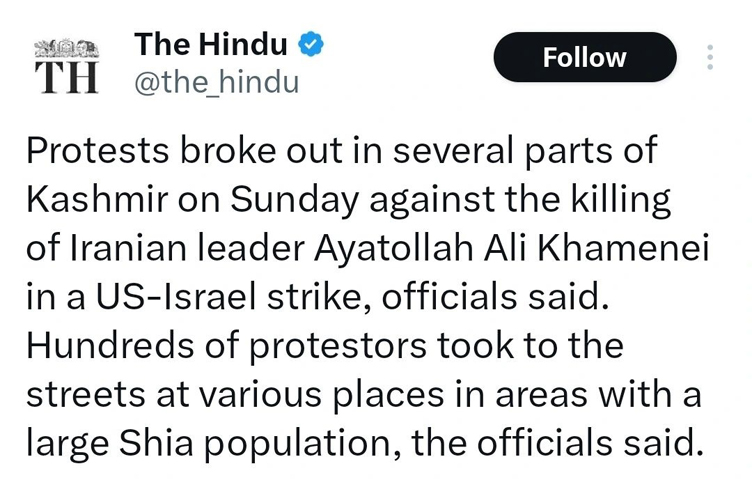
India’s democratic framework rests on an intricate balance between diversity and unity. It is a country of multiple religions, languages, ethnicities and political traditions, yet it seeks to sustain a single constitutional identity. Within this vast mosaic, moments of violence, terror attacks, insurgencies, military operations, often expose fractures that are otherwise muted. One recurring controversy has been the public expression of sympathy by some individuals for militants killed in security operations, whether in the context of insurgency in Jammu and Kashmir or in relation to global ideological figures such as Ali Khamenei. Such expressions provoke outrage in wider society, raise questions about national loyalty, and generate fierce political debate.
The issue is not merely about isolated reactions after an encounter or a strike. It touches deeper concerns about identity, alienation, political messaging, and the state’s engagement with citizens in regions that have witnessed conflict. It also raises difficult questions about whether public policy, especially in education and integration, has adequately addressed vulnerabilities in certain districts of Kashmir, Uttar Pradesh, or West Bengal where political mobilization around religious identity sometimes intersects with radical rhetoric.
At the heart of the debate lies a fundamental tension: how does a plural democracy confront radicalism without stigmatizing entire communities? How does it ensure that security operations against armed militants do not inadvertently fuel narratives of victimhood? And what role can education, particularly state-run institutions such as Sainik Schools Society schools or Kendriya Vidyalaya Sangathan institutions, play in shaping civic values and national belonging?
Understanding the phenomenon of post-conflict sympathy
Expressions of sympathy after militant deaths have appeared in different forms over the decades. In the 1990s, during the peak of militancy in Jammu and Kashmir, funerals of insurgents sometimes drew crowds. In later years, social media amplified such sentiments, making fringe expressions more visible and sometimes more provocative. It is important to distinguish between organized support for violence and emotional reactions rooted in local identity or grievance.
In conflict zones, social dynamics are complex. Militants are often local youth. Families and neighbors may see them first as sons or brothers, even if they reject their actions. Security forces, on the other hand, are often viewed as external agents of the state. This emotional layering can produce sympathy that does not necessarily equate to endorsement of violence but reflects community ties and anger over broader political disputes.
However, when such sympathy is articulated in explicitly ideological terms, praising violent acts, invoking global Islamist leaders, or denouncing India’s constitutional framework, it enters a different domain. Here, the concern shifts from emotional response to potential radicalization. Public institutions and political leaders must tread carefully, ensuring that criticism of extremist views does not morph into collective blame.
The legacy of conflict in Jammu and Kashmir
No discussion of militancy and public sentiment in India can avoid the history of Jammu and Kashmir. The insurgency that erupted in 1989 altered the region’s political landscape. Decades of violence, cross-border infiltration, political missteps, and cycles of protest have left deep scars.
For many young people growing up in the Valley, their formative years were marked by checkpoints, shutdowns, and news of encounters. Even when militancy declined numerically, the psychological environment remained shaped by narratives of injustice and resistance. The constitutional changes of August 2019, when Article 370 was effectively abrogated and the state reorganized into union territories, further intensified debates about identity and autonomy.
In such an environment, education becomes more than academic instruction. It becomes a tool for either bridging divides or reinforcing them. When schools function irregularly because of strikes or security concerns, the vacuum can be filled by rumor, grievance, and online propaganda. Strengthening formal schooling in such areas is often presented as a long-term counter to radical narratives.
Political polarization in Uttar Pradesh and West Bengal
While Kashmir has a distinct conflict history, political polarization in parts of Uttar Pradesh and West Bengal has also drawn attention. These states have large Muslim populations and have witnessed communal tensions at various points. Political competition sometimes sharpens identity lines, especially during elections.
In Uttar Pradesh, communal riots in the past decade have left mistrust between communities. In West Bengal, allegations of political violence and identity-based mobilization frequently surface. In such settings, isolated expressions of sympathy for controversial international figures can be amplified by opponents as proof of widespread disloyalty, even when they are not representative.
The danger lies in generalization. India’s Muslim population is over 200 million strong, diverse in language, sect, class and political orientation. To attribute the actions or statements of a few individuals to an entire community risks undermining social cohesion. Yet ignoring extremist rhetoric entirely can also allow fringe ideologies to gain ground. Balancing these realities requires a nuanced approach.
Education as a strategic response
Education has long been viewed as a cornerstone of nation-building. After independence, India invested heavily in institutions that combined academic rigor with civic orientation. The Kendriya Vidyalaya Sangathan network was established in 1963 to serve children of transferable central government employees, including defense personnel. These schools follow a standardized curriculum under the Central Board of Secondary Education and emphasize national integration by enrolling students from diverse backgrounds across states.
Similarly, the Sainik Schools Society was created in 1961 to prepare students for entry into the National Defence Academy and instill discipline and patriotism. Over time, Sainik Schools expanded beyond their original mandate, offering quality residential education in multiple states.
Proponents of expanding such institutions into districts considered vulnerable to radical messaging argue that they can promote a shared civic identity. Residential schooling in particular can expose students to peers from other regions, reduce insularity, and cultivate structured extracurricular engagement. The emphasis on physical training, debate, and community service can also channel youthful energy into constructive avenues.
The limits of institutional symbolism
Yet institutions alone cannot resolve deep-seated grievances. A Sainik School building in a district does not automatically change perceptions if families feel excluded from economic growth or political representation. Similarly, a Kendriya Vidyalaya may offer excellent academics, but if access remains limited to a small fraction of the population, its impact on broader social attitudes may be modest.
Educational reform must therefore address scale and inclusivity. In many districts of Uttar Pradesh and West Bengal, government primary schools struggle with infrastructure deficits, teacher shortages, and uneven learning outcomes. Addressing these gaps could have a more transformative effect than establishing elite institutions that serve relatively few students.
Moreover, curriculum matters. Civic education must go beyond slogans. It should include critical thinking, constitutional values, comparative religion, and the history of India’s freedom movement, highlighting contributions from all communities. When students see themselves reflected in national narratives, they are less likely to perceive patriotism as belonging to another group.
Digital media and the amplification of fringe voices
The rise of social media has altered the landscape of political expression. A post praising a controversial leader abroad can go viral within hours, drawing national attention. Algorithms reward provocation. In such an environment, isolated instances of sympathy can appear more widespread than they actually are.
Countering online radicalization requires digital literacy as much as security monitoring. Schools can play a role in teaching students how to evaluate sources, recognize misinformation, and understand the consequences of public speech. Programs that encourage dialogue rather than echo chambers can also mitigate polarization.
At the same time, law enforcement agencies must enforce existing laws against incitement to violence. The line between protected speech and unlawful support for terrorism is legally defined, and consistent application is essential to maintain credibility. Selective enforcement risks reinforcing perceptions of bias.
Economic opportunity and integration
Education is closely linked to employment. Regions with high youth unemployment are more susceptible to radical narratives that frame the state as indifferent or hostile. Skill development programs, entrepreneurship initiatives, and integration into national labor markets can strengthen the tangible benefits of belonging.
For example, linking students from districts in Kashmir or eastern Uttar Pradesh to internships in metropolitan centers may broaden horizons and build networks beyond local identity politics. When young people experience upward mobility within the constitutional framework, they have a stake in its stability.
Investment in infrastructure, roads, broadband, healthcare, also signals state presence in positive ways. Development cannot be a substitute for political dialogue, but it can reduce the sense of abandonment that extremist recruiters exploit.
The constitutional framework and equal citizenship
India’s Constitution guarantees freedom of religion and expression, subject to reasonable restrictions. This framework must remain the foundation of any response to controversial speech. Labeling entire communities as sympathetic to terrorism undermines the principle of equal citizenship.
It is equally important to acknowledge that the overwhelming majority of Indian Muslims participate peacefully in democratic life, serve in the armed forces, civil services, and judiciary, and contribute to business and culture. Any policy aimed at countering radicalization must be careful not to stigmatize them.
Inclusive nationalism emphasizes shared values rather than uniform identity. It draws strength from diversity while insisting on constitutional boundaries against violence. Educational institutions can embody this by celebrating cultural pluralism alongside civic duty.
Policy pathways forward
Expanding central schools into underserved districts could be one component of a broader strategy. Opening new branches of Kendriya Vidyalayas where land and demand permit, increasing scholarships for minority students in Sainik Schools, and upgrading existing government schools to central standards are practical steps.
Teacher training is equally crucial. Educators must be equipped to handle sensitive discussions about terrorism, geopolitics, and religion without alienating students. Partnerships with civil society organizations can support dialogue initiatives and mentorship programs.
Community engagement matters. Schools that involve parents in decision-making and cultural events can build trust. When families see institutions as collaborative rather than imposed, resistance diminishes.
Finally, transparency in security operations and accountability for misconduct help prevent grievances from festering. A rights-respecting approach strengthens the moral authority of the state and reduces the appeal of narratives portraying it as oppressive.
Beyond binaries
The question of why some individuals express sympathy for militants cannot be reduced to a single cause, nor can it be addressed by a single policy. It intersects with history, politics, media, economics, and identity. Education is a powerful lever, but it must be inclusive, well-resourced, and embedded in a larger framework of opportunity and justice.
India’s strength lies in its ability to debate contentious issues within a democratic framework. Confronting radicalism while preserving pluralism is a delicate task, yet it is essential for long-term stability. Expanding quality schooling, whether through Kendriya Vidyalayas, Sainik Schools, or strengthened state institutions, can contribute to building informed citizens who see their futures within the constitutional order.
The ultimate objective should not be to enforce uniformity of thought but to cultivate a shared commitment to peaceful coexistence and the rule of law. When young Indians, across regions and religions, internalize these principles, sympathy for violence will remain marginal, and the democratic project will endure.