
The result of the initiative is a mosaic of EU-wide initiatives and country-specific pathways that together form the most comprehensive mobility architecture ever negotiated between India and Europe. Popularly described in diplomatic circles as the “Mother of all Agreements,” the pact goes far beyond tariff reductions and market access. It creates a structured, legally anchored framework for the movement of people, students, researchers, professionals, and skilled workers, between India and the 27 member states of the European Union
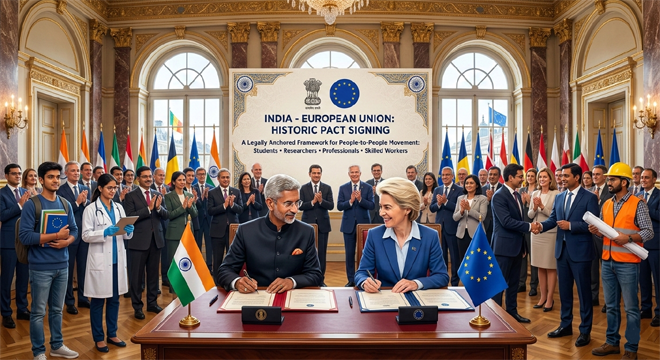
The conclusion of negotiations for the India–EU Free Trade Agreement (FTA) and the accompanying Mobility Partnership in January 2026 marks one of the most consequential shifts in global talent flows in recent decades. Popularly described in diplomatic circles as the “Mother of all Agreements,” the pact goes far beyond tariff reductions and market access. It creates a structured, legally anchored framework for the movement of people, students, researchers, professionals, and skilled workers, between India and the 27 member states of the European Union.
For Europe, the urgency is demographic and economic. Aging populations, shrinking workforces, and acute shortages in sectors such as information technology, healthcare, engineering, advanced manufacturing, and green energy have created systemic bottlenecks. For India, the opportunity lies in exporting talent in a regulated, dignified manner while ensuring recognition of qualifications, social security portability, and post-study work rights for its students.
Although the agreement announced in January 2026 is undergoing legal scrubbing and ratification, with full proactive enforcement targeted for July 1, 2026, European governments have already begun aligning their domestic immigration systems to leverage the new framework. The result is a mosaic of EU-wide initiatives and country-specific pathways that together form the most comprehensive mobility architecture ever negotiated between India and a regional bloc.
The architecture of the mobility partnership
At the heart of the mobility partnership is the creation of a predictable, rules-based system. Historically, Indian professionals navigating Europe faced fragmented visa processes, inconsistent recognition of qualifications, and uncertainty around long-term residency. The FTA seeks to reduce this friction through three foundational pillars: streamlined entry, mutual recognition of qualifications, and social security coordination.
One of the most visible innovations is the EU Talent Pool and the proposed “Legal Gateway Office” in New Delhi. Envisioned as a one-stop hub, this office aims to fast-track visa processing — with a stated target of approving 90 percent of eligible applications within 30 days — for students, researchers, and professionals. It is designed not merely as a consular facilitation center but as a matching platform that connects Indian candidates with verified vacancies across EU member states in high-demand sectors such as IT, artificial intelligence, engineering, and healthcare.
Equally transformative is the framework for mutual recognition of academic and professional qualifications. Indian degrees and certifications — whether in engineering, medicine, IT, or even traditional medicine systems — will be recognized across more than 17 sectors, significantly reducing the need for retraining or redundant examinations. For Indian doctors, nurses, engineers, architects, and technologists, this removes one of the largest barriers to European employment.
The third pillar is social security portability. Within five years of implementation, the EU aims to establish agreements that ensure Indian workers do not lose pension contributions or healthcare benefits when moving between India and EU member states. Portability across all 27 EU countries will enable professionals to build cumulative benefits rather than starting from scratch with each relocation. This addresses a longstanding grievance among globally mobile Indian professionals.
Student mobility as the uncapped frontier
Perhaps the most politically significant provision of the agreement is the “uncapped” student mobility offering. Unlike quota-based schemes that limit annual admissions, the new framework allows Indian students to enroll in European universities without numerical ceilings tied specifically to nationality. This positions Europe as a competitive alternative to traditional destinations such as the United States, Canada, and Australia.
Complementing this is an automatic 12-month job-seeker visa granted to Indian students upon graduation from European institutions. In many member states, the mobility partnership extends this to a three-year post-study work permit for Indian graduates, creating a structured pathway from education to employment. This is a marked shift from earlier regimes in which graduates often faced abrupt visa expirations or short job-search windows.
The agreement also strengthens access to Erasmus Mundus scholarships. Under the enhanced funding framework, Indian scholars are expected to receive greater institutional support, reinforcing academic exchange in advanced research areas such as AI, climate science, biotechnology, and renewable energy.
For Indian families weighing overseas education, these provisions reduce uncertainty. The promise of an automatic job-search visa and a multi-year post-study work permit makes the European pathway economically rational rather than speculative.
Germany’s aggressive talent strategy
No European country illustrates the urgency of demographic adjustment more than Germany. As Europe’s largest economy, Germany faces structural labor shortages in engineering, healthcare, IT, and advanced manufacturing. Its response has been to overhaul its immigration architecture.
Central to this strategy is the “Chancenkarte” or Opportunity Card — a points-based system allowing qualified professionals to enter Germany for up to 12 months without a prior job offer. Points are awarded based on education, work experience, age, and language proficiency. For Indian engineers and IT specialists, this reduces dependence on employer sponsorship at the application stage.
Germany has also recalibrated its Skilled Immigration Act to simplify recognition of foreign qualifications and lower salary thresholds in bottleneck professions. In parallel, the EU Blue Card salary threshold has been reduced to €45,934.20 for shortage occupations such as IT, engineering, and healthcare as of 2026.
The EU Blue Card itself offers a fast track to permanent residency in 21 to 33 months, depending on German language proficiency. Spouses can work without restriction, and family reunification is relatively streamlined. In the context of the India–EU mobility framework, Germany’s reforms signal an open invitation to Indian talent.
Ireland’s English-speaking advantage
For many Indian professionals, language is a decisive factor. Ireland leverages its English-speaking environment to position itself as a culturally and linguistically accessible gateway to Europe.
The Critical Skills Employment Permit is tailored to high-demand occupations, particularly in IT, healthcare, and engineering. It offers a simplified process and provides a pathway to permanent residency after a defined period of employment. Ireland’s tech ecosystem — home to major multinational firms — has amplified demand for Indian software engineers, data analysts, and cybersecurity specialists.
For students, the Stamp 1G visa allows graduates to remain in Ireland for up to two years post-study, during which they can work and transition to long-term employment permits. Within the broader EU mobility architecture, Ireland offers a familiar, English-speaking stepping stone into the European labor market.
The Netherlands and the culture of high-skilled migration
Netherlands has long maintained a Highly Skilled Migrant (HSM) program that emphasizes employer sponsorship through certified companies. The system is designed for efficiency: once a job offer is secured from a recognized sponsor, the visa process is relatively swift.
Dutch authorities have streamlined onboarding for international talent in technology, renewable energy, and logistics. The Orientation Year Permit provides foreign graduates from Dutch and top global universities a year to seek employment, making it attractive for Indian students pursuing master’s degrees in STEM disciplines.
The Netherlands’ open business culture and strong startup ecosystem have drawn Indian entrepreneurs and technology professionals. Under the India–EU framework, mutual recognition of qualifications further enhances the attractiveness of this route.
France and the long-term Talent Passport
France promotes its “Talent Passport” as a four-year residence permit for highly skilled professionals, researchers, and investors. The scheme offers long-term residency stability and family reunification rights.
France’s push is closely tied to its ambition to become a European leader in AI, advanced research, and green technologies. Indian engineers, scientists, and doctoral researchers are prime candidates. The Talent Passport’s flexibility — including options for entrepreneurs and researchers — aligns with the innovation-driven sectors prioritized in the India–EU agreement.
Italy’s manufacturing revival and hiring surge
Italy, traditionally less prominent in skilled migration debates, is experiencing acute labor shortages in manufacturing and engineering. With one in three firms reportedly intending to hire non-EU personnel by 2026, Italy is simplifying entry procedures for professionals in targeted sectors.
For Indian mechanical and electrical engineers, Italy’s manufacturing clusters present new opportunities. The India–EU FTA framework supports recognition of qualifications, enabling smoother entry into these roles.
Portugal’s flexible pathways
Portugal has emerged as a popular destination due to relatively straightforward visa pathways. The Digital Nomad Visa (D8) targets remote workers with high incomes, offering a route to permanent residency. For Indian IT professionals working for global companies, this provides flexibility without immediate employer sponsorship in Portugal.
The Tech Visa and Job Seeker Visa further expand options. The latter allows individuals to enter Portugal for up to six months to search for employment — a pragmatic bridge between aspiration and opportunity.
Denmark’s pay limit scheme
Denmark operates a Pay Limit Scheme, providing fast-tracked work permits for highly skilled professionals meeting specified salary thresholds. IT and engineering roles feature prominently in shortage lists.
Within the India–EU framework, such national schemes become more accessible due to streamlined recognition of qualifications and enhanced mobility coordination.
The United Kingdom’s parallel track
Although no longer part of the EU, the United Kingdom maintains close mobility ties with India. The India Young Professionals Scheme allows Indian citizens aged 18 to 30 to live and work in the UK for up to two years without employer sponsorship. With approximately 3,000 places released annually via ballot, the scheme is competitive but symbolically significant.
While separate from the EU framework, it underscores Europe-wide recognition of India as a major talent partner.
Target sectors shaping the migration wave
Across these schemes, certain sectors consistently emerge as priority areas.
Technology and AI dominate recruitment pipelines. Software development, cybersecurity, data analytics, and artificial intelligence expertise are in high demand. Indian professionals, trained in large domestic tech ecosystems, align naturally with these needs.
Healthcare is another critical domain. Aging European populations require doctors, nurses, and medical technicians. Germany and Ireland, in particular, are aggressively recruiting healthcare workers.
Engineering and green energy reflect Europe’s climate transition agenda. Mechanical, electrical, and renewable energy engineers are essential for decarbonization goals.
A distinctive feature of the India–EU agreement is recognition of traditional Indian medicine systems. Select EU states will allow AYUSH practitioners to provide services, integrating Ayurveda and related disciplines into regulated frameworks.
Family reunification and pathways to permanence
For Indian professionals evaluating relocation, family considerations are central. Many EU schemes, including the Blue Card and national skilled worker visas, allow spouses and children to accompany the primary applicant. Spouses often receive open work authorization.
Pathways to permanent residency typically materialize after three to five years of lawful employment. In Germany, permanent residence can be obtained in as little as 21 months with sufficient language proficiency. Similar timelines apply in Ireland and the Netherlands under qualifying conditions.
This clarity around permanence distinguishes the India–EU mobility framework from more restrictive or uncertain regimes elsewhere.
Strategic implications for India
For India, the agreement represents both opportunity and responsibility. On one hand, it creates structured avenues for its skilled workforce to access global markets with legal safeguards. On the other, it raises questions about brain drain.
However, policymakers increasingly frame mobility as “brain circulation.” Indian professionals abroad often remit funds, build networks, and eventually return with enhanced skills. Social security portability ensures that transnational careers do not penalize workers financially.
Moreover, the recognition of qualifications reduces the humiliation and economic waste of retraining highly skilled individuals for equivalent roles.
Ratification and the road to July 2026
While political agreement was reached in January 2026, the pact requires legal scrubbing and ratification by EU institutions and member states. Implementation is targeted for July 1, 2026.
In practice, many national reforms are already underway, anticipating ratification. Governments are aligning administrative processes, digitizing visa systems, and expanding consular capacity in India.
If executed effectively, the India–EU mobility partnership could redefine global labor flows, positioning Europe as a primary destination for Indian talent and embedding mobility within a comprehensive trade framework.
A rebalanced global talent map
The India–EU FTA’s mobility dimension signals a shift in global talent geopolitics. Europe, once perceived as relatively closed compared to traditional Anglophone destinations, is recalibrating in response to demographic realities.
For Indian students and professionals, the message is clear: Europe is not merely open; it is actively recruiting. Structured pathways, recognition frameworks, social security safeguards, and family-friendly policies collectively lower barriers.
As July 2026 approaches, the success of this “Mother of all Agreements” will depend on administrative efficiency, political will, and sustained cooperation. If realized as envisioned, it could mark the beginning of a new era in India–Europe relations — one defined not only by trade in goods and services, but by the structured movement of people, ideas, and skills across continents.