
The operation unfolded against years of mounting tensions: covert sabotage, cyber operations, maritime confrontations, and proxy clashes stretching from Syria to Lebanon. Yet this moment represented a qualitative shift—overt, large-scale, and coordinated not only by Israel but, according to official statements, in partnership with the United States
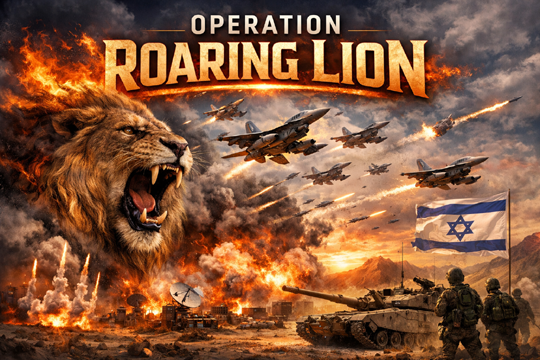
In one of the most dramatic escalations in the long shadow war between Israel and Iran, 200 Israeli fighter jets reportedly took to the skies in what Israeli officials described as the largest strike formation in the history of the Israeli Air Force. The operation, named “Operation Roaring Lion,” targeted approximately 500 Iranian missile and air defense sites in a sweeping campaign designed to degrade Tehran’s military infrastructure and blunt what Israel calls an existential threat.
The scale alone marked a historic moment. Never before had such a concentrated aerial formation been deployed by Israel in a single coordinated strike. The targets included missile depots, launch facilities, radar installations, and elements of Iran’s layered air defense systems. According to Israeli statements, the goal was not symbolic retaliation but structural degradation—crippling the capacity of what Prime Minister Benjamin Netanyahu described as “the terror regime’s war machine.”
The operation unfolded against years of mounting tensions: covert sabotage, cyber operations, maritime confrontations, and proxy clashes stretching from Syria to Lebanon. Yet this moment represented a qualitative shift—overt, large-scale, and coordinated not only by Israel but, according to official statements, in partnership with the United States.
Netanyahu’s existential framing
In a nationally televised address, Benjamin Netanyahu framed the operation in existential terms. For him, the strike was not a tactical maneuver but a historic pivot. “Israel and the United States embarked on an operation to remove the existential threat posed by the terrorist regime in Iran,” he declared.
Netanyahu’s rhetoric echoed a long-standing Israeli doctrine: that a nuclear-armed Iran is intolerable. For decades, Israeli leaders across political divides have warned that Tehran’s nuclear ambitions represent a red line. The Ayatollah-led regime’s repeated declarations calling for “Death to Israel,” combined with its support for armed proxies such as Hezbollah and other regional militias, have shaped Israeli strategic thinking.
In invoking 47 years of hostility, Netanyahu tied the present to the 1979 Islamic Revolution and the ideological hostility that followed. He thanked U.S. President Donald Trump for what he called “historic leadership,” emphasizing that the operation was joint. This framing signals that the strike was not merely an Israeli initiative but part of a broader alignment between Jerusalem and Washington.
The language was designed for multiple audiences: Israelis under threat of retaliation, Iranians living under clerical rule, regional actors watching nervously, and Western allies weighing the consequences.
The military calculus behind 200 jets
Deploying 200 fighter aircraft simultaneously is not only a demonstration of force but of logistical sophistication. Such an operation requires mid-air refueling coordination, electronic warfare suppression, cyber integration, and precise intelligence mapping. The targets—500 missile and air defense installations—suggest an effort to degrade Iran’s capacity to retaliate effectively.
Air defense systems are the backbone of territorial protection. By targeting radar arrays and missile batteries, Israel aimed to blind and disarm before striking deeper assets. Missile depots, meanwhile, represent Iran’s primary conventional deterrent against Israel and U.S. forces in the region.
Strategically, the operation appears designed to reset the escalation ladder. Rather than incremental tit-for-tat exchanges, this was an attempt to impose overwhelming disruption. Whether it achieves long-term deterrence remains uncertain, but its immediate message was unmistakable: Israel retains deep strike capability and operational reach.
Joint action and the American dimension
Netanyahu’s explicit acknowledgment of the United States introduces a complex geopolitical layer. Cooperation between Israel and the United States has long included intelligence sharing, joint exercises, and missile defense collaboration such as the Arrow and Iron Dome systems. But direct joint action against Iranian targets marks a significant escalation.
For Washington, the calculus involves balancing deterrence against the risk of regional conflagration. U.S. forces in Iraq, Syria, and the Gulf remain vulnerable to retaliatory strikes by Iranian proxies. The alignment with Israel in a kinetic operation signals resolve but also raises stakes.
Donald Trump’s support, as cited by Netanyahu, situates the strike within a broader narrative of confronting Iran’s regional ambitions. It reflects an enduring American debate over whether deterrence requires decisive force or calibrated diplomacy.
Tehran’s missile and air defense network
Iran’s missile program has been central to its asymmetric strategy. Lacking a modern air force comparable to Western or Israeli capabilities, Tehran invested heavily in ballistic and cruise missiles, along with drones. These systems allow Iran to project power across the region, from the Gulf to the Levant.
By targeting 500 missile and air defense sites, Israel aimed to dismantle this network. Even partial success could disrupt command-and-control, degrade launch readiness, and undermine confidence in Iran’s defensive umbrella.
Yet Iran’s doctrine emphasizes redundancy and dispersion. Many facilities are hardened or underground. The true extent of damage will likely remain contested, filtered through competing narratives from Jerusalem and Tehran.
The nuclear shadow
At the heart of Israel’s justification lies the nuclear question. Israeli leaders have repeatedly vowed to prevent Iran from acquiring nuclear weapons capability. While international agreements and inspections have attempted to regulate Tehran’s nuclear program, distrust runs deep in Jerusalem.
Netanyahu’s assertion that “this murderous terrorist regime must not be allowed to arm itself with nuclear weapons” underscores the urgency Israel attaches to preemption. For Israel, the prospect of a hostile regime with nuclear capability is not an abstract strategic risk but an existential one.
Whether the strikes directly targeted nuclear facilities or focused on missile infrastructure supporting potential delivery systems, the message is intertwined with the nuclear debate. Military action, in this view, becomes a form of enforced non-proliferation.
Operation roaring lion and civilian resilience
Netanyahu urged Israeli citizens to comply with Home Front Command directives, warning that “the coming days… will demand patience and fortitude.” This reflects an expectation of retaliation. Iran’s arsenal includes long-range missiles capable of reaching Israeli territory, as well as allied militias positioned closer.
Israel’s civil defense system—shelters, early warning sirens, and missile interception systems—forms part of the national security architecture. The Home Front Command’s instructions are not mere formalities; they are a lived reality in a country accustomed to rocket alerts.
Civilian resilience becomes as critical as military prowess. The psychological dimension—maintaining unity under threat—has long been central to Israeli strategic culture.
A call to Iran’s diverse peoples
One of the most striking elements of Netanyahu’s speech was his direct appeal to Iran’s ethnic communities: Persians, Kurds, Azeris, Balochis, and Ahwazis. By naming these groups, he signaled support for internal dissent against the clerical establishment.
This rhetorical move positions the strike not merely as external aggression but as a catalyst for internal liberation. Netanyahu framed the operation as creating “conditions for the brave Iranian people to take their destiny into their own hands.”
Whether such appeals resonate inside Iran is uncertain. Nationalist sentiment often intensifies under foreign attack. Yet the message reflects Israel’s broader strategy of isolating the regime from the populace.
The India–Israel moment in a time of war
Amid the geopolitical tremors, an unexpected emotional vignette emerged from an Israeli citizen, Chaya Kaplan-Lester. On a midnight errand to a neighborhood grocery store, she heard Indian music playing loudly. The store owner had turned it on because India’s leader, Narendra Modi, was visiting Israel.
The moment moved her to tears. Between cucumbers and milk cartons, she felt she was “dancing with India’s angel.” In her reflection, India was not merely a country but a civilizational force—an elephant: enormous, steady, gentle yet strong.
Her metaphor captured something deeper than diplomacy. India, with nearly 1.4 billion people and an ancient heritage, represents scale and continuity. In Hebrew, India is “Hodu,” echoing the biblical phrase “Hodu LaShem ki tov”—give thanks to God, for He is good. She played with the linguistic resonance between “Hod” (splendor) and “Modi,” a name rooted in praise.
In a season of war and accusation, she saw gratitude itself as an act of defiance.
Shared experiences of complex neighborhoods
Kaplan-Lester’s reflection also touched on shared security concerns. India, like Israel, inhabits a complex neighborhood. It has confronted terrorism and separatist violence. It has wrestled with balancing democracy under pressure.
This shared experience has underpinned growing defense cooperation between India and Israel over the past two decades. Israel has supplied advanced defense systems, surveillance technologies, and agricultural innovations to India. Trade between the two nations has expanded to billions of dollars annually.
When India stands publicly with Israel during moments of crisis, it carries symbolic weight. India represents nearly a fifth of humanity. Its diplomatic posture influences global perceptions.
Defense partnership and strategic convergence
India has emerged as one of Israel’s largest defense partners. The collaboration spans missile systems, drones, radar technologies, and cybersecurity. Joint ventures and technology transfers have deepened ties beyond simple buyer-seller transactions.
For Israel, India offers scale and strategic depth. For India, Israel offers cutting-edge technology and rapid innovation cycles. The relationship reflects pragmatic convergence rather than ideological alignment.
In the context of Operation Roaring Lion, the symbolism of Modi’s presence—if contemporaneous—suggests diplomatic continuity even amid military escalation. It underscores that Israel’s global relationships extend beyond Western capitals.
The global reaction and regional risks
A strike of this magnitude reverberates far beyond Israel and Iran. Gulf states monitor developments closely, wary of missile spillover. European governments balance concerns about nuclear proliferation with fears of regional war. Russia and China assess shifts in power equilibrium.
Markets react to uncertainty. Energy prices fluctuate when conflict threatens supply routes. Shipping lanes in the Gulf and Red Sea become risk zones.
The central question remains whether the operation deters further escalation or triggers it. Military history offers examples of both outcomes.
The moral and strategic debate
Supporters of the strike argue that preemptive action prevents greater catastrophe. If Iran’s missile and nuclear capabilities are curtailed, the region may avoid a far deadlier confrontation later.
Critics warn that large-scale air campaigns risk civilian casualties, entrench hardliners, and ignite broader conflict. They question whether military force can sustainably dismantle deeply embedded programs.
This debate is not new. It echoes earlier Israeli operations against perceived existential threats, as well as American interventions in the Middle East. The balance between deterrence and escalation remains precarious.
Unity, gratitude, and the language of resilience
In Kaplan-Lester’s grocery store epiphany, gratitude emerged as a counterpoint to fear. The idea that nations have guiding angels reflects a spiritual interpretation of geopolitics. Whether literal or metaphorical, it expresses a longing for moral alignment in turbulent times.
Her invocation of “Hodu LaShem ki tov” reframed India’s presence as a reminder of goodness amid chaos. In a world quick to condemn, acknowledgment becomes sacred.
For Israelis facing missile alerts and uncertain days, such moments of solidarity matter. They reinforce the sense that Israel is not isolated.
The uncertain road ahead
Operation Roaring Lion marks a watershed. A 200-jet formation striking 500 targets is not routine military maneuvering; it is strategic messaging at scale. It signals capability, resolve, and willingness to act.
Yet wars are rarely defined by opening salvos alone. Retaliation, diplomacy, covert maneuvering, and international mediation will shape what follows. The coming days, as Netanyahu warned, will demand patience and fortitude.
For Israel, the stakes are existential. For Iran, national pride and regime survival are intertwined. For the region, stability hangs in balance.
And in a small grocery store aisle, with Indian music echoing past midnight, an Israeli citizen felt the brush of something larger—history, alliance, gratitude. In that moment, amid warplanes and warnings, the idea of splendor—hod—lingered.
Hodu LaShem ki tov. Give thanks, for He is good.

