
Regulatory innovations such as the Social Stock Exchange, new fundraising instruments, and diaspora philanthropy trends are slowly opening pathways through which NRIs and global donors can participate in financing higher education. DronePages invites NRIs to create their own university in India
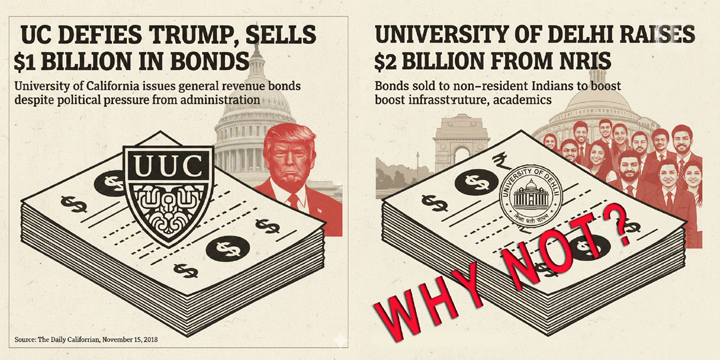
The question of whether Indian non-resident Indians (NRIs) can fund universities in India that are incorporated as Section 8 companies sits at the intersection of philanthropy, financial regulation, higher education policy, and global capital flows. It also reflects a broader shift in how educational institutions worldwide are seeking alternative financing mechanisms amid changing political and economic environments. A recent development in the United States — where the University of California sold approximately $2 billion in general revenue bonds even while facing political pressure from the administration of Donald Trump — demonstrates how universities in some jurisdictions can access capital markets in sophisticated ways. The contrast with India is stark. Indian universities, particularly those structured as non-profit entities such as Section 8 companies, operate under very different regulatory and financial constraints.
Yet, the Indian system is evolving. Regulatory innovations such as the Social Stock Exchange, new fundraising instruments, and diaspora philanthropy trends are slowly opening pathways through which NRIs and global donors can participate in financing higher education. Understanding these mechanisms requires unpacking the legal nature of Section 8 companies, the constraints on non-profit education institutions, and the emerging opportunities that could reshape the funding landscape for Indian universities in the coming decades.
Section 8 companies and the non-profit university model
Section 8 companies, created under India’s Companies Act, are entities established for charitable or not-for-profit objectives such as education, social welfare, research, or environmental causes. Unlike conventional corporations, they are prohibited from distributing profits to shareholders. Any surplus generated must be reinvested into achieving the organization’s objectives. Many private universities and educational institutions in India operate under structures similar to trusts, societies, or Section 8 companies precisely because education has historically been treated as a public good rather than a profit-making enterprise.
This structural philosophy shapes every aspect of financing. Investors typically seek returns through dividends, capital appreciation, or interest payments linked to profits. Section 8 companies cannot offer dividends or equity appreciation in the conventional sense, making them unattractive to traditional investors. However, this does not mean they cannot raise funds at all. Rather, they must rely on alternative instruments aligned with their non-profit nature.
NRIs can legally fund Section 8 universities in multiple ways, including donations, grants, debt instruments such as debentures, and certain innovative capital instruments. The ability to accept foreign contributions is subject to compliance with India’s foreign funding regulations, particularly registration under the Foreign Contribution Regulation Act (FCRA), which typically becomes available after a few years of operation or through prior government approval.
The key issue is not legality but structure: how to design funding mechanisms that satisfy both donor expectations and regulatory requirements while preserving the non-profit character of the institution.
Lessons from global university financing models
Globally, universities — particularly in the United States — have developed diverse funding channels. Public universities often issue municipal bonds backed by tuition revenue, state support, or institutional assets. Endowments, alumni contributions, research grants, and philanthropic donations form additional pillars of funding. The bond issuance by the University of California illustrates the financial sophistication achievable when institutions possess strong credit ratings, predictable revenue streams, and legal authority to borrow.
In India, most universities lack these conditions. Many are dependent on tuition fees, government grants, or philanthropic support. They often lack independent balance sheets robust enough to support large debt issuance. Moreover, regulatory frameworks historically discouraged commercialization of education, limiting financial innovation.
Nevertheless, globalization and rising demand for quality education are pushing Indian institutions to explore new funding avenues. The growing wealth of the Indian diaspora is particularly significant. NRIs already fund scholarships, research chairs, infrastructure projects, and entire campuses in some cases. The challenge is creating scalable mechanisms that allow large pools of diaspora capital to flow into higher education systematically rather than episodically.
Borrowing through bonds and debentures by Section 8 companies
Contrary to common assumptions, Section 8 companies do possess borrowing powers. They can issue debentures or bonds, including to private investors, provided transactions occur at arm’s length and comply with corporate and securities laws. Interest payments must represent legitimate compensation for capital rather than disguised profit distribution.
However, practical obstacles remain. Non-profit entities often face difficulties pledging assets as collateral because their assets are held for charitable purposes and cannot be freely monetized. Creditworthiness becomes a challenge when revenue streams are uncertain or regulated, as is often the case with tuition fees in education. As a result, lenders may perceive higher risk compared to corporate borrowers.
Despite these constraints, debt financing is not impossible. Large educational institutions with stable fee income, research funding, or government backing could potentially access bond markets. The absence of precedent in India reflects structural inertia more than legal prohibition. Over time, as institutions mature and governance improves, debt markets could become a viable funding channel.
For NRIs, investing in bonds issued by a Section 8 university could theoretically provide a return through interest payments while supporting education. However, regulatory clarity and investor protection frameworks would need to strengthen to build confidence.
The Social Stock Exchange and innovative capital instruments
One of the most important regulatory developments in India is the creation of the Social Stock Exchange (SSE), an initiative overseen by the Securities and Exchange Board of India. The SSE is designed to enable non-profit organizations to raise funds from the public through instruments tailored to social impact rather than financial return.
Under this framework, eligible non-profit organizations — including Section 8 companies — can issue Zero Coupon Zero Principal (ZCZP) instruments. These instruments function essentially as structured donations. Investors or donors provide funds for a specific project without expecting interest or repayment of principal. The value to the contributor lies in social impact, tax benefits, and reputational returns rather than financial gain.
For NRIs, this model is particularly attractive. Many diaspora donors seek to support educational or social causes without necessarily expecting monetary returns. The SSE provides transparency, governance standards, and reporting mechanisms that can increase trust. Over time, this could unlock significant diaspora capital for Indian universities, especially if large institutions list projects related to infrastructure, research, or scholarships.
The SSE model represents a conceptual shift: from philanthropy as informal giving to philanthropy as a regulated, market-linked activity with standardized disclosures. This transition could dramatically expand funding opportunities for education.
Why traditional IPOs remain impossible for universities
A fundamental constraint is that universities structured as non-profits cannot undertake traditional initial public offerings (IPOs). IPOs involve issuing shares that confer ownership rights, dividends, and capital appreciation potential. Section 8 companies cannot distribute profits to shareholders, making conventional equity investment incompatible with their legal structure.
Even if regulations permitted listing, investor demand would remain limited because financial returns would be uncertain. Education outcomes, social impact, and long-term knowledge creation do not translate easily into shareholder value metrics.
However, some countries have experimented with hybrid models. For-profit education companies, online learning platforms, and training providers have gone public globally. India also has listed education-related companies, but these are typically service providers rather than universities themselves.
For Indian universities to access equity markets directly, major legal reforms would be required — including rethinking the non-profit mandate of higher education. Such a shift remains politically sensitive, given concerns about commercialization and affordability.
Foreign contributions and NRI participation
NRIs can fund Section 8 universities through foreign contributions, subject to regulatory compliance. Institutions must obtain FCRA registration or prior permission to receive overseas funds. Once approved, they can accept donations from individuals, foundations, or corporations abroad.
Diaspora funding already plays a significant role in India’s education sector. Alumni contributions to elite institutions, philanthropic endowments, and research grants from global foundations are common. What is evolving is the scale and structure of these contributions. Rather than one-time donations, there is growing interest in long-term partnerships, endowment creation, and impact-linked funding.
NRIs may also participate indirectly through philanthropic trusts, venture philanthropy funds, or collaborative academic partnerships between Indian and foreign universities. These models combine financial support with knowledge exchange, faculty mobility, and research collaboration.
Structural barriers preventing Indian universities from accessing capital markets
Several systemic factors explain why Indian universities rarely issue bonds or access public markets.
First, legal entity status is a major constraint. Many universities are established through state legislation or registered as trusts or societies, which lack shareholding structures necessary for equity financing.
Second, the non-profit orientation limits financial flexibility. Surpluses must be reinvested rather than distributed, reducing investor incentives.
Third, regulatory compliance and governance standards vary widely across institutions. Public market investors require transparency, audited financials, predictable revenue streams, and strong governance frameworks.
Fourth, asset monetization is difficult. University land and infrastructure are often subject to restrictions preventing commercial exploitation. Without collateral, debt financing becomes expensive or unavailable.
Finally, universities prioritize educational outcomes rather than shareholder returns. Aligning academic goals with investor expectations presents philosophical as well as practical challenges.
These barriers are not unique to India, but they are particularly pronounced due to the country’s regulatory history and public policy priorities.
The potential role of diaspora capital in transforming Indian higher education
Despite constraints, the potential of diaspora funding is enormous. India has one of the world’s largest expatriate populations, with significant wealth concentrated in developed economies. Many NRIs retain emotional and cultural ties to India and are interested in contributing to nation-building initiatives, including education.
If appropriate financial mechanisms emerge, diaspora capital could help finance world-class universities, research centers, and innovation ecosystems. Endowment culture — common in American universities — remains underdeveloped in India. Building large endowments could reduce dependence on tuition fees and government grants, enabling institutions to invest in research and faculty development.
NRIs could also support specialized funds focused on scholarships for disadvantaged students, infrastructure modernization, or emerging fields such as artificial intelligence, biotechnology, and climate science. Structured giving platforms, tax incentives, and transparent reporting would be critical to attracting sustained participation.
Comparing Indian and global policy approaches to university financing
Countries vary widely in how they finance higher education. The United States relies heavily on tuition, philanthropy, and capital markets. Europe depends more on government funding. East Asian countries combine state investment with private sector participation.
India historically emphasized public funding and non-profit models but faces fiscal constraints as demand for higher education expands. Private participation has grown, yet regulatory complexity remains high.
The emergence of mechanisms such as the SSE suggests policymakers recognize the need for innovation. By creating pathways for social investment without compromising non-profit principles, India may gradually bridge the gap between philanthropy and capital markets.
Governance, transparency, and investor confidence
For any funding mechanism to succeed, governance standards must improve. Donors and investors — including NRIs — require confidence that funds will be used effectively. Transparent financial reporting, independent audits, outcome measurement, and professional management are essential.
Universities seeking large-scale funding must adopt corporate-style governance while preserving academic autonomy. This balance is challenging but achievable. Institutions that demonstrate accountability and impact will attract greater support.
Technology can play a role as well. Digital platforms enabling real-time reporting of project progress, financial utilization, and educational outcomes could strengthen trust and engagement with donors worldwide.
Future possibilities: hybrid financial models for education
Looking ahead, several innovative models could reshape university financing in India.
One possibility is blended finance combining philanthropic grants, concessional loans, and government support. Another is outcome-based funding, where investors provide capital upfront and returns depend on achieving educational outcomes such as graduate employment rates.
Public-private partnerships could finance infrastructure projects, while universities retain academic control. Endowment funds managed professionally could generate sustainable income streams.
Regulatory reforms could also allow limited financial returns tied to specific commercial activities such as research commercialization or intellectual property licensing, without compromising the core non-profit mission.
If implemented carefully, these hybrid models could unlock significant capital while preserving affordability and access.
Policy reforms needed to unlock funding potential
Several policy measures could accelerate funding opportunities for Section 8 universities.
Simplifying FCRA procedures for educational institutions would encourage diaspora contributions. Expanding tax incentives for donors could increase philanthropic flows. Creating credit enhancement mechanisms or government guarantees could help universities issue bonds at reasonable interest rates.
Encouraging endowment creation through regulatory clarity and investment flexibility would build long-term financial stability. Strengthening accreditation and governance standards would improve investor confidence.
Finally, promoting awareness among NRIs about available funding channels — including SSE instruments — would broaden participation.
A gradual but promising transformation
Indian NRIs can indeed fund universities structured as Section 8 companies through donations, foreign contributions, debt instruments, and innovative platforms such as the Social Stock Exchange. While traditional IPOs remain impossible due to the non-profit nature of these institutions, alternative financing mechanisms are emerging that align social impact with capital mobilization.
The comparison with global institutions like the University of California highlights the distance India still needs to travel in developing mature higher education financing ecosystems. Yet, the direction of change is clear. Regulatory innovation, diaspora engagement, governance improvements, and financial creativity are gradually expanding possibilities.
India’s higher education system stands at a pivotal moment. With rising demand for quality education, research, and innovation, new funding models are essential. If policymakers, universities, and diaspora communities collaborate effectively, Section 8 institutions could evolve into financially sustainable, globally competitive centers of learning supported by both domestic and international capital.
The transformation will not happen overnight. But the foundations are being laid for a future in which Indian universities can access diverse funding streams while remaining committed to their social mission — a balance that could redefine higher education financing not only in India but across the developing world.