
India rising under Prime Minister Narendra Modi’s leadership. This is a story of connectivity, strategic ambition, economic recovery, regional integration, and the geopolitical signalling of a rising power determined to erase its infrastructure deficit
If there is one thing that defines 21st-century India under Prime Minister Narendra Modi, it is the unapologetic ambition to build infrastructure that was once dismissed as fantasy. After the high-altitude engineering spectacle of the Atal Tunnel, the country is now preparing to go literally underwater. The Cabinet Committee on Economic Affairs has cleared a ₹18,662-crore twin-tube underwater road-cum-rail tunnel beneath the Brahmaputra in Assam, India’s first project of its kind and only the second globally. The symbolism is as powerful as the engineering: a nation once struggling to build basic bridges is now competing with the likes of Europe and East Asia in megaproject sophistication.
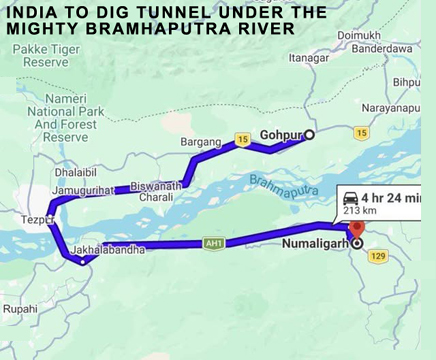
The numbers are staggering. A 33.7-km corridor from Gohpur on NH-15 to Numaligarh on NH-715, including a 15.79-km Tunnel Boring Machine-driven underwater stretch, will cut travel time between the north and south banks from nearly six hours to roughly 20–30 minutes. The project will operate in EPC mode, Engineering, Procurement and Construction, a structure increasingly favoured by governments worldwide because it shifts risk away from taxpayers toward contractors, while improving accountability in project delivery. In global infrastructure finance language, that means fewer cost overrun headaches, fewer insurance disputes, fewer arbitration battles with attorneys, and fewer desperate conference calls between bureaucrats and contractors trying to rescue sinking budgets.
But beyond numbers and acronyms lies a larger story, a story of connectivity, strategic ambition, economic recovery, regional integration, and the geopolitical signalling of a rising power determined to erase its infrastructure deficit.
Connectivity revolution in the northeast
For decades, India’s northeastern region has been geographically connected to the mainland by a narrow land corridor often called the “Chicken’s Neck.” Within the region itself, riverine barriers, especially the Brahmaputra — created enormous logistical challenges. A trip between Numaligarh and Gohpur currently requires a 240-km detour via Kaliabhomora bridge near Silghat, passing through sensitive ecological zones including Kaziranga National Park. That journey consumes nearly six hours and involves fuel costs, gas/electricity usage, vehicle wear, and lost productivity that quietly accumulate into massive economic inefficiencies.
With the new underwater alignment, distance drops to about 34 km. In development economics terms, that is not merely a transport improvement, it is a structural economic transformation. The World Bank has repeatedly demonstrated through infrastructure impact studies that reducing travel time between production and consumption centres produces disproportionate gains in GDP growth. Freight costs fall, supply chains become predictable, and businesses gain confidence to invest. When logistics improves, banks feel safer issuing loans, insurance companies reduce premiums, and investment banks begin structuring infrastructure bonds.
The Northeast Frontier Railway integration is equally crucial. The tunnel will connect the Rangia-Mukongselek line and the Furkating-Mariani loop line, creating multimodal synergy rarely achieved in India’s past projects. Multimodal infrastructure, combining road, rail, waterways, and airports, is considered the gold standard globally, as emphasised in reports by McKinsey & Company and Deloitte, which highlight that integrated transport corridors can reduce logistics costs by 10–20 percent in emerging economies.
Strategic and defense significance beyond economics
Infrastructure in frontier regions is never just about commerce. It is about sovereignty. The Northeast shares borders with China, Myanmar, Bhutan, and Bangladesh. Rapid troop and equipment transfer capability is a national security multiplier. During crises, roads can collapse, bridges can be targeted, or weather can disrupt mobility. An underwater tunnel provides redundancy, a secure alternative route resistant to floods, storms, or sabotage.
Strategic analysts at think tanks such as the Observer Research Foundation have long argued that border infrastructure parity with China is essential. Beijing’s western provinces boast world-class highways and railways reaching sensitive border zones. India’s response has accelerated dramatically in the past decade, and the Brahmaputra tunnel is part of that broader strategic doctrine. Military logistics planners understand that mobility equals deterrence. A 20-minute crossing instead of a six-hour detour changes operational readiness entirely.
There is also psychological messaging. Infrastructure megaprojects signal state capacity. When investors, diplomats, or adversaries observe a nation building underwater tunnels, they infer institutional competence, the ability to manage complexity, coordinate agencies, and deliver results. That perception influences foreign investment flows as much as tax incentives or credit ratings.
Economic nodes and regional development
The corridor is designed to connect 11 economic nodes, eight logistics nodes, three social nodes, and two tourism nodes. Industrial hubs such as Numaligarh Industrial Area, IIDC Titabor, Industrial Estate Nagaon, IIDC Demow, and the multimodal logistics park at Jogighopa will benefit directly. Access to airports including Tezpur and Donyi Polo Airport improves business mobility, while inland waterway terminals at Biswanath Ghat and Tezpur enhance river transport integration.
From a business chamber perspective, organisations like the Confederation of Indian Industry and FICCI often emphasise that infrastructure connectivity determines investment decisions more than tax incentives. A manufacturing company considering a plant location evaluates transportation costs, energy reliability, labour availability, and regulatory ease. If trucks take six hours to cross a river, that location loses competitiveness. If crossing takes 20 minutes, the equation flips dramatically.
This is how infrastructure becomes an economic catalyst. New hotels appear, hosting conferences and trade fairs. Logistics firms open warehouses. Training classes emerge to prepare local youth for jobs. Universities introduce specialised degrees in civil engineering, tunnelling technology, and infrastructure management. Healthcare facilities expand to handle population growth, offering treatment and rehab services that previously required long travel. Even niche industries like cord blood banking or medical tourism can emerge once connectivity improves.
Employment and human capital impact
The government estimates around 80 lakh person-days of employment during construction. That figure includes direct jobs — engineers, machine operators, surveyors — and indirect jobs such as supply chain workers, food vendors, accommodation providers, and service staff. Infrastructure employment has multiplier effects; each worker earning wages spends money locally, boosting retail and services.
Consulting studies by PwC indicate that large infrastructure projects often create three to five times more indirect employment than direct construction jobs. For regions with historically limited industrialisation, such projects become human capital incubators. Workers gain technical skills transferable to future projects across the country or abroad. Skilled tunnelling workers from India are already employed in Middle Eastern megaprojects, demonstrating how domestic infrastructure investment can export expertise.
Financial inclusion also grows alongside infrastructure. Workers open bank accounts to receive wages. They access credit for motorcycles or housing mortgages. Insurance penetration rises as contractors mandate coverage for safety compliance. Micro-entrepreneurs take loans to start roadside businesses. Infrastructure, in short, becomes a gateway to financial empowerment.
Global comparisons and technological context
Underwater tunnels are among the most complex engineering feats. Europe’s Channel Tunnel connecting the United Kingdom and France remains the iconic example, while Asia boasts advanced projects like Japan’s Seikan Tunnel and China’s numerous river crossings. India entering this league is a milestone.
The Tunnel Boring Machine technology used in the Brahmaputra project represents decades of innovation. Modern TBMs operate with advanced sensors, AI-driven navigation software, and automated segment installation. Construction companies rely heavily on digital twins — virtual simulations predicting geological conditions and structural behaviour. These software systems reduce risk, prevent collapse incidents, and optimise maintenance planning.
Infrastructure financing models have also evolved. Governments combine budget allocations with sovereign borrowing, multilateral agency support, and sometimes private participation. Agencies like the Asian Development Bank frequently support transport corridors in Asia, recognising their role in regional integration. Even when projects are domestically funded, global financial markets monitor them closely because they influence national credit ratings and investment sentiment.
Environmental considerations and sustainability
Building beneath one of Asia’s largest rivers inevitably raises environmental concerns. The Brahmaputra supports biodiversity, fisheries, and agriculture. Engineering designs therefore include advanced monitoring systems to prevent water leakage, sediment disruption, or ecological damage. Environmental impact assessments typically involve multiple agencies, independent experts, and mitigation strategies such as wildlife corridors or pollution control measures.
Interestingly, improved connectivity can reduce environmental pressure in certain areas. Currently, long detours through Kaziranga contribute to traffic congestion and vehicle emissions inside a sensitive wildlife zone. A direct tunnel route could reduce that ecological burden significantly. Sustainable infrastructure is increasingly viewed not as a contradiction but as a necessity — something global climate frameworks also emphasise.
Logistics efficiency and trade expansion
India’s logistics costs historically hovered around 13–14 percent of GDP, higher than global benchmarks. Reducing this figure is essential for manufacturing competitiveness. Multimodal corridors like the Brahmaputra tunnel contribute directly to cost reduction by shortening routes and improving reliability. Freight companies can schedule deliveries precisely, reducing inventory holding costs. Manufacturers benefit from just-in-time production models.
Trade expansion is not limited to domestic markets. The Northeast serves as India’s gateway to Southeast Asia under the Act East policy. Improved connectivity strengthens cross-border trade with Myanmar and beyond. Exporters transporting tea, petroleum products, or manufactured goods gain time savings that translate into price competitiveness internationally. Commodity trading firms monitor such infrastructure developments because transport efficiency directly affects arbitrage opportunities and profit margins.
Tourism and cultural economy
Tourism stands to gain enormously. Assam’s natural beauty, wildlife sanctuaries, and heritage sites attract visitors, but accessibility has always been a constraint. Faster connectivity encourages weekend tourism from neighbouring states and boosts hospitality investment. Hotels, resorts, restaurants, and adventure tourism companies emerge around improved transport corridors.
Tourism economics often produces high employment intensity relative to investment. A new highway or tunnel can trigger dozens of small enterprises — homestays, transport services, handicraft shops, cultural performances. Local communities benefit directly, and governments gain tax revenue. The multiplier effect spreads through rural economies, supporting artisans, farmers, and service providers.
Financial ecosystem ripple effects
Large infrastructure projects create ripple effects across the financial ecosystem. Banks provide project finance loans to contractors. Insurance companies issue policies covering equipment, workers, and liability risks. Law firms and attorneys manage contracts, disputes, and compliance. Investment banks structure bonds or refinancing packages. Credit rating agencies evaluate fiscal impact on government balance sheets.
Even unrelated sectors feel the impact. Real estate developers anticipate rising land values near new corridors, offering housing mortgages to buyers. Small businesses seek working capital loans to expand operations. Technology firms provide software solutions for project management and traffic monitoring. Telecommunication companies invest in network expansion to serve new economic clusters. Infrastructure is therefore not just concrete and steel; it is a financial ecosystem generator.
Governance, policy, and execution challenges
Megaprojects inevitably face challenges — land acquisition disputes, geological surprises, cost overruns, contractor conflicts, or environmental litigation. Effective governance determines success. India’s shift toward EPC contracts reflects lessons learned from past public-private partnership failures where revenue projections proved unrealistic. Under EPC, the government bears financing responsibility but transfers execution risk to contractors, ensuring clearer accountability.
Transparency mechanisms also matter. Digital dashboards tracking progress, drone monitoring of construction sites, and public disclosure of milestones reduce corruption risks. International experience shows that governance quality often determines whether megaprojects become national pride or financial burdens.
Infrastructure as political narrative
Infrastructure has always been political theatre. From American interstate highways under President Eisenhower to China’s Belt and Road Initiative, governments use infrastructure to demonstrate leadership. In India, megaproject announcements generate headlines, boost public confidence, and reinforce narratives of national transformation. Critics may debate priorities, but visible infrastructure progress is hard to ignore.
Political messaging also influences investor sentiment. When investors perceive policy stability and execution capacity, they feel safer committing capital. Infrastructure pipelines signal long-term economic momentum, encouraging domestic and foreign investment. For regions like the Northeast, historically seen as remote, such projects rebrand them as opportunity zones.
Social transformation and quality of life
Beyond economics and strategy lies the human dimension. Imagine a patient needing urgent medical treatment who previously endured hours of travel to reach a hospital. With improved connectivity, emergency response times drop dramatically. Education access improves as students commute more easily to colleges offering specialised degrees. Families maintain social ties across riverbanks that once felt distant.
Quality of life improvements often translate into demographic shifts. Young professionals are more willing to live and work in regions with good infrastructure. Businesses relocate operations to lower-cost areas once connectivity barriers disappear. Urbanisation patterns evolve, creating new growth centres. Sociologists call this “infrastructure-driven spatial transformation,” a phenomenon observed globally.
Technology, innovation, and knowledge spillovers
Megaprojects act as laboratories for innovation. Engineers develop new techniques, materials, and safety protocols that later spread across industries. Universities collaborate with contractors, producing research and training programs. Domestic companies gain expertise that can be exported internationally, enhancing national competitiveness.
India’s growing infrastructure sector increasingly integrates advanced technologies — sensors monitoring structural health, AI-based traffic management, predictive maintenance systems. These innovations create opportunities for startups and technology firms. Software companies providing analytics, cybersecurity, or digital infrastructure management benefit from government projects as anchor clients.
Risks, resilience, and long-term sustainability
Every megaproject carries risks — financial, environmental, technical, and social. Climate change adds new uncertainties such as extreme rainfall or flooding. Engineers therefore design resilience features, including drainage systems, emergency evacuation routes, and monitoring sensors. Long-term maintenance planning is crucial; tunnels require regular inspection, ventilation upgrades, and structural repairs over decades.
Funding maintenance is often overlooked. Governments must allocate resources for lifecycle costs, not just construction. International experience shows that neglecting maintenance can turn infrastructure assets into liabilities. Sustainable financing models, including toll revenues or dedicated maintenance funds, ensure longevity.
A symbol of India’s infrastructure era
The Brahmaputra underwater tunnel represents more than a transport project. It symbolises India’s transition from incremental development to bold engineering ambition. It reflects confidence in domestic capability, willingness to invest heavily in frontier regions, and recognition that infrastructure drives economic destiny.
From insurance policies protecting workers to loans financing equipment, from attorneys drafting contracts to engineers deploying cutting-edge software, from investment banks analysing fiscal impact to local entrepreneurs opening businesses, the project’s ripple effects will extend far beyond Assam. It will influence trade patterns, employment trends, strategic calculations, and national psychology.
When completed, vehicles and trains will glide beneath the mighty Brahmaputra in minutes — a journey that once took half a day. Passengers may barely notice the engineering marvel around them. But economists, strategists, and policymakers will recognise what it represents: a nation diving confidently into the future, determined to bridge geography, accelerate recovery, and transform opportunity through infrastructure.