
Wood dominates American housing primarily because it is cheap, fast, and financially efficient within the country’s lending architecture. According to studies by the National Association of Home Builders and consulting analyses from McKinsey, wood-frame houses can cost 20–40 percent less than reinforced concrete structures in many U.S. regions
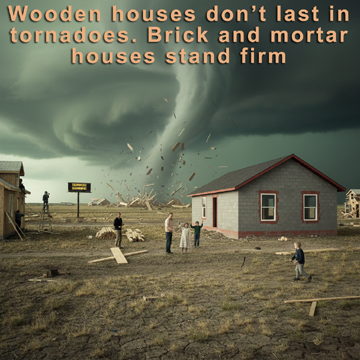
Tornado alley, timber dreams and the great American housing paradox. Every time a tornado watch flashes across television screens in Texas — sirens blaring from Houston to Galveston — the same global question resurfaces with astonishing predictability: why on earth are Americans still building wooden houses in one of the world’s most violent storm corridors? To observers from countries where concrete, brick, and steel dominate residential construction, the sight of entire neighborhoods shredded into splinters looks less like natural disaster and more like engineering negligence. Yet the reality is far more complex than the viral meme narrative of “flimsy wooden toy houses.” The American housing ecosystem sits at the intersection of economics, insurance markets, mortgage financing, labor supply, climate science, cultural preference, and regulatory frameworks. To understand why timber homes continue to rise in tornado-prone regions, one must follow the money — from construction costs to insurance premiums, from credit markets to investment bank securitization models — rather than simply blaming builders or homeowners.
Cost, credit and the irresistible math of wood
Wood dominates American housing primarily because it is cheap, fast, and financially efficient within the country’s lending architecture. According to studies by the National Association of Home Builders and consulting analyses from McKinsey, wood-frame houses can cost 20–40 percent less than reinforced concrete structures in many U.S. regions. That difference is decisive when families depend on long-term mortgage loans. A $300,000 house financed over 30 years with interest becomes dramatically more expensive if construction costs rise by even 15 percent. Mortgage affordability calculations — the backbone of American housing demand — push builders toward timber.
Banks and mortgage lenders rely on predictable valuation models. Wood construction fits standardized appraisal software, risk models, and securitization frameworks used by government-backed entities like Fannie Mae and Freddie Mac. These loans are bundled into mortgage-backed securities sold through investment banks to global investors. Financial efficiency, not structural strength, becomes the dominant driver. When lenders run credit risk simulations during underwriting conference calls, the difference between concrete and wood rarely appears as a decisive factor because insurance coverage absorbs disaster risk.
Insurance is the silent hero — and villain — in this story. Homeowners insurance spreads catastrophe losses across national risk pools. If a tornado destroys a house, insurers pay claims, and rebuilding begins quickly. The economic recovery cycle depends on reconstruction spending. Deloitte catastrophe modeling reports show that insurance payouts after disasters often stimulate local economies through rebuilding activity, creating a perverse incentive structure: destruction followed by recovery spending keeps economic wheels turning.
Insurance economics: rebuilding as a business model
The American insurance industry operates on probability models refined over decades. Tornado risk, hurricane exposure, termite damage, moisture rot — all are quantified. Premiums adjust accordingly. A homeowner in Texas pays more than one in Arizona, but the difference is rarely high enough to discourage construction. Government disaster relief programs further reduce perceived risk. The Federal Emergency Management Agency provides financial assistance after major disasters, effectively subsidizing rebuilding.
Contrast this with countries where insurance penetration is low and households bear direct losses. In India or Southeast Asia, a destroyed house may mean financial ruin. Consequently, families invest heavily in durable materials like concrete despite higher upfront costs. In the United States, the presence of insurance and government aid shifts incentives toward affordability and speed rather than permanence.
Global consulting firm PwC has noted that disaster insurance markets create “reconstruction resilience cycles,” where communities rebuild repeatedly without fundamental structural change because financial systems support repetition. It may look irrational from outside, but economically it functions.
Climate science versus construction culture
Texas faces multiple environmental threats: tornadoes, hurricanes, humidity, termites, and flooding. Wood structures are vulnerable to moisture absorption, rot, and pest infestation. Yet wood also possesses advantages — flexibility during wind loads and rapid repairability. Engineering studies from the American Society of Civil Engineers show that properly anchored wood-frame homes can withstand moderate tornado winds, especially EF2 or EF3 events. Catastrophic EF4 and EF5 tornadoes, however, destroy nearly all residential structures regardless of material.
Concrete houses do offer superior resistance, particularly insulated concrete forms capable of withstanding winds exceeding 200 mph. But they cost more, require specialized labor, and take longer to build. Labor shortages in the U.S. construction industry further reinforce wood dependence. Training workers for concrete construction demands technical classes, certifications, and sometimes engineering degrees that are less common among residential contractors.
In countries like Japan, strict building codes and seismic engineering expertise produce highly resilient structures despite frequent earthquakes. The difference lies in regulatory philosophy: Japan prioritizes structural resilience; the U.S. prioritizes affordability and housing supply volume.
Mortgage markets and the politics of affordability
Housing affordability is a politically explosive issue in America. Rising home prices threaten middle-class stability, voter sentiment, and economic growth. Policymakers therefore encourage construction methods that maximize supply. Wood framing allows faster housing production, reducing shortages. Government-sponsored mortgage programs amplify demand by offering low-down-payment loans, tax deductions on mortgage interest, and credit incentives for first-time buyers.
If regulations suddenly required concrete homes in tornado zones, housing costs would surge. Millions of households would lose eligibility for loans. Real estate markets could freeze. Investment banks holding mortgage-backed securities would face valuation shocks. Policymakers understand this domino effect, which is why structural mandates remain limited.
The U.S. Chamber of Commerce has repeatedly warned that housing supply constraints could reduce GDP growth by limiting labor mobility. Workers cannot relocate for jobs without affordable housing. Thus, construction material choices indirectly influence national economic productivity.
Disaster recovery as economic stimulus
Natural disasters are tragedies, but they also generate measurable economic activity. Reconstruction spending boosts employment in construction, materials manufacturing, logistics, and retail sectors. Government stimulus funds often accompany rebuilding. Economists sometimes call this the “broken window paradox,” though modern research recognizes both positive and negative effects.
After major hurricanes in Texas, billions flow into the region for rebuilding. Contractors receive loans, homeowners file insurance claims, suppliers increase production, and banks process financing transfers. Recovery becomes an economic engine. From a purely macroeconomic perspective, repeated rebuilding may appear inefficient, but localized economies benefit in the short term.
Consulting analyses from the World Bank and OECD show that disaster recovery spending can temporarily increase GDP growth, though long-term productivity may suffer. Policymakers therefore balance resilience investments against economic constraints.
Cultural psychology and the American dream
Beyond economics lies culture. The American dream historically includes homeownership — a detached house with a yard, often built of wood. Timber construction dates back centuries, rooted in abundant forests and frontier expansion. Cultural inertia matters. People build what they know, trust, and can afford.
Wood also offers customization flexibility. Homeowners can renovate, add rooms, or remodel interiors easily. Contractors require fewer specialized tools compared to concrete construction. For families juggling education expenses, student loans, medical treatment bills, and daily utilities like gas and electricity, affordability outweighs structural durability concerns.
Termites, moisture and maintenance economics
Wooden homes in humid regions face termite infestation risks. Subterranean termites can destroy structural beams silently. Repair costs may reach tens of thousands of dollars, sometimes exceeding insurance coverage limits. Moisture exposure causes rot and mold, creating health hazards requiring expensive treatment and rehab efforts for occupants with respiratory issues.
Yet maintenance economics still favor wood. Repairs are easier and cheaper compared to concrete structural damage. Homeowners view maintenance as manageable rather than catastrophic. Pest control services, moisture barriers, and chemical treatments mitigate risks.
Global housing studies by UN-Habitat show similar patterns in tropical countries where wood or bamboo remains common despite environmental challenges due to affordability and availability.
Structural reality: concrete is stronger but not invincible
Brick and concrete houses provide superior resistance to wind and debris, particularly when reinforced with steel. However, they are not tornado-proof. Roof failure remains the primary vulnerability in most homes regardless of wall material. Once a roof lifts off under extreme wind pressure, internal pressure increases, causing wall collapse.
Engineering research indicates that underground or reinforced tornado shelters provide the highest survival probability. Many American homes include storm shelters or safe rooms installed during construction or retrofitted later. Insurance companies sometimes offer premium discounts for such safety features, aligning financial incentives with resilience.
Global comparisons: why other countries build differently
Developing nations often rely on concrete because labor costs are lower relative to materials. In India, for example, manual labor is inexpensive, making concrete construction financially viable despite higher material costs. Additionally, families treat houses as multi-generational assets rather than 30-year mortgage products. Durability matters more than speed.
In Europe, stricter energy efficiency standards and fire regulations encourage masonry construction. Government subsidies for energy-efficient buildings offset costs. Housing finance systems differ significantly from the U.S., reducing reliance on standardized wood models.
Japan’s earthquake-resistant steel and concrete structures reflect another risk environment. Regulatory enforcement and cultural acceptance of higher costs enable resilience.
Thus, American wooden housing is not stupidity but a rational outcome of financial, regulatory, and cultural variables.
The insurance-mortgage-construction triangle
Three forces dominate American housing decisions: insurance companies, mortgage lenders, and builders. Builders choose materials that satisfy lender appraisal requirements and buyer affordability constraints. Lenders rely on insurance to mitigate risk. Insurance companies adjust premiums but rarely prohibit construction.
This triangle forms a stable equilibrium resistant to change. Breaking it would require major policy intervention, such as subsidies for concrete construction or stricter building codes — both politically challenging.
Risk perception and human behavior
Humans underestimate low-probability catastrophic risks. Behavioral economists call this “normalcy bias.” Residents of tornado-prone areas often believe disasters will not strike them personally. When storms occur, communities rebuild quickly, reinforcing the cycle.
Risk perception also depends on visibility. Termite damage and moisture rot occur gradually and privately, while tornado destruction appears dramatic but rare. Consequently, homeowners prioritize immediate affordability over long-term resilience.
Technology, materials and future innovation
Advances in construction technology may change the equation. Insulated concrete forms, cross-laminated timber, steel framing hybrids, and modular construction methods promise stronger yet affordable housing. Construction software modeling allows engineers to simulate wind loads and optimize designs. Investment banks are increasingly funding prop-tech startups developing resilient materials.
Government research agencies explore building codes integrating climate resilience without excessive cost increases. Insurance companies also incentivize resilient construction through premium discounts.
Disaster narratives and media sensationalism
Media coverage often portrays American wooden houses as laughably weak compared to concrete structures elsewhere. Viral images of flattened neighborhoods reinforce stereotypes. Yet similar destruction occurs globally when extreme storms hit poorly built structures of any material. Sensational narratives ignore nuanced engineering realities.
Moreover, disaster coverage rarely highlights survival statistics showing many wood homes withstand moderate storms when properly constructed. Nuance does not trend on social media; outrage does.
Financial vulnerability of homeowners
Behind structural debates lies household financial stress. Many American families already carry significant debt — mortgages, car loans, student loans, credit card balances. Adding higher construction costs could push homeownership beyond reach. Policymakers therefore prioritize affordability to maintain social stability.
Healthcare costs add another burden. Families saving for medical treatment, rehab therapy, or specialized procedures like cord blood banking often cannot afford expensive housing upgrades. Economic trade-offs shape risk tolerance.
Government policy dilemmas
Should governments mandate stronger houses in disaster zones? Economists warn that strict regulations could increase housing shortages, raise rents, and worsen inequality. Yet inadequate resilience increases disaster costs and insurance payouts. Policymakers must balance competing priorities: affordability, safety, and fiscal responsibility.
The World Bank recommends targeted subsidies for resilient construction rather than blanket mandates. This approach encourages safer housing without crippling affordability.
Lessons for climate-vulnerable nations
As climate change intensifies storms globally, many countries will face similar dilemmas. Rapid urbanization demands affordable housing, yet resilience becomes increasingly important. The American experience illustrates how financial systems shape construction choices. Nations designing housing policies today can integrate resilience earlier to avoid future rebuilding cycles.
Conclusion: rational choices in an irrational storm world
Calling Americans stupid for building wooden houses in tornado zones oversimplifies a deeply interconnected system of finance, insurance, culture, and policy. Wood persists because it aligns with mortgage markets, insurance models, labor availability, and affordability politics. Concrete may be stronger, but economics often wins over engineering ideals.
The real lesson is not about wood versus concrete. It is about incentives. When insurance spreads risk, mortgages demand affordability, and governments prioritize housing supply, construction choices follow predictable patterns. Until those incentives change, timber homes will continue rising across Texas plains — vulnerable yet financially rational — waiting for the next tornado warning to test the balance between nature, economics, and human optimism.