Either its tariffs or a military flotilla. Trump fulfills the definition of a boorish bully with no sense of future consequences. A second aircraft carrier in the Mediterranean will help Israel fulfill its own goals while Iran is kept busy
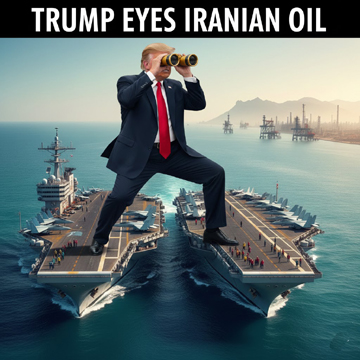
In global politics, pressure can arrive in many forms. Sometimes it is economic — tariffs, sanctions, restrictions on Insurance markets, blocked Loans, frozen Credit lines, and suspended Trading privileges. Other times it is unmistakably kinetic — a military flotilla moving across warm waters, aircraft carriers positioned within striking range, guided-missile destroyers slicing through strategic chokepoints. The choice between tariffs and a carrier strike group is rarely just tactical. It is symbolic. It signals how a leader views leverage, consequences, and the future.
When President Donald Trump announced that the United States would send a second aircraft carrier to the Middle East “very soon,” he framed it as readiness. “If we need it, we’ll have it ready, a very big force,” he said at the White House, while also expressing confidence that negotiations with Iran would be “successful.” The carrier in question, the USS Gerald R. Ford, would reportedly depart the Caribbean for the region amid heightened tensions following indirect talks in Oman.
The message was unmistakable: diplomacy would proceed but backed by steel and nuclear reactors.
Yet critics argue that this style of brinkmanship resembles the posture of a boorish bully — heavy on theatrics, light on long-term consequence management. They ask whether the United States, under such leadership, is thinking through the Insurance costs of escalation, the economic Loans required to sustain prolonged deployments, and the Credit risk to global stability if miscalculation turns warning into war.
The carrier and the conference table
Trump’s announcement came days after a meeting with Israeli Prime Minister Benjamin Netanyahu in Washington. Netanyahu suggested that a “good deal” with Iran might be possible but voiced reservations if any agreement did not curb Tehran’s ballistic missile program. Tehran has publicly rejected pressure to include missiles in negotiations, insisting that its deterrent capabilities are non-negotiable.
Meanwhile, the US carrier strike group buildup in the region has included the USS Abraham Lincoln, guided-missile destroyers, fighter jets, and surveillance aircraft. The deployment of the Ford, a nuclear-powered supercarrier capable of hosting more than 75 aircraft, adds considerable weight.
In theory, military readiness strengthens diplomatic leverage. In practice, it can complicate negotiations. Diplomacy thrives in quiet rooms and steady pacing. Carrier deployments operate on spectacle.
Modern negotiations often involve encrypted Conference Call sessions between diplomats, intelligence officials, and allied governments. The choreography matters. Every public statement is parsed. Every deployment is interpreted.
When military hardware arrives before ink dries on draft frameworks, it raises the question: is the United States Hosting talks or Hosting escalation?
From JCPOA to zero enrichment
The current tensions trace back to the unraveling of the Joint Comprehensive Plan of Action. The JCPOA had required Iran to curtail aspects of its nuclear program in exchange for sanctions relief. Trump withdrew the United States from the deal during his first term, calling it insufficient. Following that withdrawal, Tehran began enriching uranium beyond the limits set by the agreement, though it continues to deny seeking a nuclear weapon.
Upon returning to office, Trump initially signaled openness to a new deal. However, he soon adopted a zero-enrichment stance — a position Iranian negotiators have repeatedly described as a non-starter.
Diplomacy often involves incremental adjustments, calibrated Trade-offs, and carefully structured Transfer of obligations. A zero-enrichment policy demands absolute surrender on a core sovereignty issue. It is akin to telling a counterpart in a high-stakes negotiation that only full capitulation will suffice.
That approach may energize domestic political audiences. It may also stall progress entirely.
The rhetoric of regime change
Trump later suggested that a change of government in Iran would be the “best thing that could happen.” Such remarks are politically explosive. They blur the line between negotiation and overt support for regime change.
Questions swirl about past comments regarding support for Iranian dissidents. Critics ask pointedly: what happened to the lists that were allegedly discussed, the names that intelligence agencies were said to want? Such insinuations, whether grounded or speculative, feed a narrative of covert interference.
International relations operate on perception as much as reality. Even the suggestion of assassination lists, real or imagined, can poison diplomatic space.
Iran’s leadership is unlikely to engage constructively while publicly told that their removal is desirable. In any negotiation, threatening the other side’s political survival undermines trust.
Risk of escalation in a fragile region
Gulf Arab states have warned that further attacks could trigger another regional conflict. The Middle East remains destabilized from years of war, including Israel’s recent 12-day conflict with Iran, during which the United States briefly joined by striking three Iranian nuclear sites in an operation dubbed “Midnight Hammer.”
At the time, Trump declared that the strikes had “totally obliterated” the facilities. Yet the head of the International Atomic Energy Agency, Rafael Grossi, has since described inspection efforts as “imperfect and complicated and extremely difficult.”
Inspectors reportedly returned after the conflict but have not been able to visit the targeted sites. Verification is the backbone of nonproliferation. Without it, claims and counterclaims dominate headlines.
Escalation in this context is not merely military. It ripples through oil markets, Gas/Electricity prices, Insurance premiums for shipping, and sovereign Credit ratings. Investors respond to uncertainty. Trading desks watch missile trajectories and diplomatic tweets with equal intensity.
A single miscalculation can spike crude oil prices overnight, affecting Mortgage rates in distant suburbs, student Loans, and the affordability of basic commodities.
The economics of brinkmanship
Military deployments are expensive. Carrier strike groups require fuel, maintenance, personnel support, and long logistical chains. Defense budgets absorb these costs, often financed through federal borrowing.
In domestic terms, that borrowing intersects with debates about infrastructure, healthcare Treatment, and education funding. Every billion spent at sea is a billion not spent on community Classes, Rehab facilities for veterans, or technological innovation in civilian Software sectors.
Supporters argue that deterrence prevents greater costs. Critics counter that constant high-tension deployments drain resources and increase the probability of unintended conflict.
There is also a hidden Insurance calculus. Global insurers price risk across maritime routes. War risk premiums rise when naval forces concentrate in volatile regions. That cost eventually filters into consumer prices.
Economic pressure, including tariffs and sanctions, operates differently. It weaponizes market access and Credit lines. Yet tariffs can also rebound domestically, raising prices and harming exporters.
The choice between tariffs and carriers is not binary. It is strategic layering. But layering without foresight can create cumulative strain.
Diplomacy as discipline, not spectacle
Negotiations are rarely cinematic. They are methodical. Teams draft frameworks, Attorneys scrutinize clauses, Lawyers debate interpretations, and technical experts review compliance mechanisms. The architecture of a nuclear agreement resembles a dense legal document more than a dramatic speech.
Every enrichment limit, every inspection protocol, every Transfer of material is defined in painstaking detail.
Public declarations of “very big force” may energize domestic constituencies, but they complicate delicate talks. Diplomacy requires discipline. It requires restraint in language and patience in posture.
The art of negotiation is less about dominance and more about sequencing.
The shadow of domestic politics
Foreign policy does not unfold in isolation. Leaders balance domestic audiences, party bases, and electoral cycles. Strong rhetoric can rally supporters. Yet international counterparts calculate differently.
For Iran’s leadership, concessions risk internal backlash. For Gulf states, instability threatens economic modernization plans. For Israel, missile programs represent existential risk.
Every actor conducts its own risk assessment.
Meanwhile, in the United States, public discourse often simplifies complex geopolitical realities into slogans. The narrative of strength versus weakness overshadows granular analysis of consequences.
Technology, surveillance, and modern warfare
The USS Gerald R. Ford represents cutting-edge naval technology. Its nuclear reactor enables extended deployment without refueling. Its electromagnetic aircraft launch system modernizes sortie generation. It is a floating fortress.
But modern warfare also involves cyber capabilities, AI-driven Software analytics, and satellite surveillance. Military superiority is not only about hardware. It is about integration.
Ironically, many of the tools that monitor nuclear sites, analyze ballistic trajectories, and assess battlefield conditions rely on civilian-developed Software ecosystems. Engineers with advanced Degrees contribute as much to deterrence as sailors at sea.
The militarization of technology intersects with civilian innovation pipelines. Escalation risks diverting talent from medical Treatment research, renewable energy, and climate Recovery efforts into defense priorities.
Human consequences and humanitarian dimensions
Regional conflict would not remain confined to military installations. Civilian populations bear the brunt. Hospitals face strain. Infrastructure collapses. Displacement increases.
Rehab centers for trauma victims multiply. Insurance claims for destroyed property soar. International donors Donate funds for humanitarian relief.
The rhetoric of force rarely addresses the aftermath. Rebuilding requires long-term Recovery planning. It requires Loans from international institutions. It requires transparent governance and credible legal frameworks.
War’s end rarely matches its beginning in clarity.
Gulf warnings and energy markets
Gulf Arab nations have cautioned that escalation could spiral into broader conflict. The region remains economically tethered to global energy markets. Disruption would ripple worldwide.
Gas/Electricity supply chains are sensitive. Even rumors of conflict can affect pricing.
Energy-dependent economies face vulnerability. Importers confront inflation. Exporters fear infrastructure damage.
Military signaling must therefore account for economic interdependence.
The international watchdog and verification challenges
Rafael Grossi’s comments about inspection difficulties underscore a central tension: trust but verify. The International Atomic Energy Agency’s authority depends on access. Without site visits, assessments rely on indirect evidence.
Verification regimes are not symbolic. They are technical processes requiring cooperation.
When dialogue is “imperfect and complicated,” progress becomes incremental.
The nuclear file is not resolved by carriers alone.
Bully or strategist?
Critics describe Trump’s approach as that of a boorish bully — threatening tariffs or dispatching carriers without fully weighing long-term consequences. Supporters counter that only strength commands respect in adversarial contexts.
The truth may lie somewhere in between.
Leadership involves balancing deterrence with diplomacy. Excessive caution invites exploitation. Excessive aggression invites escalation.
Strategic foresight considers downstream effects: economic volatility, humanitarian crises, alliance cohesion, and global Credit stability.
The Middle East has endured decades of intervention, proxy conflict, and sanctions. Another spiral would deepen scars.
The path forward
A durable agreement requires compromise. It requires calibrated sanctions relief in exchange for verifiable constraints. It requires phased implementation.
It also requires political courage. Leaders must articulate why incremental progress matters more than maximalist rhetoric.
Carrier deployments can serve as insurance against aggression. They should not substitute for negotiation.
The ultimate objective is stability, not spectacle.
Consequences beyond the horizon
Tariffs and flotillas are tools. How they are used defines leadership.
Sending the USS Gerald R. Ford to the Middle East signals readiness. It also signals risk. Every action reverberates through Insurance markets, Loans, Mortgage rates, Credit systems, and humanitarian infrastructures.
Foreign policy is not a television show. It is a web of consequences.
If negotiations succeed, carriers will fade quietly into routine patrols. If they fail, escalation could reshape the region once again.
The measure of statesmanship lies not in the volume of force displayed but in the foresight applied. The world watches not only what leaders deploy, but what they build in the aftermath.