
This experiment in coercion by USA created short-term uncertainty for Indian exporters. It failed to significantly alter India’s energy policy. New Delhi maintained that its oil purchases from Russia and Iran were driven by national interest, price stability, and energy security—principles it would not abandon under external pressure
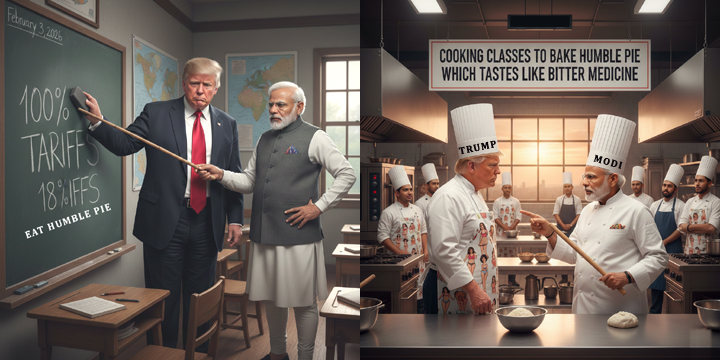
When Reuters confirmed that the United States had completely scrapped the 25% penal tariffs on Indian goods, it marked more than a routine adjustment in trade policy. It signalled the closing of a bruising chapter in India–U.S. economic relations and the opening of a recalibrated partnership shaped by strategic realism rather than punitive pressure. The headline numbers tell the story starkly: reciprocal tariffs cut from 25% to 18%, overall tariffs slashed from an effective 50% to 18%, and India emerging with one of the lowest reciprocal tariff rates in Asia.
Markets reacted instantly. The rupee rallied, benchmark indices Sensex and Nifty surged nearly 3%, and export-heavy sectors—from textiles and leather to gems, jewellery, seafood, and specialty chemicals—saw sharp gains. But beyond the celebratory market response lies a deeper narrative about India’s negotiating posture, the limits of coercive trade diplomacy, and the evolving geometry of global commerce in a fractured world.
President Donald Trump steps back: The end of a tariff experiment
The now-scrapped tariff regime was not merely about trade deficits or market access. The additional 25% penalty imposed by Washington was explicitly linked to India’s continued purchases of Russian oil amid the Ukraine war. By stacking a reciprocal tariff of 25% with a further 25% penalty, the U.S. had effectively imposed a 50% barrier on Indian exports—an extraordinary measure against a strategic partner.
This experiment in coercion produced mixed results at best. While it created short-term uncertainty for Indian exporters, it failed to significantly alter India’s energy policy. New Delhi maintained that its oil purchases were driven by national interest, price stability, and energy security—principles it would not abandon under external pressure. The rollback, therefore, is as much an admission of limited leverage as it is a concession.
Donald Trump’s announcement on February 2, 2026, cutting tariffs to 18%, reflects a pivot from pressure to pragmatism. It acknowledges that punitive tariffs against a large, diversified economy like India generate collateral damage for U.S. importers, consumers, and supply chains without guaranteeing political compliance.
Modi’s firm stand and the politics of economic sovereignty
Prime Minister Narendra Modi’s response framed the tariff cut as a victory for firm negotiation rather than confrontation. His statement celebrating reduced tariffs for “Made in India” products and emphasising cooperation between “the world’s largest democracies” was carefully calibrated. It projected calm confidence, avoiding triumphalism while underscoring India’s refusal to be browbeaten.
Domestically, this episode reinforces a central plank of the Modi government’s economic diplomacy: that India will engage deeply with global markets but not at the cost of strategic autonomy. The exclusion of sensitive sectors such as agriculture and dairy from the final trade deal—confirmed by Commerce Minister Piyush Goyal—fits squarely into this philosophy. These sectors are not just economic categories; they are political and social fault lines, supporting millions of livelihoods and deeply embedded in India’s rural economy.
By holding the line on agriculture and dairy, India has signalled that trade liberalisation will proceed on Indian terms, sequenced carefully to protect vulnerable constituencies while expanding opportunities in manufacturing and services.
The trade deal in its final stages
According to Piyush Goyal, the India–U.S. trade agreement is now in the final stages of detailing. Negotiating teams are ironing out technical processes, after which a joint statement will be issued and the agreement formally inked. The deliberate pace suggests a desire to avoid the rushed, headline-driven deals that often unravel later under domestic scrutiny.
What is already clear, however, is the broad architecture. Tariff reductions will apply across a wide basket of industrial and manufactured goods, particularly those where India has built global competitiveness. At the same time, politically sensitive areas—food security, smallholder agriculture, and dairy—remain outside the scope of concessions.
This balance explains why industry bodies have broadly welcomed the deal while farmers’ groups have not mobilised against it. It also reflects lessons learned from earlier trade negotiations, where poorly communicated concessions triggered domestic backlash.
Markets speak first: Stocks, Rupee, and sectoral winners
Financial markets are often the most immediate and unsentimental judges of policy credibility. Their reaction to the tariff rollback was unequivocal. Equity benchmarks jumped, the rupee strengthened, and export-oriented stocks led the rally. Textiles, leather goods, gems and jewellery, seafood exports, and specialty chemicals—sectors particularly sensitive to U.S. tariffs—outperformed sharply.
This response reflects expectations of volume recovery and margin expansion. An 18% tariff is still a cost, but it restores competitiveness relative to peers in Asia facing higher reciprocal rates. It also reduces uncertainty, allowing exporters to plan production cycles, negotiate long-term contracts, and invest in capacity expansion with greater confidence.
Finance Minister Nirmala Sitharaman’s comment that tariff reductions would help exports pick up was not mere reassurance; it was grounded in empirical experience. Even during the period of heightened tariffs, India’s exports showed resilience—a fact that becomes more significant in retrospect.
Export resilience under pressure: How PM Modi brought down the haughty US empire
One of the more understated aspects of this episode is how Indian exporters adapted during the tariff squeeze. Trade data for November showed that India’s overall exports continued to grow despite mounting U.S. tariffs. Shipments to the U.S. itself rebounded, even as exporters simultaneously deepened ties with existing partners and explored new destinations.
This diversification was not accidental. Over the past few years, India has systematically worked to strengthen trade routes with Europe, West Asia, Africa, and Southeast Asia. Free trade agreements, logistics improvements, and targeted export incentives have reduced overreliance on any single market.
In effect, the tariff pressure accelerated a strategic shift already underway. Indian firms learned to hedge geopolitical risk by spreading market exposure. When the U.S. tariffs are now reduced, they return not as dependent supplicants but as more confident, diversified players.
Trump, trade, and the question of Russian oil
Donald Trump’s assertion that Prime Minister Modi has promised to stop buying Russian oil adds a geopolitical layer to the deal. Whether this represents a firm commitment or a diplomatic interpretation remains to be seen. India has consistently stated that its energy decisions are based on availability and price, not geopolitical signalling.
What is clear is that the U.S. has chosen to resolve this issue through negotiation rather than punishment. The tariff rollback suggests that Washington recognises the limits of linking trade penalties to third-country policy disputes, especially when dealing with a partner that values strategic independence.
For Trump, the deal also offers a domestic political narrative: tariffs reduced, markets stabilised, and a major partner brought into closer alignment—at least rhetorically—on a key geopolitical issue.
India among Asia’s lowest tariff regimes: A strategic advantage
One of the most consequential outcomes of the deal is India’s new positioning within Asia. With reciprocal tariffs at 18%, India now enjoys one of the lowest tariff burdens in the region for access to the U.S. market. This has implications beyond bilateral trade.
Multinational firms evaluating supply chain diversification increasingly compare tariff regimes alongside labour costs, infrastructure, and political stability. A lower tariff rate enhances India’s attractiveness as a manufacturing and export hub, especially at a time when companies are seeking alternatives to overconcentration in any single country.
This advantage compounds India’s ongoing efforts under initiatives such as Make in India and Production Linked Incentives, creating a more compelling value proposition for global investors.
Agriculture and dairy: The red lines that held
The explicit exclusion of agriculture and dairy from the trade deal deserves special attention. These sectors are often where trade agreements unravel, and India’s negotiating stance here reflects a hard-earned understanding of domestic political economy.
Agriculture supports nearly half of India’s population, directly or indirectly. Dairy, dominated by small producers and cooperative structures, is particularly sensitive to import competition. Opening these sectors prematurely could trigger social disruption and political backlash disproportionate to any marginal economic gain.
By keeping these red lines intact, the government has preserved negotiating capital for future rounds, when domestic reforms and productivity gains may allow for more gradual liberalisation.
Industry confidence and the psychology of trade
Beyond balance sheets and tariff schedules lies the psychology of trade. Prolonged uncertainty is often more damaging than a known cost. The tariff rollback restores predictability, which is essential for exporters making multi-year investments.
Industry responses reflect this relief. Business leaders have framed the deal not just as a tariff cut but as a signal of mutual respect between two large economies. That perception matters. Trade thrives when partners believe disputes will be resolved through dialogue rather than sudden punitive measures.
A broader lesson in economic statecraft
This episode offers a broader lesson in economic statecraft for a fragmented global order. Tariffs wielded as blunt instruments can disrupt trade flows, but they rarely produce lasting political concessions. In contrast, sustained engagement, backed by credible alternatives and domestic resilience, shifts negotiating dynamics.
India’s experience illustrates this principle. By absorbing short-term pain, diversifying markets, and maintaining a firm but non-confrontational stance, it altered the cost-benefit calculation for the U.S. The result is not a zero-sum victory but a recalibrated relationship that better reflects mutual interests.
Looking Ahead: What the deal means for the next decade
As the final details are inked and the joint statement released, attention will turn to implementation. Tariff reductions must translate into actual market access, smoother customs procedures, and reduced non-tariff barriers. Monitoring mechanisms will matter as much as headline rates.
Over the longer term, the deal sets a precedent. It demonstrates that India can negotiate with major powers on relatively equal footing, leveraging market size, strategic relevance, and economic resilience. It also signals to other partners that India’s red lines are real, but so is its willingness to cooperate.
A reset, not an endpoint
The scrapping of punitive U.S. tariffs and the reduction of reciprocal rates to 18% mark a reset in India–U.S. trade relations, not an endpoint. It reflects the convergence of economic pragmatism, political calculation, and strategic patience.
For India, the outcome validates a negotiating strategy rooted in firmness without belligerence. For the U.S., it underscores the limits of coercion and the benefits of engagement with a rising economic power. For global markets, it offers a reminder that even in an era of fragmentation, dialogue can still prevail over disruption. As Prime Minister Modi noted, when two large democracies work together, the benefits extend beyond bilateral trade. In a world searching for stable anchors, this recalibrated partnership may yet prove to be one of them.