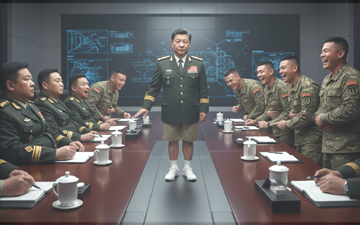
China’s military is an organisation ruled and run by one person, Xi Jinping. He has either sacked or killed all the generals in command. Effectively, the Chinese Army has become an army of pot bellied bureaucrats and party functionaries in uniform with hypertension
Recent high-profile purges at the summit of China’s military leadership — notably the investigation and removal of Gen. Zhang Youxia, vice chairman of the CMC and once a close ally of Xi, along with Joint Staff Department chief Liu Zhenli — encapsulate the scale of Xi’s consolidation. These actions have sparked urgent questions about the PLA’s capacity to think strategically and the implications for tensions across the Taiwan Strait.
The last decade has seen a transformation in the People’s Liberation Army (PLA) unlike any since Mao Zedong’s consolidation of the armed forces in the Chinese Communist Party’s early years. At the heart of this transformation is Xi Jinping, the general secretary of the Chinese Communist Party (CCP) and chairman of the Central Military Commission (CMC), who has systematically reshaped the PLA’s leadership, structure, and priorities. What has emerged is a military increasingly defined by political loyalty to one man rather than autonomous professional judgment, a development with repercussions for internal cohesion, combat readiness, and the balance of power in East Asia.
The rise of Xi as commander-in-chief without equal
Xi’s grip on the PLA is not incidental — it is structural.
The so-called chairman responsibility system, enshrined in Chinese law and practice, makes the CMC chair the decisive authority over the PLA, the People’s Armed Police, and China’s militia forces. This system ensures the CCP’s absolute control over its armed forces, and by extension makes Xi not just a political leader but the ultimate military commander.
Under Xi, the focus on absolute party control has intensified. This was not an overnight shift; other Chinese leaders, including Deng Xiaoping, Jiang Zemin, and Hu Jintao, maintained CCP authority over the military. However, Xi has turned personal loyalty into a core criterion for leadership, often at the expense of professional military competence. Analysts note that loyalty now outweighs experience or skill, reshaping promotions and assignments across the PLA’s ranks.
This trend has important implications: while political control over armies is common in authoritarian states, hyper-centralization around a single individual — and the associated elimination of independent military judgment — carries distinct strategic risks.
Purges and the politicization of the officer corps
Xi’s anti-corruption campaign, which began soon after he took power in 2012, rapidly spread to the armed forces. Generals, admirals, and senior officials were investigated, demoted, or expelled from the CCP on charges ranging from financial misconduct to political disloyalty. In some cases, entire branches of the military command were restructured.
However, the recent downfall of Zhang Youxia stands apart in both symbolism and impact. Zhang, a veteran of the 1979 conflict with Vietnam, was once considered untouchable. His sudden fall — alongside other significant commanders — signals a deeper shift: that no individual within the PLA hierarchy is safe from Xi’s authority, regardless of past service or personal ties. Observers interpret these moves not merely as anti-corruption measures but as explicit statements about political loyalty. Analysts argue that the message is unmistakable: “Political loyalty stands well before combat readiness.”
Such closures consolidate Xi’s control but create a vacuum of experienced voices at the top. With many seasoned generals removed, there are concerns that fearing reprisal, senior officers will be less inclined to offer candid advice, especially if it runs counter to Xi’s ambitions.
The paradox of modernization and combat effectiveness
China’s military modernization effort is often described as rapid, thorough, and strategic. The PLA has expanded its navy, developed advanced fighter aircraft and hypersonic missiles, and deployed increasingly sophisticated joint command structures. In some areas, it is believed to rival the capabilities of advanced Western militaries, narrowing gaps that once defined the U.S. military advantage.
Yet size and technology do not automatically yield combat effectiveness. The RAND report highlights a crucial paradox: despite rapid equipment modernization, the PLA’s ability to translate those tools into battlefield success remains far from proven. There has been no genuine test of China’s modernized forces in high-intensity conflict since 1979, and therefore considerable uncertainty remains about how these forces would perform under actual combat conditions.
This discrepancy between hardware and warfighting performance is rooted in deeper structural issues. While the PLA fields impressive systems, its leadership still prioritizes the preservation of CCP rule and political reliability over practical wartime preparedness. This orientation shapes training, promotions, assessments, and strategic planning.
Political reliability versus military professionalism
One of the central insights of the RAND analysis is that the PLA’s focus has historically been on upholding CCP rule rather than preparing for war — and this remains the case today. The PLA began as the armed wing of the CCP in the early 20th century, and that identity persists in its core mission orientation.
From the suppression of internal uprisings to its role in domestic governance, the PLA has been conditioned to value party loyalty above all. In Xi’s era, this commitment has been amplified: political commissars and party committees operate within military units to oversee personnel and to enforce ideological conformity, often at the expense of operational flexibility. The emphasis on political work — and the suspicion of independent military judgment — risks stifling initiative and adaptability.
This dynamic has key consequences:
- Promotions may reward loyalty over competence, creating a leadership cadre more attuned to Xi’s ideological expectations than to the realities of modern warfare.
- Officers may hesitate to present realistic threat assessments or dissenting strategic judgments, out of fear that such candor could be viewed as disloyal.
- Training and doctrine may emphasize political indoctrination, diluting focus on warfighting essentials.
Structural reforms and organizational upheaval
China’s effort to build a “world-class military” has involved sweeping reforms in organization and command structures. The PLA has reconfigured its forces to improve joint operations, establish theater commands, and integrate services such as the Army, Navy, Air Force, Rocket Force, and newly elevated arms like the Information Support Force. These changes are intended to break down hierarchical silos and make the PLA more effective in complex operations that combine land, sea, air, space, and cyber domains.
Yet these transformations have coincided with an organizational culture that still privileges political conformity over battlefield learning. Officers are promoted or demoted less on the basis of operational achievement than on loyalty. Internal evaluations often filter upward bad news or cautionary assessments, reinforcing an echo chamber that can mask weaknesses.
The consequence, RAND suggests, is a military that may look strong on paper but lacks the cultural depth and operational confidence to perform under stress — a hallmark of truly effective fighting forces.
Combat readiness: Myth and reality
The PLA’s combat readiness — particularly in a cross-Taiwan Strait conflict — is a subject of intense debate among analysts. Wargames and theoretical models often show Chinese forces inflicting severe losses on U.S. intervention forces. Moreover, commentators sometimes predict that China could achieve decisive military superiority by as early as 2027.
But these assessments risk conflating hardware proliferation with battlefield competence.
Firstly, the PLA has not fought a major war since 1979, meaning that real-world tests of integrated modern combat remain absent. Training and exercises, while rigorous, are fundamentally different from the unpredictability and decision pressures of actual combat.
Secondly, the PLA’s doctrinal emphasis on joint operations and modern networks has advanced rapidly on paper, yet implementation in real scenarios remains unproven. Communicating and coordinating across services under fire, adjusting to unexpected enemy tactics, and executing flexible maneuvers require nuanced judgment and experience — competencies that thrive on candid internal critique, not political reticence.
Lastly, the RAND report underscores that the PLA’s core mission remains linked to regime stability and political control. This priority can undermine both strategic flexibility and combat preparedness, particularly if leaders interpret readiness through a political lens rather than a tactical one.
Implications for Taiwan and regional security
The leadership upheavals and ideological prioritization within the PLA matter most when assessed against Xi Jinping’s stated interests — especially concerning Taiwan. Xi has repeatedly articulated his desire to bring Taiwan under Beijing’s control, by force if necessary. His rhetoric and military exercises around the island signal these ambitions.
However, removing experienced generals who might advocate caution risks narrowing the range of internal debate on this crucial issue. Analysts argue that without seasoned voices willing to temper executive risk appetite, the likelihood of miscalculation increases. A military led by yes-men becomes a force that validates a leader’s biases rather than counsels prudence, amplifying the danger of conflict escalation.
Taiwan’s defense planners are acutely aware of such dynamics. Taipei closely monitors PLA leadership changes, interpreting them for signs of shifting intentions. A force that is politically aligned but potentially less operationally robust presents both threats and uncertainties. While it could be used to coerce or intimidate, its actual effectiveness in a conflict remains unclear.
Veterans and the cost of purges
The removal of seasoned commanders such as Zhang Youxia also deprives the PLA of institutional wisdom, particularly from those with firsthand experience in real warfare. Zhang’s combat history and decades of service would, in theory, contribute to strategic depth and operational judgment — qualities that cannot be replaced quickly or easily. Without leaders willing to question assumptions or warn of unpreparedness, the PLA faces an erosion not just of expertise but of strategic temperance.
Moreover, purges create a chilling effect on remaining commanders: fear suppresses debate, and ambition overtakes candor. Officers may focus more on political positioning than operational excellence, further distorting the military’s culture away from professional competence.
China’s military in strategic context
China’s military modernization cannot be understood solely through the lens of technology and numbers. It must also be evaluated through the prism of organizational psychology and civil-military relations.
RAND’s analysis challenges simplistic narratives of inevitable Chinese military superiority. While China’s arsenal is formidable, the mismatch between equipment and combat readiness, coupled with a political mission that overshadows operational imperatives, suggests a more complex picture: one where political loyalty and regime security shape strategy as much as, if not more than, battlefield efficacy.
In essence, the PLA may be highly capable at noncombat missions — humanitarian assistance, disaster response, peacekeeping — and in projecting national power through displays and exercises. But when it comes to high-intensity peer conflict, the true capabilities are uncertain at best and potentially overestimated at worst.
A military shaped by politics, not war
Xi Jinping has undoubtedly reshaped the Chinese military. Through purges, restructuring, and the prioritization of political loyalty, he has ensured that the PLA answers primarily to him — and by extension to the CCP. This centralization has removed dissent, enabled rapid implementation of policies, and projected an image of unified control.
Yet these same forces may undermine Chinese military effectiveness. A force that fears independent thought, rewards political allegiance over merit, and prioritizes regime security above combat readiness may excel in internal order but lag in the complex demands of modern warfare. The PLA’s paradox — large, modern, and technologically advanced yet uncertain in warfighting — is not simply a reflection of growing pains but of a deliberate political choice about what the army is for. As China’s military ambitions grow, so too does the need for global strategic observers to differentiate between how powerful an army appears and how effectively it would perform when truly tested. The legacy of Xi’s military reforms may well depend on which of these two assessments proves closer to reality in the years ahead.