If the Epstien reveals are to be believed, Ronald Reagan is still alive, he’s the alter ego of Ronald Mcdonald. Kim Jong Un travels secretly to Maralago via underground tunnel to massage Trump’s toes. Co-authored by Nostradamus. Seriously? Ridiculousness as a crutch to lame America
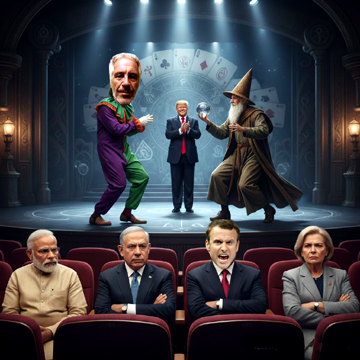
If one were to believe the latest breathless “revelations” attributed to the so-called Epstein files, the world we inhabit is not geopolitics but a travelling circus. Ronald Reagan is not dead, we are told, but lives on as the alter ego of Ronald McDonald. Kim Jong Un allegedly glides through underground tunnels to Mar-a-Lago for clandestine massage sessions with Donald Trump. The disclosures are helpfully co-authored by Nostradamus, presumably to lend medieval gravitas to modern nonsense. “Seriously?” is not merely a question here; it is the only sane response.
Yet these claims have been floated with straight faces in certain corners of the internet and amplified with deliberate timing, as if their sheer audacity might distract from more consequential developments unfolding elsewhere. The sudden resurrection of Epstein-linked sensationalism, precisely as the India–EU Free Trade Agreement gains momentum, tells us far more about American anxiety than about any hidden truth. This is not revelation. It is desperation dressed up as disclosure.
The Epstein files as a Rorschach test
The Epstein saga has long ceased to be about Jeffrey Epstein himself. It has become a Rorschach test onto which every political fear, grievance, and fantasy can be projected. In one version, Epstein is the key to exposing a global elite cabal; in another, he is a convenient vault into which inconvenient facts can be locked forever. What matters less than evidence is insinuation. Names, photographs, half-remembered meetings—these are enough to fuel endless speculation.
The newest wave of “Epstein reveals” abandons even the pretense of plausibility. When conspiracy theory stops pretending to be investigative journalism, it mutates into parody. Reagan as McDonald’s mascot is not an allegation; it is a meme masquerading as a secret. Kim Jong Un’s subterranean spa diplomacy belongs not to foreign policy analysis but to late-night stand-up comedy. The invocation of Nostradamus is the final flourish—an admission that prophecy has replaced proof.
And yet, these claims circulate, are shared, debated, and defended. That is the real story.
Timing is the tell
The question worth asking is not “Are these claims true?”—they are manifestly not—but “Why now?” The answer lies outside the gossip economy and inside the strategic one. The India–EU FTA represents a quiet but significant shift in global trade architecture. It signals Europe’s willingness to hedge against over-dependence on the United States and China alike, and India’s emergence as a central node in manufacturing, services, and standards-setting.
For Washington, accustomed to setting the tempo of global economic narratives, this is unsettling. The United States is not excluded from the world, but it is no longer its unquestioned axis. When influence wanes, noise increases. Sensation fills the vacuum left by strategy.
The sudden “opening” of Epstein files, framed as earth-shattering truth bombs, functions as a distraction and a pressure tactic. It keeps global attention trained on American domestic drama rather than on structural realignments that do not favour US primacy.
From power to performance
There was a time when American power spoke in policy, production, and persuasion. Today, too often, it performs. The spectacle matters more than substance; virality trumps viability. The absurd Epstein narratives fit neatly into this performance politics. They demand outrage, not analysis. They provoke laughter or horror, not reflection.
Donald Trump, central to many of these tales, embodies this shift. His political persona thrives on exaggeration, shock, and personal mythmaking. In such a universe, it is almost logical that Kim Jong Un would appear not as a nuclear-armed adversary but as a masseur slipping through secret tunnels. Reality is inconvenient; caricature is controllable.
This is not soft power. It is soft farce.
Nostradamus as co-author, reason as casualty
The decision—implicit or explicit—to rope in Nostradamus is revealing. When modern political discourse begins to lean on a 16th-century astrologer, it is conceding the collapse of rational authority. Evidence no longer convinces; prophecy titillates. Facts are dull; symbols are seductive.
Nostradamus has been retrofitted for centuries to “predict” everything from world wars to stock market crashes. That he now allegedly co-authors Epstein revelations is almost poetic. It confirms that these narratives are not meant to be verified, only believed—or at least circulated.
Belief is optional. Attention is mandatory.
The weaponisation of absurdity
There is a darker edge to all this. Absurdity is not always accidental; it can be weaponised. When discourse is flooded with the ridiculous, the serious struggles to be heard. If Reagan can be McDonald and geopolitics can be a massage parlour joke, then trade agreements, supply chains, and regulatory convergence feel boring by comparison.
This suits those who benefit from stagnation. The India–EU FTA is technical, detailed, and incremental. It does not lend itself to memes. It threatens no one dramatically, but it rebalances quietly. Against such developments, the only counter is noise.
The more outrageous the claim, the more oxygen it consumes.
India, Europe, and the calm of substance
Contrast the hysteria around Epstein-style disclosures with the tone emerging from New Delhi and Brussels. The India–EU negotiations have been marked by patience, pragmatism, and an emphasis on mutual benefit. They are not framed as ideological crusades but as economic necessities in a fragmented world.
This calm is precisely what unnerves those addicted to spectacle. India is not playing to the gallery; Europe is not seeking applause. Together, they are building something functional. In an age of performative politics, functionality is radical.
The attempt to drown this out with conspiratorial froth only highlights the contrast.
America’s anxiety of relevance
The United States remains a formidable power, but it is increasingly anxious about relevance rather than capacity. Its institutions are polarised, its narratives fractured. In such conditions, scandal becomes a unifying language. Everyone can argue about Epstein. Few have the patience to read tariff schedules.
The feebleness of the current attempt lies in its transparency. To suggest that releasing—or recycling—sensational material somehow reasserts dominance is to misunderstand the nature of contemporary power. Influence today flows through standards, partnerships, and credibility. None of these are strengthened by circulating gossip, however lurid.
When everything is revealed, nothing is understood
There is also a paradox at play. When “everything” is claimed to be revealed, understanding collapses. The flood of alleged disclosures creates fatigue. Audiences become cynical, disengaged, or amused. Serious wrongdoing, where it exists, risks being lost in the din.
By stretching the Epstein narrative to the point of self-parody, its amplifiers have ensured that it will be taken less seriously, not more. This may be intentional. Confusion is a form of control. If truth is indistinguishable from satire, accountability dissolves.
The global south is watching
Beyond Europe and America, the Global South observes these theatrics with a mix of amusement and calculation. Countries once lectured on governance now watch the loudest democracy in the room descend into conspiratorial chaos. They take notes, not cues.
India’s posture in this moment is instructive. It is engaging the world without noise, expanding options without theatrics. That is precisely why it must be caricatured or overshadowed—because it offers an alternative model of influence that does not depend on shock value.
Seriously?
So yes, “Seriously?” is the correct response. Not only to the idea that Ronald Reagan lives on as Ronald McDonald, or that Kim Jong Un sneaks underground for spa diplomacy, or that Nostradamus has joined the investigative journalism guild—but to the notion that such stories can meaningfully alter global trajectories.
They cannot. They only reveal the hollowness of the attempt.
The world is changing through trade corridors, technology standards, and demographic gravity, not through tabloid prophecy. The India–EU FTA will matter long after the latest Epstein meme has expired. History has a way of discarding noise and retaining structure. And that, more than any imaginary tunnel or resurrected president, is the truth that makes some people very uncomfortable.