
Indians love to exist like ants. They are brain washed from their childhood not to ask for a better life – the comfortable way of life is supposedly not for the so-called Indian way of life. That is why we execute jugaad to exist and survive but never innovate to lead a life of luxury. That would be selfish and self-centered. Right?
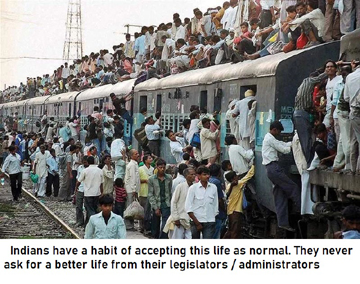
If one were to keep a tally of how often India’s failures are blamed on its population, the count would quickly become absurd. Bad roads? Too many people. Unemployment? Population pressure. Weak public schools? Overcrowding. Strained hospitals? Population explosion. The phrase has become a conversational reflex, a lazy explanation that ends debates before they begin. “India is like this because we have a huge population” is repeated so often that it has acquired the status of common sense. But common sense, when left unexamined, often turns into a convenient lie.
Population is not an explanation; it is a fact. And facts, by themselves, do not cause failures. How societies respond to facts does. A large population can be a burden only if it is treated as one. Handled differently, it is also the greatest resource a country can possess.
India’s problem is not that it has too many people. It is that it has systematically failed to build enough—enough factories, enough infrastructure, enough schools, enough hospitals, and enough homes—to serve them.
Population as an asset, not a curse
At its most basic level, population is potential. More people mean more workers, more consumers, more entrepreneurs, more inventors, and more taxpayers. Every advanced economy today—whether the United States in the 20th century, China after the 1990s, or Europe during its industrial expansion—leveraged population growth as an engine of scale.
Scale matters. Large populations allow industries to grow bigger, supply chains to deepen, and specialization to flourish. A country with hundreds of millions of people can support massive manufacturing ecosystems, large domestic markets, and globally competitive firms. India already sees glimpses of this advantage in sectors like information technology, pharmaceuticals, and increasingly, electronics manufacturing.
So why does this same population suddenly become a “problem” when the conversation turns to roads, schools, or hospitals?
Because it is easier to blame people than to interrogate policies.
The real shortage: Supply, not people
When roads are congested, it is not because there are too many people who need to travel. It is because there are too few roads, too little public transport, and too much regulatory paralysis in infrastructure development. When housing is unaffordable, it is not because too many people want homes. It is because cities refuse to build vertically, zoning rules remain archaic, and builders must navigate a labyrinth of approvals before laying a single brick.
India does not suffer from excess demand. It suffers from constrained supply.
Factories are scarce not because Indians lack the will to work, but because land acquisition is difficult, compliance costs are high, and policy uncertainty discourages long-term investment. Quality schools are limited not because children are too many, but because education remains tightly controlled, innovation is stifled, and private participation is viewed with suspicion. Hospitals are overcrowded not because patients exist, but because healthcare infrastructure has not scaled with population growth.
In every sector, the pattern is the same: demand rises naturally with population, while supply is artificially throttled by policy.
The culture of permission and delay
India’s development story is weighed down by a culture of permission. To build, one must first ask. Then ask again. And again. Licenses, clearances, inspections, and approvals pile up, each one adding cost, delay, and uncertainty. By the time a project finally begins, its economics may no longer make sense.
This system was not designed to encourage production; it was designed to control it. Its origins lie in a post-colonial mindset that distrusted private enterprise and equated regulation with governance. Over time, regulation metastasized into restriction.
The result is predictable. When supply is restricted, prices rise, quality suffers, and shortages become chronic. Yet instead of questioning the system that creates scarcity, we blame population for exposing it.
Electricity, housing, and the fear of scale
Consider electricity. India’s power shortages are often attributed to rising population and consumption. But electricity is not scarce because Indians use too much of it. It is scarce because generation, transmission, and distribution have long been subject to policy distortions, state monopolies, and financial mismanagement.
Where private generation has been allowed to scale, capacity has increased. Where competition has been encouraged, efficiency has followed. The lesson is simple: if you want more electricity, let more players generate it, transmit it, and sell it.
Housing tells a similar story. India’s cities are bursting at the seams not because migration is unnatural, but because urban planning is hostile to growth. Floor space index limits, outdated zoning laws, and endless approvals ensure that supply never catches up with demand. The result is slums, informal housing, and inflated rents—all blamed, conveniently, on population.
Education and healthcare: Sectors frozen in time
Education and healthcare are perhaps the clearest examples of how population becomes a scapegoat for policy failure. India has millions of young people, yet quality schools and colleges remain scarce. Why? Because education is treated as a moral domain rather than an economic one. Entry barriers are high, curricula are rigid, and innovation is discouraged. Private players are allowed in, but tightly leashed.
Healthcare suffers from the same contradictions. India needs thousands of new hospitals, clinics, and medical colleges. Instead of enabling rapid expansion, policies limit seats, restrict investment, and overregulate pricing. Doctors and nurses are in short supply not because people are many, but because training capacity is artificially capped.
In both sectors, liberalization is viewed with suspicion, even as public systems struggle under impossible loads.
The Economics we pretend not to understand
The underlying logic is not complicated. More freedom leads to more investment. More investment leads to more supply. More supply lowers costs and improves quality. This is not ideology; it is basic economics.
Countries that embraced this logic transformed population growth into prosperity. China, often cited as a cautionary tale of overpopulation, did not lift hundreds of millions out of poverty by reducing its population. It did so by liberalizing production, welcoming investment, and building relentlessly at scale.
India, by contrast, liberalized selectively and hesitantly. Where it did so—telecom, aviation, parts of manufacturing—the results were dramatic. Prices fell, access expanded, and quality improved. Where it did not, scarcity persisted.
Blaming people is politically convenient
There is another reason population remains the default excuse: it absolves decision-makers of responsibility. If the problem is “too many people,” then no one is accountable. Policies are not questioned. Systems are not reformed. The status quo survives.
Blaming population also carries a subtle moral judgment—that people are somehow at fault for existing, aspiring, and demanding basic services. This mindset quietly shifts the burden of failure from institutions to citizens.
It is a deeply anti-democratic idea.
India stands at a crossroads. One path continues the familiar cycle: regulate, restrict, underbuild, and then blame population for the resulting shortages. This path leads to perpetual frustration, social tension, and wasted potential.
The other path is harder but more honest. It accepts population as a given and builds accordingly. It liberalizes sectors that matter, simplifies approvals, encourages scale, and treats private investment as a partner rather than a threat.
This path does not guarantee perfection. But it guarantees progress.
It’s mismanagement: Stop apologizing for high population
India does not need fewer people. It needs more confidence in its ability to build for them. A large population is not an excuse for failure; it is a test of governance. Countries fail not because they have too many citizens, but because they refuse to empower production at scale.
The choice is stark. Either India liberalizes, builds, and produces for its millions—or it continues to blame those very millions for wanting electricity, housing, education, healthcare, and dignity. Population is not the problem. The refusal to build for it is.