
Other than Sher Shah Suri, the Afghan ruler and general commanding all of North India, Bihar and Bengal, India has never seen even a remote likeness of a European style welfare state. Therefore, tax evasion is a way of life in India. If GST had been introduced with 3% for all goods and services, India would have taken off as a highly inclusive and growth oriented economy
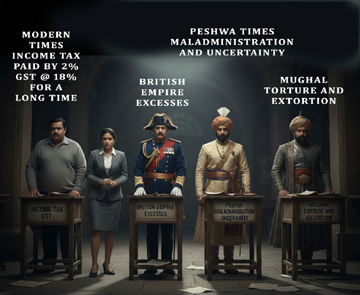
Evading taxes in India is not a modern moral failure; it is a historical instinct shaped by centuries of extractive governance. Long before spreadsheets, GST slabs, and compliance portals, the Indian citizen learned—often painfully—that the state was something to fear, not trust. Taxes were rarely linked to welfare, protection, or dignity. They were instruments of domination, survival taxes paid under duress, and often evaded as an act of self-preservation.
In India, tax avoidance has never been a casual white-collar crime. It has been a full-time profession, perfected across empires, dynasties, and administrative regimes. The techniques have changed—from hiding grain to hiding cash—but the logic has remained constant: when the state takes without giving, evasion becomes rational.
To understand India’s uneasy relationship with taxation today, one must trace this behaviour back through history, where citizens learned—generation after generation—that compliance offered little security, while discretion often ensured survival.
Mughal rule: Taxation under fear and extortion
During Mughal times, taxation was not a contractual obligation between ruler and citizen. It was a coercive extraction enforced by military might. The Mughal administrative apparatus, especially at local levels, was notorious for arbitrary assessments, extortion, and brutality. Revenue officials, backed by armed forces, could seize land, crops, livestock, or even family members to meet revenue targets.
For the common public, paying taxes was less about civic duty and more about avoiding torture—mental, physical, professional, and financial. The fear was not of audits or penalties but of violence and humiliation. As a result, evasion became a survival mechanism. Crops were hidden, land was underreported, produce was smuggled, and parallel informal arrangements flourished.
Importantly, the taxes collected did not translate into welfare, healthcare, education, or legal protection for the masses. The empire’s priorities lay elsewhere—monuments, armies, courtly excess, and territorial expansion. The citizen learned an early lesson: the state collects efficiently, but it does not protect generously.
Peshwa era: Administrative whiplash in conquered lands
The Maratha expansion under the Peshwas carried a different political narrative but produced a similar economic psychology in conquered territories. Regions like Bengal (Gaur), Odisha (Kalinga), Telangana, Rayalaseema, Bundelkhand, and northern Uttar Pradesh experienced frequent administrative disruptions as control shifted between powers.
For residents of these lands, taxation became unpredictable. New rulers meant new assessments, new intermediaries, and new demands. The lack of continuity eroded livelihoods and lifestyles. The problem was not merely high taxation but uncertainty—taxes could change overnight, enforcement could be erratic, and legal protections were thin.
In such an environment, compliance was risky. Visibility invited extraction. Stability lay in remaining under the radar. Cash economies, informal trade networks, and deliberate underreporting became standard tools to protect family assets from administrative shocks.
Once again, the citizen absorbed a lesson that would echo across centuries: when governance is unstable and arbitrary, transparency is dangerous.
British rule: Institutionalised extraction without welfare
If earlier empires relied on brute force, the British perfected extraction through law, bureaucracy, and systemic exploitation. Colonial taxation was ruthless in its efficiency and devastating in its impact. Land revenue systems like the Permanent Settlement and Ryotwari system institutionalised poverty while guaranteeing revenue flows to the Crown.
The British state in India was explicitly extractive. Taxes funded imperial wars, British industry, and colonial administration—not Indian welfare. Famines occurred alongside record tax collections. Railways were built to move goods and troops, not to alleviate rural distress. Education and healthcare were minimal and elitist.
Tax evasion during British rule was no longer just instinctive—it was moral. Avoiding colonial taxes was seen as resistance. Hoarding, black markets, informal trade, and cash-based economies flourished not merely because people wanted to cheat, but because compliance meant financing one’s own oppression.
By Independence, the Indian citizen had been conditioned for nearly a millennium to view taxation as a one-way street.
Post-independence India: High taxes, low assurance
Independence promised a new social contract. The Constitution spoke of justice, equality, and welfare. The state adopted socialist ideals and positioned itself as the guardian of the poor. Yet, for the average tax-paying citizen, the lived experience told a different story.
Income taxes were high, indirect taxes pervasive, and bureaucratic harassment routine. Public services remained patchy. Corruption filled the gap between collection and delivery. The welfare state existed largely on paper, while implementation was uneven and politicised.
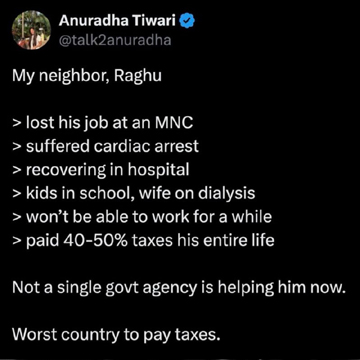
Over time, a strange contradiction emerged: citizens paid 40–50% of their income through direct and indirect taxes, yet continued to self-insure for everything—healthcare, education, retirement, and emergencies. The state collected like a developed nation but delivered like a fragile one.
The trust deficit widened.
GST and the cash economy: Old habits, new taxes
The introduction of the Goods and Services Tax was projected as a landmark reform—a unified, transparent tax regime that would simplify compliance and widen the tax base. Instead, for many small businesses and traders, it became yet another reason to retreat into cash.
An 18% GST in an economy for a very long time, where the welfare state is unreliable feels punitive rather than progressive. Small entrepreneurs operating on thin margins see little incentive to comply when healthcare remains private, education expensive, and legal recourse slow and uncertain. We all know that the income tax threshold was increased to Rs 12 lakh per year and GST was lowered to 5% for more goods only under the pressure of tariffs from Donald Trump’s United States administration.
Cash-based businesses are not merely evading taxes; they are insulating themselves from a system they do not trust to support them when things go wrong. The informal economy survives because formalisation promises surveillance, not security.
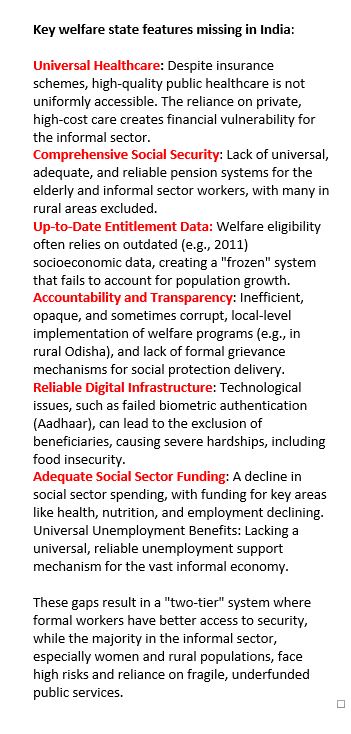
The missing welfare state
At the heart of India’s tax evasion problem lies a deeper question: what is the real return on taxes when citizens need the government the most?
When a person spends a lifetime paying taxes—directly and indirectly—the expectation is not charity. It is dignity. It is security. It is the assurance that a sudden cardiac arrest will not cost them their job, their savings, and their children’s future all at once. It is the belief that a spouse on dialysis will not reduce a family to financial ruin.
In a welfare-oriented state, illness does not mean economic collapse. Unemployment does not mean social exile. Education does not depend on private debt. Law and order is not a privilege bought through influence.
In India, these assurances remain fragile at best.
Crisis is a personal failure, never a state responsibility in India
One of the most damaging features of Indian governance is the quiet normalisation of personal tragedy as personal responsibility. Lose your job after a medical emergency? Plan better. Can’t afford private healthcare? Save more. Children’s education disrupted? Take a loan.
The state steps back precisely when it should step forward.
Taxes continue to fund infrastructure, grand projects, and balance sheets, but the insurance function of taxation—the moral justification for compulsory contribution—is missing. Citizens are asked to pay like stakeholders but treated like bystanders when crises strike.
In such a system, evasion is not rebellion; it is risk management.
Trust, not rates, is the real issue
The debate around taxation in India is often reduced to rates, slabs, and compliance mechanisms. But the real issue is not how much the state collects—it is whether citizens trust the state to stand by them in their weakest moments.
A nation’s strength is not measured by its tax-to-GDP ratio alone. It is measured by whether a taxpayer feels protected when they are sick, unemployed, or vulnerable. It is measured by the confidence that the police will enforce the law fairly, that hospitals will treat without bankrupting, and that courts will deliver timely justice.
Without this trust, no amount of digitisation, surveillance, or enforcement will create voluntary compliance.
Governance priorities and moral legitimacy
Taxation draws its moral legitimacy from reciprocity. When that reciprocity breaks down, compliance becomes performative at best and evasive at worst. Citizens do not see themselves as partners in nation-building but as subjects funding an indifferent system.
India’s long history explains—but does not excuse—this outcome. What it demands is a recalibration of governance priorities. Welfare cannot be an afterthought. Social security cannot be episodic. Healthcare, education, and law and order must be rights backed by reliable delivery, not political slogans.
Only then does taxation stop feeling like extortion and start feeling like participation.
From extraction to empathy
India’s relationship with taxes has been shaped by centuries of extraction without assurance. From Mughal armies to colonial bureaucrats to modern compliance regimes, the citizen has learned one consistent lesson: the state takes first and explains later.
Changing this mindset requires more than reforms and slogans. It requires empathy institutionalised through policy. It requires a welfare state that shows up not just during elections or disasters, but in everyday life.
Until then, tax evasion will remain less a crime and more a coping mechanism—an inherited reflex in a society that has rarely been rewarded for trust. A nation is ultimately judged not by how much it collects from its people, but by how it stands beside them when they fall.