
Steps such as graded response action plans (GRAP), odd-even traffic schemes, bans on firecrackers, and advisories to industries have marginal effect but none addresses the core problem at scale. Delhi NCR’s airshed is vast, small policy nudges cannot overpower a system that generates millions of cubic meters of polluted air every hour
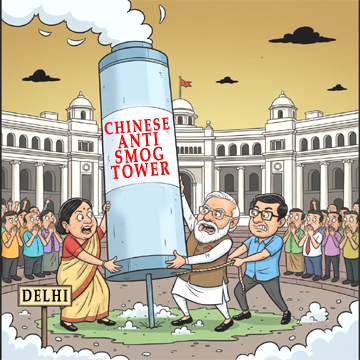
An Urban Atmosphere at Breaking Point: Every winter, Delhi NCR slips into a familiar but terrifying ritual. Schools shut, flights are delayed, hospitals fill with patients complaining of breathlessness, and the skyline disappears behind a grey-brown curtain. Air quality indices routinely cross the “severe” mark, PM2.5 levels soar many times above WHO limits, and citizens are told to stay indoors as if the city were under chemical attack. This is not a sudden calamity; it is a chronic urban disease that has been allowed to fester for decades. Vehicular emissions, construction dust, coal-based power, industrial pollution, and seasonal stubble burning converge to produce one of the most toxic urban atmospheres on Earth.
Against this backdrop, the debate in India has largely oscillated between denial, blame-shifting, and slow-moving structural solutions. Tree plantations, electric vehicle targets, lake rejuvenation, land acquisition for green buffers, and long-term shifts in agricultural practice are all necessary. But they are also painfully slow. Delhi NCR does not have the luxury of waiting twenty or thirty years for breathable air. What it needs, urgently, are emergency-scale interventions that can deliver immediate and measurable relief. This is where Chinese smog-sucking and filtering towers enter the conversation—not as a silver bullet, but as a critical stopgap technology.
Why incrementalism is failing Delhi NCR
The Union Government and state administrations have announced multiple plans over the years: graded response action plans (GRAP), odd-even traffic schemes, bans on firecrackers, and advisories to industries. While each has some marginal effect, none addresses the core problem at scale. Delhi NCR’s airshed is vast, and pollution sources are diffuse and continuous. Small policy nudges cannot overpower a system that generates millions of cubic meters of polluted air every hour.
Large infrastructure solutions such as acquiring land to create artificial lakes, expanding forest cover, relocating industries, or redesigning entire transport systems are unavoidable in the long run. However, these projects require years of planning, litigation, compensation, and political consensus. Even when implemented, their environmental impact unfolds gradually. Meanwhile, children continue to grow up with impaired lungs, and elderly citizens pay with their lives.
In emergency medicine, doctors do not wait for lifestyle changes to cure a patient in respiratory distress; they administer oxygen immediately. Smog towers are the urban equivalent of oxygen therapy. They do not cure the disease, but they prevent suffocation while deeper treatments take effect.
Learning from China’s air pollution crisis
China’s air pollution crisis in the early 2000s and 2010s was, by many measures, worse than what Delhi faces today. Cities like Beijing and Xi’an were synonymous with choking smog, reduced visibility, and public anger. Unlike many democracies that hesitate to experiment at scale, China adopted a multifaceted and sometimes radical approach. It combined strict industrial controls with massive investments in clean energy—and crucially, it experimented with direct air-cleaning technologies.
Among the most striking of these experiments was the development of large-scale urban smog towers. The most famous example is the 100-metre-tall solar-assisted smog tower in Xi’an. Rather than pretending pollution would magically disperse, Chinese engineers asked a blunt question: can we physically clean the air of an entire urban zone?
How the Xi’an smog tower works
The Xi’an tower is not science fiction. It is a functioning prototype that demonstrated measurable improvements in air quality over a large area. At its base sits a massive greenhouse-like structure. Polluted air enters this enclosure and is heated using solar energy. As the air warms, it rises naturally through the tower, passing through multiple layers of filtration systems. These filters trap particulate matter, including PM2.5 and PM10, before releasing significantly cleaner air back into the atmosphere.
What makes this system particularly relevant for India is its reliance on solar energy, a resource Delhi NCR has in abundance. The tower reportedly filtered millions of cubic meters of air per day and showed noticeable reductions in particulate concentration within a radius of several square kilometers. While it did not eliminate pollution entirely, it proved that large-scale ambient air cleaning is technologically feasible.
Smaller towers and localised clean-air zones
Not all Chinese air-cleaning innovations are monumental in scale. Beijing experimented with smaller smog towers, some standing around seven metres tall, designed to function as public art installations as well as air purifiers. One such tower, designed by artist-engineer Dan Roosegaarde (often mistakenly attributed as purely Chinese but widely adopted in China), created localized “clean air bubbles” by filtering PM2.5 particles.
These smaller installations are particularly relevant for Delhi NCR’s dense urban fabric. Imagine clusters of such towers near schools, hospitals, bus terminals, and markets. Even if they only improve air quality within a limited radius, that radius could be life-saving for vulnerable populations. Urban planning does not always require city-wide solutions; sometimes, micro-interventions at critical nodes deliver disproportionate benefits.
Electrostatic precipitators and advanced filtration
Beyond iconic towers, China has heavily invested in advanced electrostatic precipitation technologies. Electrostatic precipitators (ESPs) have long been used in industrial smokestacks, but Chinese firms have refined them into multi-stage systems (MESP) suitable for large buildings, airports, and transport hubs. These systems charge airborne particles electrically and then capture them on oppositely charged plates, removing pollutants efficiently without producing harmful ozone.
Companies like AirQuality Technology have demonstrated that such systems can operate continuously, filter pathogens as well as particulates, and integrate into existing infrastructure. For a region like Delhi NCR, where airports, metro stations, malls, and office complexes already move vast volumes of air, retrofitting MESP systems could drastically reduce indoor and semi-indoor pollution exposure.
Industrial and commercial pollution control
China’s approach also extends into industrial zones, where wet and dry scrubbers, oxidizers, and advanced filtration systems are deployed to clean emissions before they ever reach the open air. While India has regulations on paper, enforcement remains inconsistent. Importing not just Chinese hardware but also Chinese operational discipline could make a tangible difference.
For Delhi NCR, this means mandatory installation of high-efficiency pollution control equipment in power plants, brick kilns, and manufacturing units across the region. Smog towers clean what is already polluted; industrial systems prevent pollution at source. The two approaches must work together, not in competition.
Novel and experimental approaches to combat fatal pollution
China has not shied away from unconventional ideas. Mist cannons—devices that spray ultra-fine water droplets—have been deployed at construction sites and traffic corridors to settle dust particles. While critics argue that their effectiveness against fine particulates is limited, they remain useful against coarse dust, a major contributor to Delhi’s pollution load.
Inflatable clean-air domes represent another intriguing experiment. Schools like Dulwich College Beijing have used such domes to create clean-air environments for sports and outdoor activities during high-pollution days. In Delhi NCR, similar structures could protect school playgrounds, hospital courtyards, and community spaces, allowing some semblance of normal life even during smog episodes.
The “Defecate Diamonds” metaphor
The provocative phrase that smog towers “defecate diamonds” should not be dismissed as mere hyperbole. Some air filtration systems do collect particulate matter rich in carbon and other materials that can be compressed or repurposed. While literal diamonds may be more symbolic than practical, the underlying idea is important: pollution is not just waste; it is misallocated material.
If captured particulate matter can be safely processed into construction materials, pigments, or industrial inputs, air-cleaning infrastructure could partially pay for itself. Even if the economic returns are modest, the symbolic value of turning poison into product could shift public perception from helplessness to agency.
Why Delhi NCR needs these towers now
Critics argue that smog towers are expensive, energy-intensive, and ultimately cosmetic. But this critique misses the point. Delhi NCR is not choosing between smog towers and structural reform; it needs both. Emergency interventions are justified when human health is at immediate risk.
The cost of inaction is already enormous. Lost productivity, healthcare expenses, premature deaths, and reduced quality of life impose a hidden tax on the economy far greater than the price of experimental infrastructure. Moreover, deploying smog towers does not preclude long-term solutions. On the contrary, it buys time—time for policy reforms to take root and for ecosystems to recover.
Political will and the China question
There is, of course, an uncomfortable geopolitical dimension. Importing Chinese technology in the current political climate is controversial. Yet air pollution does not respect nationalistic posturing. India already imports critical medical equipment, electronics, and industrial machinery from China. To reject proven air-cleaning technology on ideological grounds would be self-defeating.
India need not blindly copy China. Smog towers can be indigenised, adapted to local conditions, and manufactured domestically with technology transfer. Indian institutes and startups could collaborate with global partners to refine designs suited to the subcontinent’s climate and pollution profile.
Integrating smog towers into a broader strategy
Smog towers should be seen as one component of a layered defence system. Alongside them must come stricter emission standards, accelerated transition to renewable energy, serious reform of agricultural practices, and urban redesign that prioritises public transport and green spaces. Artificial lakes and wetlands, though slow to build, will eventually play a role in microclimate regulation and dust suppression.
But none of these long-term measures negate the urgency of the present crisis. Delhi NCR is gasping for air today, not in 2045.
From symbolism to survival
Some dismiss smog towers as symbols meant to placate public anger. Yet symbols matter when they are functional. A visible structure that cleans air, even partially, sends a powerful message that the state acknowledges the crisis and is willing to experiment boldly. It also creates pressure for accountability: if air quality improves around a tower, citizens will demand more such interventions; if it does not, policymakers must explain why.
In China, experimentation preceded optimisation. Not every project succeeded, but the willingness to try unconventional solutions accelerated learning. India’s policy culture, by contrast, often fears failure more than stagnation. Delhi NCR can no longer afford that luxury.
Breathing space for a megacity
Ultimately, smog towers will not make Delhi NCR’s air pristine. They will not erase the structural injustices and governance failures that created the crisis. But they can create breathing space—literally and metaphorically. They can reduce peak pollution loads, protect vulnerable populations, and demonstrate that technology can intervene directly in the urban atmosphere.
As climate change intensifies and urbanisation accelerates, cities across the world will face similar dilemmas. Delhi NCR has the opportunity to become not just a cautionary tale, but a laboratory for emergency-scale environmental intervention. Chinese smog-sucking towers, adapted and improved, could be one of the tools that help the city survive long enough to heal.
In an emergency, pragmatism must trump purity. Clean air is not a luxury; it is a fundamental right. If massive air-cleaning machines can help deliver even a fraction of that right today, Delhi NCR should not hesitate. The city is choking, and it needs oxygen—now.