Alongside cheap Russian crude, Iranian oil has become a pressure valve for inflation-stricken economies that refuse to be hostages to Western energy cartels. Donald Trump’s political and global ambitions clash directly with this reality
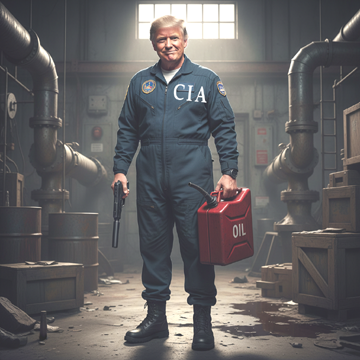
Trump’s threat to kill Iranian generals responsible for suppressing Iranian civil revolt is the first step towards accessing Iranian oil. That is not going to happen as India with friends across the world also has a considerable stake in buying cheap Iranian oil along with cheaper Russian oil. Trump wants the USA to access Iran’s oil market just as he owns and controls Venezuela’s oil economy as its proxy president after military occupation of that country. Iran may not be that simple as Venezuela was. Trump may depute the CIA to kill Iranian generals but he may not win the last round of occupation with India and Israel intervening with their petroleum related and security related interests.
Donald Trump’s threat to eliminate Iranian generals accused of crushing a civil revolt is not an isolated moral posture about human rights, nor is it merely electoral rhetoric. It is the opening gambit in a far larger geopolitical contest: access to Iranian oil and control over one of the last major hydrocarbon reserves that remains stubbornly outside Washington’s grip. The United States has long treated energy as both an economic commodity and a strategic weapon. From Saudi Arabia to Iraq, from Libya to Venezuela, oil has defined interventionist doctrine. Iran, however, is not Venezuela, and the road to Tehran is far more treacherous than the road to Caracas.
India, China, Russia, and a loose but determined network of Global South economies have invested heavily—politically and economically—in keeping Iranian oil flowing eastward at discounted rates. Alongside cheap Russian crude, Iranian oil has become a pressure valve for inflation-stricken economies that refuse to be hostages to Western energy cartels. Trump’s ambitions clash directly with this reality. If Washington believes it can simply replicate the Venezuelan model—sanctions, proxy leadership, covert operations, and eventual capture—it may be misreading the depth of resistance forming across Eurasia.
Why Iran is not Venezuela
Venezuela was isolated, economically fragile, and internally fragmented when the United States tightened the noose. Iran, by contrast, is deeply embedded in regional security networks, energy corridors, and ideological alliances. It has survived four decades of sanctions, assassinations, cyber warfare, and proxy conflicts. Its military doctrine is built around asymmetry, patience, and retaliation at a time and place of its choosing.
More importantly, Iran’s oil does not exist in a vacuum. India’s refiners, Chinese state-owned enterprises, and even discreet European intermediaries have structured long-term supply chains around Iranian crude. These arrangements are not sentimental; they are coldly economic. Iranian oil is cheap, flexible, and politically negotiable. For countries seeking strategic autonomy, it represents freedom from the volatility of Western-controlled markets.
Any American attempt to seize Iranian oil—directly or indirectly—would therefore collide not just with Tehran, but with a constellation of interests stretching from New Delhi to Beijing.
The leak that wasn’t a leak
At first glance, Trump’s request to European intelligence agencies for names of Iranian officials responsible for suppressing protests appeared to be a clumsy diplomatic misstep. The Washington Post published it almost immediately. Commentators called it reckless, amateurish, and counterproductive. They were wrong. This was not a leak. It was the weapon.
Trump did not ask for nuclear coordinates or missile silo locations. He asked for names. Names are personal. Names do not threaten regimes abstractly; they threaten individuals. By ensuring the request became public, Trump transformed intelligence collection into psychological warfare. Every commander in the Islamic Revolutionary Guard Corps woke up the next morning with the same question: am I on that list?
Psychological warfare at the state level
This is where most analysts fail. They look for aircraft carriers, sanctions packages, or missile launches. Trump operates differently. His strategy relies on destabilizing the enemy’s decision-making loop before kinetic force is ever applied. When leadership fears personal consequences, command cohesion collapses. Orders are delayed. Brutality becomes selective. Loyalty fractures. The regime’s greatest weapon—discipline—turns inward. Trump has used this method before. He publicly mocked North Korean generals. He named Venezuelan officials one by one. He telegraphed consequences so loudly that targets dismissed them as bluster—until they weren’t. The leak ensured that fear spread faster than any missile could.
Message to the clerics
Trump’s statement — “Save the names of the killers. They will pay a big price”—was not aimed at Washington or even Tehran’s leadership alone. It was directed at protesters, junior officers, clerks, drivers, and informants. He was crowdsourcing intelligence, inviting the ground level to build the target list from the bottom up. When he added, “Help is on its way,” and refused to clarify what that meant, ambiguity itself became a weapon. Uncertainty forces enemies to imagine worst-case scenarios. Is help diplomatic? Cyber? Military? Assassinations? Defections? The lack of clarity was deliberate. Trump was not being vague; he was being precise in his ambiguity.
The Venezuela Playbook Revisited
The pattern is unmistakable. First come public threats, dismissed as theatre. Then quiet coalition-building that the media ignores. Finally, sudden action while the target still believes escalation is politically impossible. Nicolás Maduro dismissed Trump’s early statements as posturing. Analysts laughed at the idea that a sitting president could be captured. Yet Maduro now sits in a US prison because he misread Step One. Iran’s leadership knows this history. That is why reports of escape routes to Russia, contingency asylum plans, and capital flight are already emerging. These are not the behaviors of a regime confronting empty threats.
India’s Quiet but Crucial Role
India’s position complicates Washington’s calculations significantly. New Delhi has invested heavily in energy diversification precisely to avoid strategic blackmail. Iranian oil, purchased through complex payment mechanisms, has been central to that effort. So, has Russian crude. India is not ideologically aligned with Tehran, but it is fiercely protective of its energy security. Any attempt by the United States to militarize Iran’s oil supply would trigger diplomatic resistance, quiet logistical obstruction, and possibly coordinated action with other major consumers. Unlike Venezuela, Iran has customers who matter—and those customers have leverage.
Israel’s Calculus: Security Without Chaos
Israel’s interests intersect but do not fully align with Washington’s. Tel Aviv prioritizes security, not regime collapse. A chaotic Iran splintering under internal collapse could unleash proxy militias, uncontrolled arsenals, and regional instability that Israel does not want. While Israel may support targeted actions against Iranian military leadership, it is unlikely to endorse a full-scale occupation or oil seizure that destabilizes the entire region. This, further limits Washington’s room for maneuver.
The Market’s Dangerous Complacency
Energy markets are behaving as if none of this, matters. Brent crude hovers around $65, with a negligible risk premium. Traders assume de-escalation. They assume Trump will not strike. This assumption is dangerously complacent.
Twenty-one million barrels of oil pass through the Strait of Hormuz daily—over one-fifth of global supply. Even a minor disruption would trigger a violent repricing. A two-million-barrel-per-day loss could send prices soaring 15–20 percent within days. Markets are betting against a man who has already defied consensus twice in seven months.
Winning Without Firing a Shot
Yet the most unsettling possibility is that Trump may not need to strike at all. By publicizing the collection of kill lists, he has injected paranoia into the Iranian security apparatus. Every act of repression now carries personal risk. Every order to fire on protesters could move a name higher on Washington’s list. The rational response for many officials is not greater brutality, but quiet defection. Slower responses. Deliberate incompetence. Capital flight. Exit planning. This is regime erosion from within.
The Regime Turns on Itself
History shows that authoritarian systems rarely collapse from external attack alone. They rot internally first. Trust evaporates. Loyalty becomes transactional. Fear replaces ideology. Trump’s move accelerates this process. He is not attacking Iran directly; he is ensuring that every internal contradiction is magnified. The mullahs thought they were fighting protesters. Instead, they are fighting uncertainty, paranoia, and a foreign leader who has already demonstrated that disbelief is not a defense.
Oil, Power, and the Final Contest
At its core, this is not about human rights or democracy. It is about oil, control, and the architecture of global power. Whoever controls Iranian oil controls pricing, supply chains, and political leverage across Asia and Europe. The United States wants that control back. India and its partners want to prevent it. Iran is the battlefield, but not necessarily the final casualty.
Sleep Tight, Tehran
Trump’s strategy represents military doctrine in its most evolved form: winning without fighting by convincing your enemy that fighting is suicide. The threat is not just missiles or sanctions; it is personal accountability, public exposure, and relentless psychological pressure. Whether this gambit succeeds remains uncertain. Iran is resilient. Its allies are invested. The world is more multipolar than Washington would like to admit.
But one thing is clear: this was not an accidental leak, not careless diplomacy, and not random bluster. It was a warning. And Tehran heard it.