
Fascist Japan’s withdrawal from the League of Nations marked the beginning of isolation that hardened into confrontation leading to catastrophe. Even isolated China stagnated economically and technologically until it reversed course under Deng Xiaoping
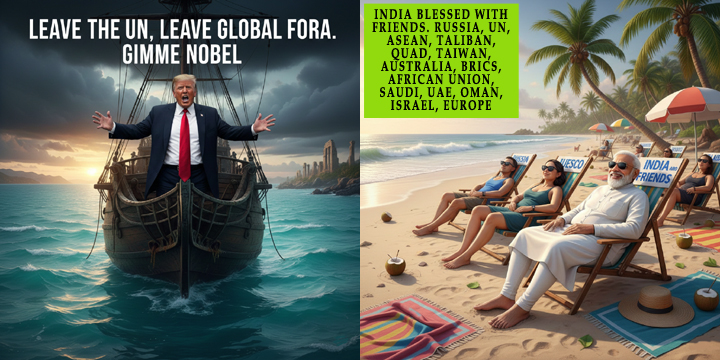
Isolation is rarely an abrupt event. It is a slow, cumulative process that begins with disengagement, indifference, and defiance—often justified domestically as strength or sovereignty—but ends in strategic irrelevance. History is unambiguous on this point. Nations that deliberately detach themselves from international law, multilateral institutions, and global norms do not rise in splendid independence; they shrink, harden, and eventually decay. Isolation is not the end of a nation’s journey, but it is very often the beginning of its end.
In the modern international system, no country—however powerful—can exist meaningfully outside a web of treaties, institutions, forums, and norms. Power today is not merely measured in military capability or economic size, but in agenda-setting capacity, coalition-building strength, and the ability to influence rules rather than merely react to them. When nations step away from this system, they surrender not only moral authority but also strategic leverage.
Historical lessons: When nations chose isolation
The 20th century offers stark examples of what happens when nations reject international engagement. Nazi Germany’s systematic withdrawal from and violation of international agreements was not merely an ideological stance; it was a strategic choice that left the country encircled diplomatically long before it was encircled militarily. By the time war broke out, Germany had few allies of consequence and no moral legitimacy, a vacuum that made its eventual defeat inevitable.
Fascist Japan followed a similar path. Its withdrawal from the League of Nations after criticism of its actions in Manchuria marked the beginning of diplomatic isolation that hardened into economic sanctions and strategic confrontation. What followed was not autonomy but catastrophe.
Even Communist China, in its early decades, experienced the suffocating effects of isolation. Cut off from global trade, finance, and institutions, China stagnated economically and technologically until it reversed course under Deng Xiaoping. The dramatic transformation that followed was not driven by isolation, but by integration—entry into global markets, participation in international bodies, and eventual accession to the World Trade Organization.
These examples underline a central truth: isolation does not protect sovereignty; it erodes it.
The modern world: Interdependence as reality, not choice
The post-World War II global order—flawed, imperfect, and often unequal—was built precisely to prevent destructive isolation. Institutions such as the United Nations, World Health Organization, UNESCO, Bretton Woods bodies, and numerous specialised agencies were designed to create constant engagement, friction, negotiation, and compromise. These mechanisms do not eliminate conflict, but they manage it.
In today’s interconnected world, supply chains span continents, financial flows cross borders in seconds, pandemics ignore passports, and climate change respects no sovereignty. International fora are no longer optional platforms; they are structural components of state power. Withdrawal from them does not halt global processes—it merely ensures that decisions are made without you.
India’s diplomatic turn: From hesitation to centre stage
Against this backdrop, India’s recent diplomatic trajectory stands out. One of the key reasons Prime Minister Narendrabhai Damodardass Modi succeeded in elevating India’s global standing is his recognition of this fundamental reality: influence comes from presence.
Over the past decade, India has consciously positioned itself as an active, constructive participant in almost every major global forum—G20, BRICS, SCO, Quad, climate summits, energy alliances, digital governance discussions, and South-South cooperation platforms. Rather than choosing blocs, India chose engagement. Rather than retreating into ideological rigidity, it pursued pragmatic diplomacy.
This approach yielded tangible results. India successfully used multilateral spaces to isolate its adversaries diplomatically, shape global narratives on terrorism, climate responsibility, and development finance, and project itself as the voice of the Global South. The G20 presidency was not merely ceremonial; it was symbolic of India’s arrival as a bridge-builder rather than a disruptor.
India understood something that many nations forget: participation is power.
Disturbing start to the New Year: US pullback
It is in this context that the geopolitical developments at the start of the new year appear deeply unsettling. The United States has withdrawn from 35 non-US international organizations and 31 United Nations entities. This comes on top of its earlier exits from the World Health Organization and UNESCO.
The scale of this shift is difficult to overstate. The United States is not just another member of the multilateral system; it is its largest financial pillar. As of 2023–24, the US accounts for roughly 22 percent of the UN’s regular budget, about 26 percent of UN peacekeeping funding, and nearly 28 percent of total direct government funding to the wider UN family. In agencies like UNESCO, the US contribution alone has historically covered around 22 percent of assessed budgets.
This is not merely a budgetary adjustment. It is a structural shock.
Beyond money: How withdrawal reshapes power
While the immediate concern will be financing gaps, the deeper impact lies elsewhere. When a major power exits multilateral institutions, it reshapes global priorities, bargaining dynamics, and decision-making processes. Programs that were once shielded by US political backing become vulnerable. Agendas shift. Smaller nations lose an advocate—or, depending on perspective, a counterbalance.
Institutional paralysis is a real risk. UN agencies are not private corporations that can quickly pivot to new revenue models. They depend on predictable funding to operate peacekeeping missions, humanitarian relief, disease surveillance, educational programs, and crisis response mechanisms. A sudden withdrawal at this scale risks hollowing out the system from within.
More subtly, the legitimacy of multilateralism itself takes a hit. If the world’s most powerful nation treats international institutions as dispensable, it sends a signal—especially to authoritarian regimes—that rules are optional and cooperation is transactional.
India’s immediate calculus: Opportunity and burden
For India, the US pullback creates a complex mix of opportunity and risk.
On the positive side, India now faces an unprecedented leadership opening. With the US stepping back, India can further consolidate its role as a stabilising force and credible voice of the Global South. Its consistent participation, relatively principled stance, and growing economic weight give it moral and political capital that many others lack.
However, leadership is never free. The vacuum left by the US will inevitably create pressure on other major contributors to step up. For India, this means difficult budgetary choices. Increased contributions to international institutions may clash with domestic development priorities, especially in a country where fiscal demands are already immense.
There is also a direct impact on India-linked platforms such as the International Solar Alliance and various energy and sustainability bodies where India has played a founding or leading role. Reduced global funding flows could slow projects, weaken momentum, and strain institutional capacity.
The ground-level fallout: Invisible but severe
Beyond the high-level diplomacy, the effects will be felt on the ground. Reduced funding means fewer healthcare interventions, weaker disease surveillance, and diminished crisis-response capacity—issues that disproportionately affect developing countries. NGOs dependent on multilateral funding will struggle. Philanthropic inflows often follow government money; when the latter dries up, the former usually contracts.
For India, which is both a donor and a recipient in different contexts, this creates a dual vulnerability. Domestic NGOs working in health, education, nutrition, and disaster relief may face funding shortages just as international demand for services increases.
The bigger impact no one is talking about
Yet there is a deeper, more structural consequence that remains largely unspoken: the erosion of norm-setting itself.
International institutions do not merely distribute money; they create standards—on health, labour, climate, education, technology, and human rights. When major powers withdraw, these standards weaken. In their place emerge fragmented, competing frameworks driven by narrow national interests rather than collective good.
This is where the real danger lies. A world without shared norms is not multipolar; it is chaotic. In such a system, power replaces principle, coercion replaces consensus, and smaller nations lose protection.
For India, a country that benefits enormously from predictable rules—whether in trade, maritime law, or climate negotiations—this is a serious long-term risk. India’s rise has been enabled not by breaking the system, but by working within it while gradually reshaping it.
Isolation Is contagious
One nation’s withdrawal often emboldens others. If multilateralism is seen as optional, more states will pick and choose engagement based on short-term convenience. This creates a vicious cycle: reduced participation leads to weaker institutions, which in turn justify further withdrawals.
The irony is that even the most powerful nations cannot escape the consequences. Pandemics, climate disasters, cyber threats, and financial crises do not respect borders. When coordination mechanisms weaken, everyone pays the price.
India’s strategic imperative: Engagement without illusion
India must therefore walk a careful line. It cannot afford naïve idealism about multilateral institutions, many of which are inefficient and politically compromised. But it also cannot afford cynicism or withdrawal.
The task ahead is not blind defence of the existing order, but active reform from within. India must push for fairer representation, better accountability, and more equitable financing—while staying firmly engaged.
In a world drifting towards fragmentation, India’s greatest strength may lie in its consistency: present when others withdraw, constructive when others obstruct, and principled when others turn transactional.
The choice that shapes the century
History teaches us that nations do not collapse because they engage too much with the world; they falter because they disengage from it. Isolation begins as a choice, often framed as strength, but ends as a condition imposed by irrelevance.
As the United States steps back from significant parts of the multilateral system, the world enters uncertain terrain. For India, this moment carries both promise and peril. Leadership opportunities will grow, but so will responsibilities. Financial burdens will increase, but so will diplomatic leverage.
The larger question, however, is not about budgets or influence—it is about the kind of world that will emerge. A world of shared rules, negotiated compromises, and imperfect cooperation, or one of fragmented power and perpetual instability. For India, the answer must remain clear. Engagement is not weakness. Participation is not surrender. In the long arc of history, nations that stay connected shape the world; those that isolate themselves are eventually shaped by it—or left behind altogether.