
The gig workers’ demand for Rs 40,000 basic salary plus payment per trip shows how they have been captured by the communists en route. Reminds one of Calcutta under gangster chief minister Juto Basu. Sounds a lot like the sailor having a girl in every port and eating your cake and having it too
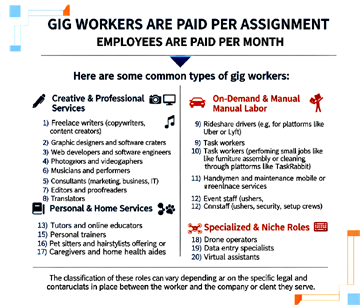
A gig is not a job; a job is not a gig. This is not ideology, it is definition. Look it up. A job comes with a contract, predictable income, legal protection, and benefits such as insurance, paid leave, and retirement contributions. A gig, by design, is transactional. It pays for a slice of time, a specific task, a limited burst of labour. The moment we blur this distinction, we enter a dishonest conversation—one where expectations are inflated on one side and responsibilities are diluted on the other. This is a semantic lie we have normalized amidst India’s confusion at the crossroads of labour, technology and dignity.
India today is trapped in precisely this semantic confusion. We talk about gig work as if it were employment, and then we argue endlessly about why it does not behave like one. The recent demand by sections of gig workers for a ₹40,000 basic salary plus per-trip payment is a symptom of this confusion, not its cause. A gig cannot logically demand a “basic salary” because a salary presupposes a job. What we are witnessing is not merely a labour dispute but a philosophical breakdown in how work itself is understood.
When ideology hijacks Economics
The demand structure emerging among gig workers increasingly resembles the language of old-school labour politics—fixed wages, guaranteed income, state intervention, and moral pressure on private enterprise. This ideological capture is not new. It evokes uncomfortable memories of Calcutta under Jyoti Basu, where good intentions, rigid labour policies, and ideological purity slowly suffocated enterprise, innovation, and job creation. West Bengal paid for that experiment for decades.
To frame platform work as exploitation by default and entrepreneurship as moral failure is to import a 1970s worldview into a 21st-century economy. It ignores scale, ignores capital risk, ignores consumer behaviour, and ignores the realities of India’s labour surplus. This does not mean workers should not demand fairness. It means demands must align with the economic nature of the work itself.
The scale of the gig economy India cannot ignore
India already has more than seven million gig workers. By 2030, that number is expected to cross 20 million. That is larger than the population of many countries. And yet, we are still debating whether this is “real work.” That debate itself reveals the depth of the problem.
Gig work exists because traditional employment has failed to absorb India’s working population. It exists because manufacturing never scaled, MSMEs remained informal, and the service sector could not create enough white-collar jobs. Platforms did not invent job scarcity; they responded to it. Food delivery, ride-hailing, logistics, and hyperlocal services grew precisely because millions needed income immediately, without degrees, references, or long hiring cycles.
Hyper-local barons are not wrong
When Deepinder Goyal defends the gig economy, he is not entirely wrong. Flexible work, fast onboarding, and daily earnings matter in a country where liquidity is survival. For millions, gig platforms are not a career choice; they are a lifeline. They allow migrants to earn from day one, students to work part-time, and families to survive without waiting months for payroll cycles.
Critics often forget that without these platforms, the alternative for most gig workers is not a “better job,” but no job at all. The moral outrage often comes from those who have never experienced the desperation of needing money today, not next month.
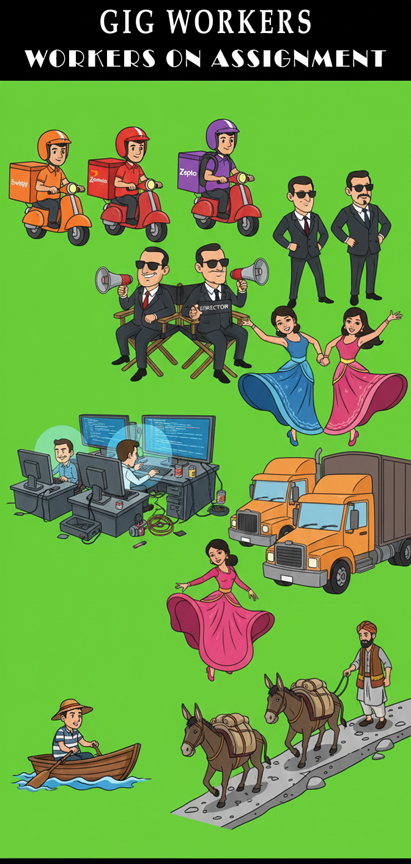
When flexibility turns into control
But here is the uncomfortable truth: flexibility feels empowering until the algorithm becomes your manager. When incentives decide your speed, ratings decide your income, and “choice” disappears during peak hours, autonomy becomes an illusion. The platform does not shout, threaten, or fire you. It simply nudges, scores, deprioritises, and deactivates. Control is exerted quietly, mathematically, and relentlessly.
This is not traditional exploitation, but it is not freedom either. It is optimisation wearing a hoodie. The worker is technically “independent,” but functionally constrained by opaque systems they do not control and cannot negotiate with.
The algorithm as the new foreman
In factories of the past, the foreman decided shifts, output, and penalties. In today’s gig economy, the algorithm does the same—only without accountability. There is no human manager to appeal to, no transparent rulebook, and often no explanation for income fluctuations. Surge pricing appears and disappears. Incentives change weekly. Penalties are automated.
The worker bears all the risk—fuel price hikes, vehicle maintenance, weather, health, and inflation—while the platform optimises margins in real time. This asymmetry is the real issue, not the existence of gig work itself.
Startup empathy, enterprise immunity
The core problem is not gig work. The problem is platforms wanting startup empathy and enterprise immunity at the same time.
They ask society to understand losses, burn rates, and scalability challenges, while also demanding exemption from labour laws, social security obligations, and regulatory scrutiny. They want the moral leeway of a startup and the legal protections of a mature corporation.
That is not sustainable. If a company is large enough to influence urban mobility, food habits, and employment patterns, it is large enough to accept corresponding responsibility. Growth cannot indefinitely be subsidised by labour precarity.
Trust is not a marketing slogan
As founders and platform leaders, one cannot say, “Don’t regulate us, trust us,” without also asking, “Have we earned that trust?” Trust is built through transparency, fair dispute resolution, predictable policies, and shared risk. It is not built through PR statements and selective data.
If a system only works when labour absorbs all shocks—weather disruptions, demand volatility, inflation, regulatory uncertainty—then it is not disruptive innovation. It is cleverly outsourced instability.
The myth of costless scale
Tech platforms often celebrate scale as an unquestioned good. But scale has consequences. When millions depend on a system for income, even minor policy changes ripple through households and communities. A reduction in incentives is not just a spreadsheet adjustment; it is rent unpaid, education postponed, healthcare avoided.
Designing for scale without designing for dignity is not neutrality—it is a choice. And it is a choice that will eventually provoke backlash, regulation, or collapse.
Gig work is not evil—it is incomplete
The gig economy is not evil. It has created income where none existed. It has introduced efficiency into broken systems. It has expanded consumer choice and urban convenience. But it is incomplete. It was designed for speed, not sustainability.
Maturity requires moving beyond binary arguments of “pro-worker” versus “pro-startup.” It requires acknowledging that both labour and platforms are essential—and that neither should bear disproportionate risk.
Gig workers fallen victim to communist Giggle workers
A mature gig economy does not mean turning every gig into a job. It means creating hybrid frameworks that reflect reality. Portable benefits, minimum earnings floors during logged-in hours, transparent algorithms, grievance redressal systems, and shared insurance models are not communist fantasies. They are pragmatic responses to scale.
It also means being honest with workers. Gig work should be presented as supplemental or transitional income, not as a guaranteed livelihood. False promises are as harmful as outright exploitation.
The role of the state: Regulate without suffocating
The Indian state has a role to play, but it must resist ideological excess. Over-regulation will kill platforms and dry up opportunities. Under-regulation will create unrest and inequality. The balance lies in light-touch, outcome-based regulation that focuses on dignity, safety, and transparency rather than rigid employment classifications.
India does not need to copy Europe’s labour rigidity or America’s laissez-faire neglect. It needs its own model, rooted in demographic reality and economic pragmatism.
The danger of romanticising precarity
There is a growing tendency to romanticise gig work as hustle culture or demonise it as neo-slavery. Both are lazy narratives. Gig work is neither heroic nor evil. It is a response to structural failure. Treating it as destiny rather than transition is the real danger.
If India accepts gig work as the final destination for millions, it is admitting defeat on manufacturing, skilling, and formal employment. That should worry policymakers far more than platform profits.
Designing systems where dignity scales
The future lies in designing systems where scale does not come at the cost of dignity. Where efficiency does not require invisibility. Where flexibility does not mean vulnerability. This is not anti-startup. It is pro-future.
Startups that solve this will not only survive regulation; they will define the next phase of Indian capitalism. Those that resist will be regulated into irrelevance or replaced by better-designed competitors.
The choice before us
India stands at a crossroads. It can either descend into ideological battles that destroy value on both sides, or it can build a mature gig economy that reflects reality, respects labour, and rewards innovation. The choice is not between capitalism and compassion. It is between denial and design.
A gig is not a job. But dignity is not optional. And the future will belong to those who understand the difference.