
Hindu societies around the world invest heavily in social stability, learning, trade channels but they never invest in political or military muscle to defend themselves in times of physical or cultural attacks. Why? Why cannot Indians around the world fund a movement to install a Hindu president of USA or African Union?
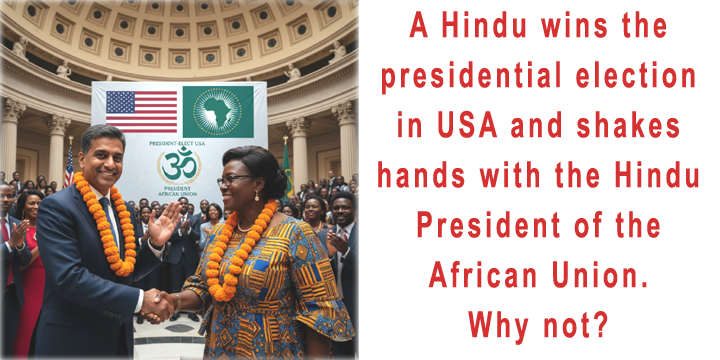
Across history and geography, Hindu Indians—whether in the subcontinent or the diaspora—have demonstrated extraordinary capacities for trade, learning, entrepreneurship, and cultural continuity. Yet an uncomfortable question recurs whenever crises erupt: why does such a large, ancient, and economically active civilisational group so often appear politically under-organised, militarily unprepared, and institutionally weak in defending its collective interests? The question is neither new nor malicious; it is historical. It surfaces in the ruins of Somnath, in the ashes of Nalanda, in the expulsion of Indians from Uganda, in the vulnerability of Hindus in Bangladesh, and in the conspicuous absence of strong Hindu lobbies in Western democracies. The issue is not intelligence or morality, but structure, ideology, and historical habit.
The repeated destruction and reconstruction of the Somnath Temple is often celebrated as a symbol of resilience. Indeed, the temple—attacked beginning with Mahmud of Ghazni in 1026 CE and subsequently damaged or destroyed multiple times—stands today as a testament to cultural persistence. Yet resilience is not the same as deterrence. Rebuilding after each destruction did not prevent the next attack. From a hard political perspective, the repeated sackings point not only to external aggression but also to a failure of sustained defensive organisation. Somnath was immensely wealthy, patronised by merchant elites and rulers, yet it did not maintain an enduring military shield proportionate to its symbolic and economic value. The uncomfortable implication is that wealth and devotion were not translated into institutional power.
A similar question arises at Nalanda. The great university was one of the most sophisticated centres of learning in the premodern world, specialising in mathematics, logic, medicine, astronomy, and philosophy. When Muhammad Bakhtiyar Khilji attacked in the late 12th century, Nalanda fell quickly, its monks massacred, its libraries burned. Legends say the manuscripts smouldered for months. Whether the duration is literal or metaphorical, the destruction was total. Why did a civilisation capable of abstract thought at the highest level fail to build even a minimal defensive apparatus around such a strategic intellectual asset? The answer is not that scholars believed knowledge alone would repel violence; rather, the knowledge system itself existed within a social order that delegated warfare to others—or neglected it entirely.
This pattern reveals a deeper civilisational bias. Ancient and medieval Hindu society invested heavily in metaphysics, mathematics, cosmology, grammar, and ethics, but relatively little in systematic military science as an autonomous academic discipline. While texts on warfare existed—the Arthashastra being the most famous—they did not become the foundation of institutionalised military academies comparable to those later developed in other cultures. There was no enduring equivalent of a “martial university” producing generations of professional strategists divorced from dynastic politics. Military power remained fragmented, personal, caste-bound, and often reactive.
The caste system itself contributed to this fragmentation. By rigidly separating intellectual, commercial, and martial functions, Hindu society discouraged cross-functional integration. Traders funded temples but did not command armies. Scholars produced knowledge but did not shape statecraft. Warriors fought, but often without economic autonomy or intellectual backing. This compartmentalisation made society efficient in stable times but brittle under sustained external pressure. When invasions came, responses were local, not civilisational. There was no unified Hindu political identity capable of mobilising resources at scale.
Over time, this structural weakness hardened into habit. Hindu polities rose and fell, but none established a long-lasting pan-Indian military or bureaucratic state until the modern era. Even powerful rulers—such as the Cholas, whose naval expeditions were formidable—did not translate military success into durable continental institutions. Power remained episodic rather than systemic. When European colonial powers arrived with professional armies, centralised taxation, and bureaucratic continuity, Indian polities collapsed with startling speed.
Colonialism further distorted Hindu political behaviour. Under British rule, Indians were systematically excluded from military command and strategic decision-making while being encouraged to excel in commerce, clerical work, and technical professions. Political mobilisation was channelled into petitions, debates, and moral appeals rather than coercive power. Nonviolent resistance, while morally powerful and historically effective against the British, also reinforced a cultural suspicion of force as illegitimate. Over time, this suspicion ossified into a reluctance to organise hard power even when morally justified.
This legacy continues into the diaspora. Hindu Indians abroad are often economically successful but politically dispersed. In countries like the United States, the United Kingdom, Australia, and Canada, Indian-origin populations are among the highest earners and most educated groups, yet they lack unified lobbies comparable to those of other communities. Their organisations tend to be cultural, religious, or philanthropic rather than political. Internal divisions—regional, linguistic, caste-based, ideological—prevent consolidation. Many prefer individual success to collective bargaining, assuming that merit and law will suffice.
The contrast becomes especially visible during moments of crisis. The expulsion of Indians from Uganda under Idi Amin, the marginalisation of Indians in Fiji, and recurring violence against Hindus in Bangladesh reveal a pattern: sudden vulnerability met with slow, fragmented response. There were no standing global Hindu institutions capable of rapid legal, diplomatic, or economic intervention. Relief efforts were reactive, not preventative. Even today, despite millions of Indians owning businesses across Africa, there is no unified mechanism to protect them from arbitrary arrest, extortion, or political targeting. Wealth exists; coordination does not.
Recent events in Western politics highlight the same weakness. When political figures take positions perceived as hostile to Indian or Hindu interests, responses are often limited to social media outrage, opinion columns, or quiet lobbying by fragmented groups. There is little sustained pressure, little electoral leverage, and no unified narrative. Protests occur, but without institutional follow-through. Anger dissipates into murmurs.
This raises the provocative question often framed crudely as “stupidity” or “weakness.” Such labels are misleading. The issue is not a lack of intelligence or courage, but a civilisational preference for inward excellence over outward power. Hindu societies historically prioritised continuity of culture over dominance of territory, preservation of knowledge over projection of force, individual liberation over collective conquest. These values produced remarkable achievements—but also predictable vulnerabilities.
Moreover, Hindu ethics traditionally emphasised dharma as situational and moral rather than absolutist. Violence was permitted but constrained, contextual, and often delegated. In contrast, societies that developed expansive empires tended to sacralise power itself, embedding warfare into identity. Over centuries, this difference mattered. Power accumulates where it is institutionalised, taught, and normalised.
The modern world, however, does not reward moral restraint without strategic capacity. Liberal democracies operate on interest aggregation, lobbying, narrative control, and sustained political pressure. Communities that fail to organise are out-organised. Global politics is not governed by virtue alone but by coalitions, funding, legal expertise, and media influence. Hindu Indians often enter these arenas late, divided, or apologetic.
There is also a psychological dimension. Historical trauma—repeated invasions, colonial subjugation, partition—has produced a defensive cultural posture. Many prefer invisibility to confrontation, assimilation to assertion. Success is framed as personal escape rather than collective empowerment. This may be rational at the individual level but is costly at the group level.
Yet change is possible, and precedents exist. Other diasporas built influence not overnight but over generations, through disciplined institution-building, ideological clarity, and willingness to invest in unglamorous political work. Hindu Indians possess the resources, numbers, and intellectual capital to do the same. What they lack is not ability, but habit.
The lesson of Somnath is not merely resilience but the cost of failing to deter. The lesson of Nalanda is not just loss but the danger of separating knowledge from power. The lesson of diaspora vulnerability is not helplessness but the price of fragmentation. None of these are immutable traits. They are historical outcomes of choices, structures, and values—choices that can be re-examined.
To ask whether Hindus are “weak” is to ask the wrong question. The real question is whether Hindu societies are willing to evolve from being culturally rich but politically passive into being institutionally robust without abandoning ethical restraint. Strength need not mean aggression; it can mean preparedness, unity, and strategic foresight. Civilisations decline not because they lack virtue, but because they mistake virtue for power.
History is unforgiving in this regard. Those who do not organise are organised against. The future will not be kinder.
APPENDIX 1
This is in response to the thousands of responses to my article above, on lack of military / security organisation in Hinduism at https://dronepages.in/why-hindu-indian-societies-are-open-to-attack/
The best way for Hinduism to survive and thrive without attacks from Islamists and Christian conversion evangelists is to organise the movement to promote Hinduism and its values. Currently, Hinduism does not have any organised movement or structure. Hindu Indians or persons of Indian origins around the world are adept at trading and getting PhDs from universities; maybe throw in a CEO’s job or two in the process but lobbying for Hinduism draws a blank in the current world order. We need to organise under DronePages to form a global organisation called ACADEMY OF RESEARCH ON HINDUISM with headquarters in New Delhi or anywhere else in India, where it will draw the maximum investors and volunteers. This has to be registered as a not-for-profit Section 8 company in India. It may be registered abroad if people get together and get in touch with me at Royalle Corporation (www.royalle.in) to do so.
Please indicate your willingness in the comments below, to donate whatever amount you wish to show committment, and participate in this endeavour.