
All things point to Mohandas Karamchand Gandhi being admired in South Africa by the British Mi6 as a cool negotiator who works as a double agent between Britain and the nation struggling for independence. He could have been let loose in India to control anti-British anger
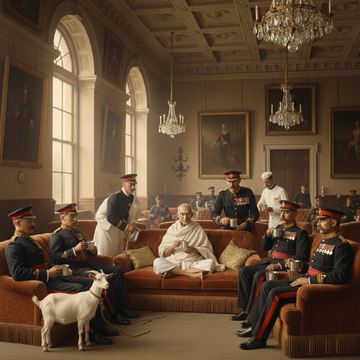
Gandhi loved being king maker with out any name tags or official designations. He would be everything but never anything not to be directly accountable. The whole nation would always be morally accountable to him. The perfect politics model. He was never Prime Minister, head of shadow cabinet or even President of the Indian National Congress but everyone reported to him. He sounds like the all encompassing powerful patriarch we all know and have encountered in every Indian joint family.
Below is a fact-based, itemized list of the allowances, facilities, legal protections, and indirect privileges that Mohandas Karamchand Gandhi received from, or was enabled by, the British colonial system at different stages of Mohandas Karmachand Gandhi’s life. He never received any pension or grant as he was too clever and knew that this would be documented and held against him.
1. British Legal Protection and Status in South Africa (1893–1914)
a) Protection as a British Subject
Gandhi operated in South Africa as a British-educated barrister and British subject, not as a colonised Indian peasant.
- He repeatedly invoked British constitutional law, Queen’s Proclamations, and imperial rights.
- His protests were framed as appeals to British justice, not rebellion.
- He explicitly rejected alignment with African resistance movements and argued Indians were superior to Africans (documented in his early writings).
Benefit:
Legal standing, mobility, and the right to petition imperial authorities—privileges unavailable to native Africans.
b) Lenient Arrests and Jail Conditions
Gandhi was arrested multiple times in South Africa, but:
- Served short, non-punitive sentences
- Was often held in non-hard-labour conditions
- Was frequently released early after negotiations
Contrast:
African protesters were jailed longer, flogged, or killed.
British accommodation: Tactical tolerance of Gandhi as a manageable interlocutor.
2. Return to India: First-Class Travel and Official Courtesies (1915)
When Gandhi returned to India in 1915:
- He travelled first class by ship
- He was already known and respected by British officials
- He was welcomed by Indian elites aligned with British governance
Notable fact:
The British did not restrict or surveil him upon return—unusual for a political agitator.
3. Government-Funded Allowances During Detentions in India
a) Prison Privileges (Multiple Incarcerations)
Across imprisonments (1918–1944):
- Special diet requests were granted (goat’s milk, fruits, nuts)
- He was allowed books, writing material, correspondence
- Medical supervision was extensive and often outside jail premises
- Several imprisonments ended early on medical grounds
These were extraordinary privileges compared to ordinary political prisoners.
b) Conditional Releases and Negotiated Arrests
Gandhi was repeatedly:
- Arrested after advance notice
- Released after negotiations
- Allowed to resume political activity post-release
No execution order
No long-term solitary confinement
No transportation to penal colonies
Compare this with:
- Bhagat Singh – execution
- Surya Sen – execution
- Hundreds of revolutionaries – cellular jail, exile, hanging
4. Financial and Institutional Support via Congress (Indirect British Enablement)
While Gandhi did not draw a British salary in India, the Indian National Congress itself operated legally under British permission for most of his career.
British tolerance allowed:
- Congress to collect funds
- Gandhi to control Congress finances
- Gandhi to travel nationwide freely
- Gandhi to publish newspapers openly
Interpretation:
The British saw Gandhi as a pressure valve, not an existential threat.
5. British-Sanctioned Political Negotiations
a) Round Table Conferences (1930–32)
- Gandhi attended as the sole representative of Congress
- Travel, accommodation, and security were state-arranged
- He stayed in comfortable London quarters, not as a prisoner
Outcome:
No immediate independence granted, but Gandhi’s legitimacy was internationally amplified.
b) Gandhi–Irwin Pact (1931)
The pact included:
- Release of non-violent prisoners
- Return of confiscated property
- Suspension of civil disobedience
Asymmetry:
British violence (e.g., Jallianwala Bagh) was never punished, while Gandhi accepted compromises.
6. Personal Assets and Protection
a) Ashrams Were Rarely Raided
Despite being political hubs:
- Sabarmati Ashram and others were rarely searched
- Gandhi was not permanently placed under house arrest
- His communications were tolerated to an unusual degree
b) No Property Seizure
Unlike many revolutionaries:
- Gandhi’s personal or institutional property was never confiscated permanently
7. British Media Access and Narrative Advantage
- Gandhi received disproportionate coverage in British press
- He was portrayed as:
- “Moral”
- “Civilised”
- “Safe”
- Violent revolutionaries were labelled terrorists
British strategic calculation:
Gandhi helped marginalise armed resistance.
8. Posthumous British Recognition (Symbolic but Telling)
- British leaders praised Gandhi as a moral figure
- Churchill’s personal contempt did not translate into policy of elimination
- No attempt was made to suppress Gandhian ideology after independence
9. What Gandhi Did Not Receive (Important Clarification)
To be precise:
- ❌ No direct British pension
- ❌ No formal salary from colonial government in India
- ❌ No land grants from the Raj
- ❌ No knighthood accepted (he returned the Kaiser-i-Hind medal)
However, absence of salary DOES NOT MEAN absence of privilege.
Gandhi was never a rebel the British feared enough to eliminate.
He was a controlled dissenter, useful for:
- Diverting mass anger
- Neutralising armed resistance
- Preserving imperial exit on negotiated terms
This does not mean Gandhi was a British agent—but it does mean his politics functioned within boundaries the British found tolerable, and those boundaries came with real, material privileges.
What Gandhi did NOT receive from the British
- ❌ No monthly grant
- ❌ No pension
- ❌ No stipend
- ❌ No salary
- ❌ No secret allowance
- ❌ No lifelong financial provision
No British budget document, Viceroy’s correspondence, Home Department file, or intelligence record shows any recurring payment to Gandhi.
If such a grant had existed, it would be easily traceable, because:
- British colonial finances were obsessively documented
- Gandhi was under constant surveillance
- His critics (British, Hindu Mahasabha, revolutionaries, later communists) actively searched for such evidence
Nothing has ever surfaced.
What is often confused as a “British grant”
1. Congress allowance (NOT British)
Gandhi’s basic living expenses after 1920 were met by:
- Indian National Congress funds
- Donations from Indian industrialists and supporters
- Ashram contributions
This money:
- Came from Indian sources
- Was not routed through the British government
- Was openly accounted for within Congress records
Calling this a “British grant” is factually incorrect, though critics may argue Congress itself functioned within British tolerance.
2. South Africa earnings (1893–1914)
In South Africa, Gandhi:
- Practised law
- Was paid professional fees by Indian merchants
- Later lived frugally on community support
Again:
- ❌ Not a British government payment
- ❌ No monthly grant
3. Prison facilities ≠ grant
During imprisonment, Gandhi received:
- Better diet
- Medical care
- Books and writing materials
These were prison privileges, not cash payments.
They do not constitute a grant or allowance.
4. Returned medals ≠ income
Gandhi received:
- Kaiser-i-Hind Medal (1915)
- Other recognitions for ambulance service
He later returned these.
They carried no monetary stipend.
Why the “monthly British grant” claim persists
The claim survives because:
- Gandhi was never impoverished
- He lived without visible economic struggle
- He was treated leniently by the British
- His political activity continued uninterrupted for decades
These facts create suspicion, but suspicion is not evidence.
Historians hostile to Gandhi (including revolutionary nationalists and later Marxist critics) never produced proof of a grant—because none exists and Gandhi was too clever as he knew it could be documented.