
Across India and the world, a pattern has emerged where protests are deployed strategically to force outcomes that could not withstand judicial, regulatory, or statutory scrutiny. Is this a pre-planned action by hyper-local companies to shut down 10-minute delivery but still retain investor funds, citing act of God? Please refer to Satyajit Ray’s Seemabaddha (1971)
Trade unions, student movements, farmer protests, civil rights marches, and anti-colonial struggles have shaped India’s constitutional and moral landscape. However, in contemporary India, a far more insidious phenomenon has taken root—where the language, symbolism, and emotional power of protest are weaponised to camouflage illegality, institutional corruption, and vested interests. What appears on the surface as a righteous struggle for workers’ rights or student justice often turns out, upon closer scrutiny, to be a carefully choreographed exercise in pressure politics, regulatory subversion, or private profiteering. The protest becomes not a tool of justice but a laundering mechanism—whitewashing unlawful outcomes under the veneer of “public demand.”
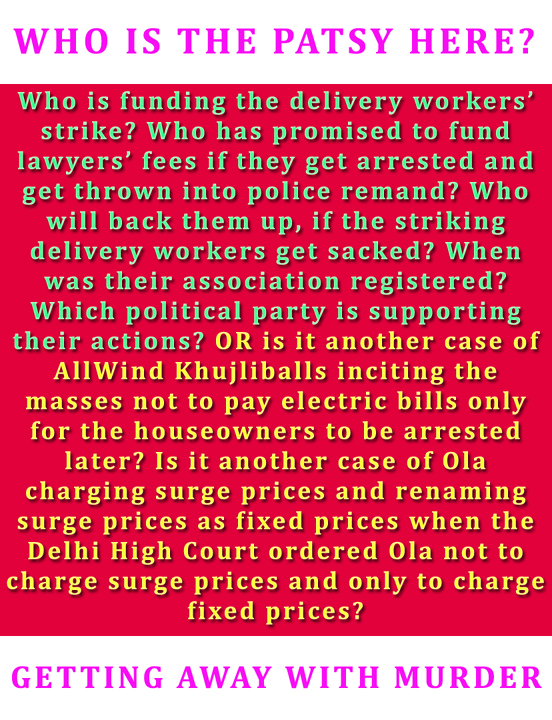
The delivery workers’ strike announced for January 31, 2025, raises precisely these uncomfortable questions. Who is funding the mobilisation? Who is underwriting legal fees in case of arrests? Who compensates workers if they are terminated? When was the association leading the agitation registered, and under what legal framework? Which political actors are amplifying the agitation, and why? These are not cynical questions; they are essential ones in a democracy where protest has become an industry rather than a spontaneous expression of collective suffering. History has shown that genuine movements rarely require opaque funding, professional slogan-shouters, or pre-arranged legal cover.
Across India, a pattern has emerged where protests are deployed strategically to force outcomes that could not withstand judicial, regulatory, or statutory scrutiny. One of the most telling examples comes from urban municipal employment. Dr Vikas Divyakirti, a well-known civil services educator, has repeatedly explained how “paid public” is used to manufacture legitimacy. In several of his lectures, he outlines a recurring method: temporary or contractual workers—often appointed illegally or beyond sanctioned strength—are mobilised through demonstrations. Professional agitators are hired to raise slogans. Media visuals are generated. Political pressure is applied. Eventually, governments regularise these appointments citing “public sentiment” or “law and order concerns,” even when the original recruitment violated constitutional norms of equality and open competition. The illegality is not corrected; it is sanctified through noise.
This model has been used repeatedly in state transport corporations, municipal bodies, and educational institutions. In many cases, temporary staff are appointed without advertisement, reservation compliance, or selection processes. Once embedded, protests erupt demanding permanency. The state, fearing unrest, complies. The losers are invisible—the qualified candidates who never got a chance to apply. The protest becomes a mechanism to bypass Article 14 of the Constitution while pretending to defend labour rights.
Student agitations offer another fertile ground for such manipulation. In several Indian universities, protests ostensibly about fee hikes, hostel shortages, or administrative injustice have later revealed deeper political engineering. At Jawaharlal Nehru University, Hyderabad Central University, Jadavpur University, and even Delhi University colleges, multiple protest waves have been linked not merely to grievances but to ideological capture, union dominance, and electoral mobilisation. While many student concerns are legitimate, the method of escalation—blocking exams, vandalising property, intimidating dissenters—often serves interests far removed from student welfare. Careers of thousands are disrupted, while political actors harvest footage, narratives, and future cadres.
Farmers’ protests, too, illustrate the duality of agitation. While agrarian distress is real, several protest movements have been infiltrated or steered by middlemen, commission agents, and political parties whose economic interests depend on preserving inefficiencies. During the farm law protests, numerous investigative reports highlighted how arhtiyas (commission agents) stood to lose from reforms and quietly bankrolled logistics, transport, and food supplies. The agitation’s public face was the distressed farmer; its backstage beneficiaries were entrenched intermediaries. The eventual repeal of the laws did not resolve farmer distress—it restored the status quo that benefits a select few.
Urban housing and slum redevelopment protests present another example. In Mumbai, Delhi, and Bengaluru, repeated agitations against redevelopment projects are often portrayed as struggles of the poor against corporate builders. Yet, investigations have shown that many protests are driven by illegal occupants, local strongmen, or politicians who benefit from maintaining ambiguity in land titles. When courts order eviction or redevelopment, protests erupt overnight. Political leaders arrive. Media cameras roll. Eventually, governments delay or dilute projects “in public interest.” The illegal occupation continues, now cloaked in moral legitimacy.
The case of Arvind Kejriwal’s early political activism provides a textbook example of populist agitation backfiring on the very people it claims to protect. His call for Delhi residents not to pay electricity bills—framed as resistance against inflated tariffs—was celebrated as civil disobedience. In reality, electricity distribution companies continued enforcing contracts, and many residents who followed the call faced disconnections, penalties, and legal trouble. The political mileage accrued to the leader; the consequences were borne by ordinary households. Protest here functioned as a shield for ambition, not as a solution to systemic issues.
Corporate manipulation through pseudo-compliance offers a parallel in the private sector. When the Delhi High Court ordered Ola not to levy surge pricing and instead charge fixed fares, the company complied in form but not in substance—rebranding surge prices as “fixed” prices pegged dynamically to demand. There was no protest here, but the principle remains the same: legality was technically observed while its spirit was violated. In labour agitations involving gig workers, one must ask whether similar tactics are at play—where protests are used to extract concessions while preserving exploitative business models under new names.
India’s gig economy has become a new battleground for such orchestrated agitation. Delivery workers, ride-hailing drivers, and warehouse staff face genuine issues—income instability, lack of social security, algorithmic control. However, the sudden appearance of highly organised protests, legal aid assurances, political endorsements, and media campaigns raises legitimate suspicion. Grassroots workers struggling to meet daily expenses rarely have the resources to sustain prolonged strikes without external backing. When funding sources are opaque, motivations must be questioned.
In several states, auto-rickshaw and taxi unions have historically been used as vote banks. During elections, fare hikes, permit relaxations, or enforcement leniency are promised in exchange for mobilisation. Protests erupt on cue; demands are met selectively. The public inconvenience is framed as worker struggle, while the underlying transaction remains political. The same pattern is now visible in app-based transport and delivery sectors, where digital platforms intersect with old-style union politics.
Teachers’ protests in private and aided schools offer another illustration. While delayed salaries and poor conditions are genuine problems, some agitations are driven by management disputes, property control battles, or attempts to regularise unauthorised appointments. In several states, courts have struck down mass regularisation orders passed after protests, reiterating that public employment cannot be secured through agitation. Yet governments continue to capitulate, citing social unrest.
Medical students’ protests over seat allocation, internship pay, or bond policies have similarly been exploited by coaching lobbies and political actors. While grievances exist, agitation often coincides conveniently with policy changes that benefit private institutions or intermediaries rather than students at large. The rhetoric of justice masks transactional outcomes.
The danger of this model lies not merely in corruption but in the erosion of democratic credibility. When protests repeatedly deliver illegal outcomes, public trust in genuine movements collapses. Citizens begin to view all agitations with cynicism, harming those truly in distress. Worse, it rewards those who can organise noise rather than those who follow law. Merit, transparency, and due process become casualties.
Dr Vikas Divyakirti’s warning is therefore not academic—it is a moral indictment of a system where legitimacy is manufactured. When paid crowds replace public conscience, democracy becomes performative. The slogan substitutes the statute. Emotion overwhelms evidence. Governments find it easier to appease mobs than to defend legality.
The solution is not to suppress protest but to interrogate it. Who funds it? Who benefits from its success? Does the demand align with constitutional principles? Are alternative voices silenced? Is illegality being retrospectively legitimised? These questions must be asked by media, courts, and citizens alike. Transparency laws should apply to protest organisations just as they do to NGOs and political parties. Legal aid promises, funding sources, and leadership structures must be disclosed. India’s future depends on preserving the sanctity of dissent without allowing it to be hijacked. Protest must remain a means to correct injustice—not a shortcut to bypass law, launder corruption, or advance private ambition. Otherwise, every shouted slogan risks becoming not a cry for justice, but a tool of deception.
Questions to be raised:
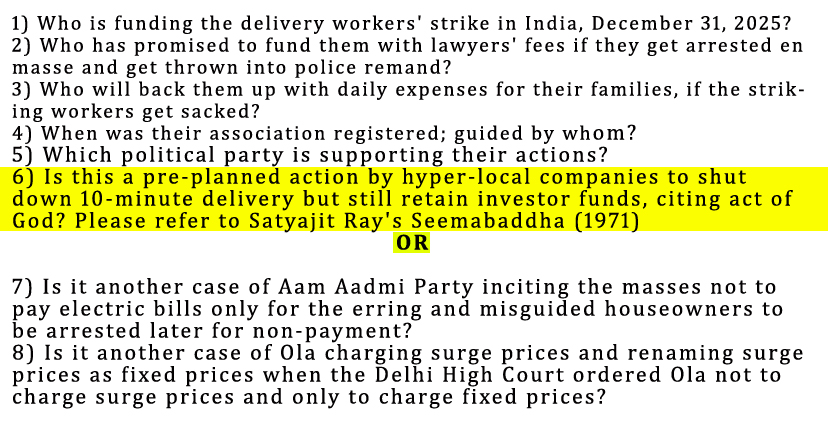
1) Who is funding the delivery workers’ strike in India on December 31, 2025?
2) Who has promised to fund them with lawyers’ fees if they get arrested en masse and get thrown into police remand?
3) Who will back them up with daily expenses for their families, if the striking workers get sacked?
4) When was their association registered; guided by whom?
5) Which political party is supporting their actions?
6) Is this a pre-planned action by hyper-local companies to shut down 10-minute delivery but still retain investor funds, citing act of God? Please refer to Satyajit Ray’s Seemabaddha (1971)
OR
7) Is it another case of Aam Aadmi Party inciting the masses not to pay electric bills only for the erring and misguided houseowners to be arrested later for non-payment?
8) Is it another case of Ola charging surge prices and renaming surge prices as fixed prices when the Delhi High Court ordered Ola not to charge surge prices and only to charge fixed prices?