
Despite having a smooth run of arm-twisting countries with a debt trap, some countries are standing firm and refusing to pay back the loan to China and also refusing to give up sovereignty and land to China
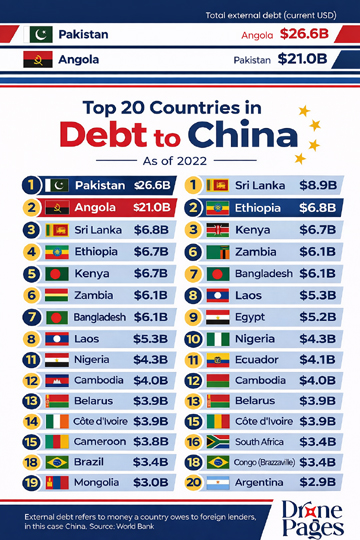
Listing the top countries indebted to China as of 2022 immediately reveals a pattern that is more political than merely financial. Pakistan, Angola, Sri Lanka, Ethiopia, Kenya, Bangladesh, Laos, Egypt and others dominate the list, most of them developing economies with weak fiscal buffers, chronic current-account deficits, or governance vulnerabilities.
What stands out just as starkly is who is absent: India. Despite being geographically proximate to China, a massive infrastructure-hungry economy, and an obvious candidate for Belt and Road Initiative (BRI) financing, India never allowed itself to become financially dependent on Chinese sovereign lending. This was not accidental, nor was it ideological posturing; it was a strategic decision rooted in institutional caution, geopolitical foresight, and financial self-reliance. India has historically relied on multilateral financing institutions such as the World Bank, Asian Development Bank, and later domestic bond markets and public-sector banking for infrastructure funding, rather than opaque bilateral loans tied to strategic assets.
Chinese loans, by contrast, often come with confidentiality clauses, sovereign guarantees, and asset-linked repayment structures that bypass parliamentary scrutiny. Indian policymakers, irrespective of party lines, understood early that Chinese capital is never neutral capital. Infrastructure funding from Beijing typically carries embedded leverage—ports, highways, power grids, and logistics corridors that can be weaponised politically during moments of fiscal stress. India avoided this trap by insisting on transparent procurement, competitive bidding, and domestic execution capacity. Even when Chinese companies were allowed to bid for Indian projects, financing was not sovereign-guaranteed.
Moreover, India maintained relatively healthy foreign exchange reserves, a diversified export base, and a manageable external debt profile, ensuring it never faced the liquidity crises that forced Sri Lanka to lease Hambantota Port or Pakistan to renegotiate energy projects under duress. India’s refusal to join the Belt and Road Initiative altogether was not merely symbolic; it was a firewall against debt-for-equity swaps that compromise sovereignty. The infographic’s list is therefore as much about India’s absence as it is about others’ presence, underscoring that fiscal discipline, democratic accountability, and strategic patience can insulate even large developing nations from falling into dependency traps.
If India represents disciplined avoidance, Montenegro represents a cautionary tale of how even a small European country can be pulled into a near-existential crisis through Chinese debt. Montenegro’s now-infamous highway project—financed largely by a Chinese policy bank—was conceived as a development catalyst but quickly turned into a fiscal nightmare. The loan amounted to nearly a quarter of Montenegro’s GDP, denominated in dollars, with limited revenue-generation capacity attached to the project. When repayment pressures mounted, Montenegro found itself unable to service the debt without external assistance, prompting fears that land, infrastructure, or strategic concessions could be demanded in lieu of repayment.
While Montenegro eventually sought help from European institutions to refinance and avert immediate default, the episode exposed the structural risk inherent in Chinese lending: projects are often oversized relative to the borrower’s economy, feasibility studies are weak, and risk is transferred entirely to the recipient state. The danger is not simply financial insolvency but political vulnerability. A country struggling to repay a Chinese loan enters a grey zone where sovereignty becomes negotiable—not through overt colonisation but through subtle economic coercion. Ports, highways, energy assets, and digital infrastructure become bargaining chips. Montenegro’s predicament echoes similar patterns seen elsewhere, from Sri Lanka to parts of Africa, where infrastructure assets quietly shift from national control to long-term Chinese influence.
What makes Montenegro’s case especially alarming is that it is a European country, theoretically protected by regional institutions, yet still vulnerable when Chinese bilateral lending bypasses EU safeguards. The lesson is clear: debt traps are not confined to poor or unstable nations; they can ensnare any country that underestimates the strategic nature of Chinese financing. Montenegro’s struggle serves as a stark reminder that development funding divorced from fiscal realism and geopolitical awareness can lead to situations where a nation’s highways, ports, or land itself become collateral in a high-stakes geopolitical negotiation.
Yet the infographic also masks a quieter, less discussed trend: several countries are increasingly standing firm, refusing to repay Chinese loans on Beijing’s terms and resisting demands that compromise sovereignty or territorial control. Across Africa, Latin America, and parts of Asia, governments are beginning to challenge the narrative that Chinese debt must be honoured at any cost. Zambia’s restructuring negotiations signalled a shift, with the country insisting on multilateral frameworks rather than opaque bilateral concessions.
Kenya has pushed back against fears that its ports would be seized, asserting parliamentary oversight and renegotiation rights. Bangladesh, despite being listed among China’s debtors, has carefully diversified its lenders and rejected several Chinese proposals that involved strategic assets. Even Sri Lanka, often cited as the archetype of debt-trap diplomacy, has become more assertive post-crisis, openly questioning the terms of Chinese lending and seeking broader creditor participation rather than unilateral concessions.
In Latin America, countries like Ecuador have renegotiated oil-backed loans, reducing China’s leverage over future exports. These acts of resistance mark an inflection point: borrower nations are learning that default does not automatically mean surrender, and that sovereignty can be defended through collective bargaining, transparency, and alternative alliances. The power asymmetry remains real—China is the world’s largest bilateral lender—but it is no longer unchallenged. As global scrutiny of the Belt and Road Initiative intensifies, and as China itself grapples with slowing growth and domestic financial stress, its ability to enforce harsh terms is diminishing. The infographic, when read carefully, is therefore not just a list of debtors; it is a snapshot of a global financial contest where some countries succumbed, others avoided the trap entirely, and a growing number are now pushing back. India’s strategic insulation, Montenegro’s near-miss with fiscal captivity, and the emerging defiance among several borrower nations together illustrate a critical truth of the 21st century: in an era where capital is a geopolitical weapon, the real battle is not over roads or ports, but over who controls the future choices of sovereign states.