
USA has officially announced a full suspension of immigration from 19 countries after the recent terrorist attack by an Afghan origin national. The countries under the ban are Afghanistan, Burundi, Chad, Republic of the Congo, Equatorial Guinea, Eritrea, Haiti, Iran, Libya, Myanmar, Somalia, Sudan, Yemen, Cuba, Laos, Sierra Leone, Togo, Turkmenistan and Venezuela
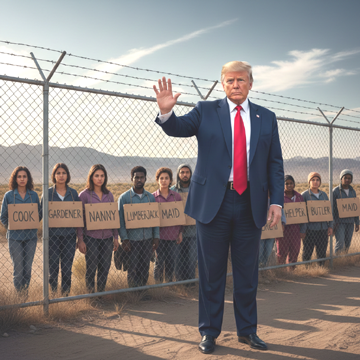
The United States has once again tightened its gates. Following a recent terrorist attack, Washington announced a full suspension of immigration from nineteen countries—stretching from Afghanistan and Iran to Haiti and Venezuela. The list spans continents, cultures, religions, political systems, and histories, but it shares one common feature: these are nations that sit on the margins of American power, often shaped—directly or indirectly—by U.S. foreign policy itself. The announcement has revived an old and uncomfortable question: how did a country built by immigrants reach a point where immigration is treated not as a source of strength but as an existential threat?
To understand the contradiction, one must return to the period when the United States actively needed immigrants and unapologetically welcomed them.
When barren America needed the world
From the late 19th century through much of the 20th, the United States functioned like a vast economic magnet. It had land to settle, factories to staff, railroads to build, laboratories to fill, and universities to populate. Immigrants were not a burden; they were the fuel. Irish laborers laid rail lines and dug canals. German engineers strengthened industry. Jewish scientists fleeing Europe transformed physics and medicine. Italians built cities. Chinese workers stitched together the American West. Later, Indians and East Asians powered Silicon Valley.
This was not altruism. It was cold, rational self-interest. America needed skilled and semi-skilled people, and it imported them at scale. The country understood a basic truth: human capital is the most valuable resource a nation can possess. The openness of the U.S. immigration system—flawed and often discriminatory, but still expansive—was one of its greatest strategic advantages over more insular empires.
Even during the Cold War, when ideology was paramount, the United States used immigration as a weapon. Scientists from Europe, defectors from communist states, and students from the developing world were encouraged to come, study, work, and stay. The message was clear: America is where ambition goes to succeed.
This openness was central to American power. The nation did not merely extract resources; it absorbed people. And people brought ideas.
The immigrant engine of power
It is impossible to talk about American dominance without acknowledging how deeply immigrant it is. A staggering proportion of Nobel Prize winners in the United States were born abroad. Major corporations—Google, Tesla, Intel, Pfizer—were founded or co-founded by immigrants or their children. Immigrants disproportionately start businesses, file patents, and staff research institutions.
More subtly, immigration refreshed American culture. It prevented stagnation. New accents, foods, religions, and ideas forced the society to renegotiate its identity constantly. That tension was uncomfortable but productive. It kept the system dynamic.
In contrast, empires that closed themselves off—late imperial China, Ottoman Turkey, even post-war Britain—declined in relevance. America, for a long time, avoided that fate precisely because it stayed porous.
What went wrong?
The turning point was not a single event but a convergence of fear, fatigue, and arrogance.
First came economic anxiety. As manufacturing jobs declined and inequality rose, political leaders found it easier to blame immigrants than to confront structural failures. Immigrants became convenient symbols of lost prosperity, even when data showed they contributed more than they consumed.
Second came security paranoia. Terrorist attacks—rare, statistically speaking—were amplified into civilizational threats. Immigration, once seen as an asset, was reframed as a vulnerability. Entire nations were judged not by individual behavior but by association, history, or religion.
Third—and most corrosively—came a sense of moral exhaustion. The United States, having declared itself the “indispensable nation,” began to see its own values as universal truths rather than contested ideals. This superiority complex bred impatience with the rest of the world. Instead of asking why resentment existed, American policy increasingly assumed resentment was irrational, inevitable, or culturally ingrained.
The war trail and its consequences
Many of the countries on the banned list share another uncomfortable link: they have been bombed, sanctioned, destabilized, or manipulated by U.S. policy.
Afghanistan, Iraq’s neighbor. Libya. Yemen. Somalia. Sudan. Iran. These are not abstract names. They are societies that have experienced decades of intervention, regime change, proxy wars, or economic strangulation. When infrastructure collapses, when institutions rot, when youth grow up amid drones and checkpoints, resentment is not mysterious—it is inevitable.
This does not justify terrorism. But it explains alienation.
A young man from a war-ravaged country does not experience America as a beacon of freedom; he experiences it as a distant force that shapes his misery without accountability. When such individuals migrate—or attempt to—they carry trauma, anger, and distrust. Treating them all as potential terrorists only confirms the narrative that America sees them as less than human.
The paradox is stark: the U.S. helps create instability abroad, then punishes people fleeing that instability.
Collective punishment as policy
The suspension of immigration from entire countries is not a security strategy; it is collective punishment. It assumes that nationality is a proxy for ideology and that violence is contagious by passport. This logic would have failed spectacularly in earlier eras. If applied consistently, Irish immigrants would have been banned during periods of anarchist violence, Germans during world wars, Japanese permanently after Pearl Harbor.
History shows that societies grow safer not by exclusion but by integration. Marginalized populations are more likely to radicalize; included ones are more likely to stabilize.
A cultural shift inward
At a deeper level, the immigration crackdown reflects an inward cultural shift within the United States. Confidence has given way to insecurity. Curiosity has been replaced by suspicion. The nation that once said “bring us your tired, your poor” now asks, “what if they change us?”
This fear is ironic. America has always been changing. That was the point.
The current posture resembles a fortress mentality—walls, bans, lists, and moral hierarchies. It assumes that American identity is fragile, that it must be protected from dilution. Empires adopt this mindset near the beginning of decline, not at the height of power.
Echoes of the British Empire
The comparison with the British Empire is instructive. Britain, too, believed deeply in its civilizational superiority. It ruled vast territories while convincing itself that it was benevolent, rational, and indispensable. It rarely listened to colonial grievances, dismissing them as ingratitude or barbarism.
When resistance emerged, Britain responded with repression, not reflection. Over time, resentment hardened into rebellion. The empire did not collapse because it lacked power; it collapsed because it lacked humility.
The United States risks repeating this error. By assuming moral infallibility and refusing to acknowledge the costs of its actions abroad, it blinds itself to the roots of global anger. Like Britain, it mistakes dominance for legitimacy.
A different path forward
America does not need to choose between security and openness. It needs to choose intelligence over fear.
First, it must abandon the idea that culture or nationality determines loyalty. Individual vetting, intelligence cooperation, and integration programs work better than blanket bans.
Second, it must confront its foreign policy legacy honestly. A nation that intervenes everywhere cannot pretend to be a neutral victim everywhere. Accountability builds credibility.
Third, the U.S. must revive its internal culture of confidence. A strong society does not fear newcomers; it absorbs them. It sets clear rules, demands participation, and offers dignity in return.
Finally, America must relearn curiosity. The world is not a problem to be managed but a reality to be engaged with. Immigrants are not carriers of chaos; they are carriers of stories, skills, and perspectives that can renew a tired system.
Immigration: The long arc of American success
The suspension of immigration from nineteen countries may satisfy a short-term political appetite, but it contradicts the long arc of American success. The United States became powerful not by excluding the world but by inviting it in. What went wrong was not immigration—it was arrogance, fear, and a refusal to reckon with consequences. Empires that believe they are too superior to listen eventually discover that superiority is not self-sustaining. America still has a choice: repeat the mistakes of fading empires or reclaim the confidence that once made it a destination rather than a fortress.