
India’s job creation strategy cannot depend on the government as no government till now has had a clear cut formula for creation of jobs at all levels of skill. The private sector, social enterprises, non-profit organizations, community networks, and citizens themselves must take the lead in generating livelihoods that are resilient, decentralized, and future-proof
For decades, Indian political discourse has revolved around two recurring themes: development and employment. Every election, parties promise millions of jobs, industrial corridors, manufacturing booms, and skill revolutions. Yet year after year, India faces the same stubborn economic reality — the government neither creates enough jobs nor considers job creation a central policy priority. India’s unemployment problem is structural, not episodic, and no political party has demonstrated the sustained, long-term, non-electoral commitment required to fix it.
The truth is uncomfortable: India’s job strategy cannot depend on the government as no government till now has had a clear cut formula for creation of jobs at all levels of skill. The private sector, social enterprises, non-profit organizations, community networks, and citizens themselves must take the lead in generating livelihoods that are resilient, decentralized, and future-proof.
This article explores why job creation is politically unattractive, how the state’s limitations shape India’s employment crisis, and what a bold civil-society-led strategy for widespread job creation can look like.
Government data, particularly from India’s Ministry of Corporate Affairs (MCA) reported in late 2025, shows over 2 lakh private companies closed in five years (FY20-25) due to amalgamation, dissolution, or being struck off, with a peak in FY23 driven by a cleanup of inactive firms, and data is accessible via India’s Open Government Data (OGD) portal for detailed, state-wise figures. Key Figures and Trends (India, FY 2020-21 to 2024-25) Total Closures: 2,04,268 private companies. Peak Year: FY 2022-23 saw the highest spike (83,452) due to a major drive to remove dormant companies. Recent Data: 20,365 closures in FY 2024-25; 21,181 in FY 2023-24. Apparent reasons: Amalgamation, conversion, dissolution, or being “struck off” (removed from records) under the Companies Act, 2013. Data source: data.gov.in (OGD Platform India): Offers specific datasets, including state-wise company closure numbers under the Companies Act. Ministry of Corporate Affairs (MCA): The primary source for official company data, though direct portal access might require navigation. News Reports: Recent articles from outlets like Times of India, Economic Times, and Rediff provide summaries from parliamentary data.

I. Why the government will not create jobs
1. Governments do not directly create jobs — they create conditions. The current Indian government in 2025 and neither the previous Indian governments have the wherewithal to create jobs. They have no plan and no vision to create jobs. On the contrary, the current government’s vision is largely all about protecting the Indian identity, the Hindu identity, reclaiming temples from Muslim invasion and ones converted to mosques, direct benefit transfer to poor farmers and the lowest common denominator, new innovation in railways, new airports and new highways. The educated, white collar, income tax paying section of India has clearly been sidelined by every single government till date.
In modern economies, governments rarely employ more than a small percentage of the labor force. India is no exception. The Central and State governments together employ fewer than 1 crore people, in a nation where 1.1 crore youth enter the workforce every year. Even doubling government hiring will barely dent unemployment numbers. Governments can build roads, offer incentives, set policies, and support industry — but the actual creation of jobs happens in enterprises, farms, startups, markets, and communities, not bureaucracies.
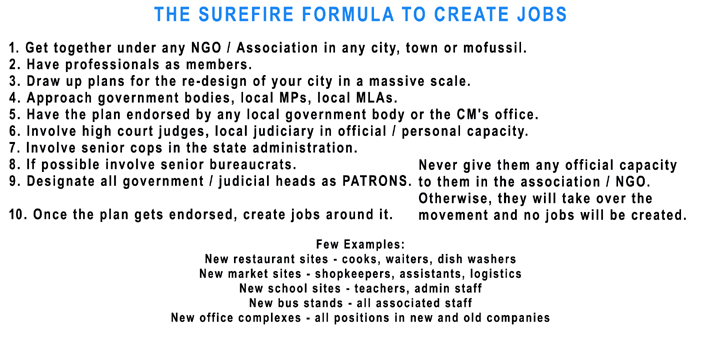
2. Political parties avoid job creation because it requires long-term investment
Jobs require: * years of investment in skills * labor regulation reforms * enabling India’s small businesses * improving education quality * infrastructure development * stable policies across elections. No political party in India has a 10–20 year economic vision. Election cycles reward short-term populism — free electricity, loan waivers, welfare schemes — not long-term structural employment reforms.
3. Creating jobs means taking political risks; Labor reforms anger unions. Land reforms anger farmers. Industrial reforms anger environmentalists or local communities. Education reforms upset teachers’ unions or state boards. Political parties prefer *not* to touch high-risk areas. Job creation requires changes that are unpopular during elections.
4. The government’s focus is shifting — from job creation to welfare. Over the last decade, the Indian state has leaned increasingly on: * cash transfers, * subsidies, * food security, * DBT schemes, * government-run skill centers. These stabilize incomes but do not create jobs. Welfare is politically rewarding — immediate, visible, emotionally resonant. Employment reform is slow and uncertain.
5. The nature of work itself is changing. Automation, AI, robotics, and digitization have displaced labor faster than governments can compensate for. Manufacturing — once the backbone of job creation — is now capital-intensive, not labor-intensive. No government can reverse global technological trends.
Given these conditions, the state cannot — and realistically will not — lead India’s job creation agenda.
II. India’s civil society: The sleeping giant of job creation
Civil society in India is enormous — far larger than most nations realize. It includes: * NGOs, * community groups, * cooperatives, * religious organizations, * educational institutions, * micro-entrepreneurs, * tech platforms, * agricultural collectives, * citizen initiatives, * local business associations.
This ecosystem already employs or supports millions, often more effectively than government programs.
In fact, civil society can play four roles the state cannot:
1. Work at grassroots level: Governments operate through hierarchies; civil society operates through networks. It can reach villages, slums, tribal belts, and informal workers faster.
2. Innovate rapidly: Startups, NGOs, and local entrepreneurs can test new ideas without waiting for bureaucratic approval.
3. Mobilize social capital: Community trust, relationships, shared culture, and local leadership matter immensely in job creation — especially in rural India.
4. Build jobs around local needs: Instead of national schemes, civil society can create hyper-local employment clusters:
* bamboo clusters in the Northeast
* dairy and poultry networks in Rajasthan and Bihar
* textile cooperatives in Tamil Nadu and Gujarat
* fisheries in coastal states
* eco-tourism in Himalayan regions
* craft clusters in Odisha and Kutch
* logistics micro-entrepreneurs in major cities
III. How civil society can create jobs: A new blueprint for India
Below is a practical, actionable model for job creation driven by civil society rather than the state.
1. Micro-Entrepreneurship at the Village and Urban Slum Level
India’s job crisis is a livelihood crisis, not a salary crisis. Employment will come from millions of people running micro-businesses: * food stalls, * tailoring shops, * beauty parlors, * repair shops, * local logistics, * cloud kitchens, * small-scale manufacturing, * handicrafts, * carpentry, plumbing, electrical services.
Civil society organizations can support these micro-entrepreneurs through:
* micro-credit, * business training, * access to online platforms, * mentorship, * shared workspaces, * cooperatives for procurement and sales. India does not need 100 unicorns. It needs 1 crore tiny businesses.
2. Skill Building Led by NGOs and Private Institutes (Not Government Centers)
Government skill programs often struggle with: * outdated curricula, * poor training quality, * weak industry connections, * poor placement rates, NGOs and private training institutes can design market-aligned skill programs in: * hospitality, * nursing, * logistics, * solar repair, * drone operations, * electric vehicle maintenance, * content creation, * coding and software testing, * retail services.
Skilling must be hyper-demand driven, not supply-driven.
3. Building Employment Clusters Instead of Scattered Jobs
Civil society can organize clusters with 100–500 workers each: * weaving and handloom clusters, * rural BPOs, * organic farming cooperatives, * recycling and waste management units, * woodworking and furniture units, * food processing groups, * eco-tourism cooperatives, * women-led SHG manufacturing units. Clusters create economies of scale, market linkages, and shared equipment.
4. Tech Platforms for Livelihoods, Not Just Entertainment
India’s digital ecosystem can be repurposed to generate jobs: * apps that connect farmers directly to buyers, * hyperlocal delivery networks, * ed-tech platforms for vocational skills, * marketplaces for handmade goods, * platforms for hiring local service providers, * AI-powered tools for small businesses. Civil society can partner with tech companies to bring these tools to underserved communities.
5. Supporting Women’s Workforce Participation
Women’s participation in India’s workforce is one of the lowest in the world. Civil society can lead a revolution by enabling: * home-based work models, * training programs inside communities, * childcare cooperatives, * microfinance tools, * safety and mobility solutions, * online marketplaces for women’s businesses. If India increases women’s workforce participation by even 10%, the economy could gain $300 billion.
6. Rural Modernization Through Social Enterprises
Social enterprises have already shown success in: * micro-irrigation, * solar electrification, * digital education, * rural logistics, * small-scale manufacturing. Examples like Barefoot College, SEWA, and Jaipur Rugs reveal how civil society can integrate rural workers into global value chains.
7. Green Jobs: India’s Largest Untapped Opportunity
Civil society can champion job creation in: * afforestation, * river restoration, * community-based tourism, * solar panel installation, * EV charging network management, * waste segregation, * recycling cooperatives, * mangrove restoration. These sectors can create millions of jobs while restoring ecological balance.
8. Building Local Supply Chains Instead of Import Dependency
Neighborhood-level production networks — bakeries, small garment units, carpenters, repair services — can replace imported goods. Civil society can enable: * maker spaces, * common facilities centers, * local procurement networks, * skill sharing programs. This strengthens economic resilience.
9. Mentorship and Business Councils
Retired professionals, entrepreneurs, teachers, and experts can mentor youth. A National Civil Mentorship Grid can pair skilled individuals with job seekers, startups, and local businesses. Civil society becomes an ecosystem of supporters, not just providers.
10. Public-Private-Citizen Partnerships (PPCPs)
Instead of waiting for the government, civil society can build its own partnerships: * Corporates bring technology and funding, * NGOs bring reach and training, * Communities bring local knowledge, * Local bodies bring logistics, * Micro-entrepreneurs bring energy. These networks can scale fast — without political interference.
IV. A Cultural Shift: Redefining Work in India
For civil-society-led job creation to succeed, India needs a cultural transformation: 1. Respect for blue-collar work. Electricians, plumbers, nurses, and carpenters are essential workers worldwide — India must elevate their dignity.
2. Acceptance of micro-entrepreneurship
Small businesses must be seen as prestigious, not inferior to government jobs.
3. Community pride in local products
Local craftsmanship and food must be valued as heritage.
4. Family support for risk-taking
Indian families often discourage entrepreneurial risks; this must evolve.
V. India’s Jobs Will Come from Its People, Not Its Politics
India is entering a demographic peak — over 65% of the population is under 35. This can become a crisis or a dividend. But the government will not solve it. Political parties will not prioritize job creation. Elections will not reward structural reforms. The responsibility — and opportunity — lies with civil society, with millions of Indians who can build enterprises, networks, and systems that create livelihoods at scale. The next great Indian economic revolution will not begin in Parliament. It will begin in villages, towns, neighborhoods, cooperatives, NGOs, startups, and communities. Job creation is not a government program. It is a national movement that civil society must lead.