
One of the biggest advantages of Facebook is its structural flexibility. Whereas newer social media often offer a narrow set of features (photo sharing, short video, following), Facebook provides multiple ways to connect, share, organize, and communicate
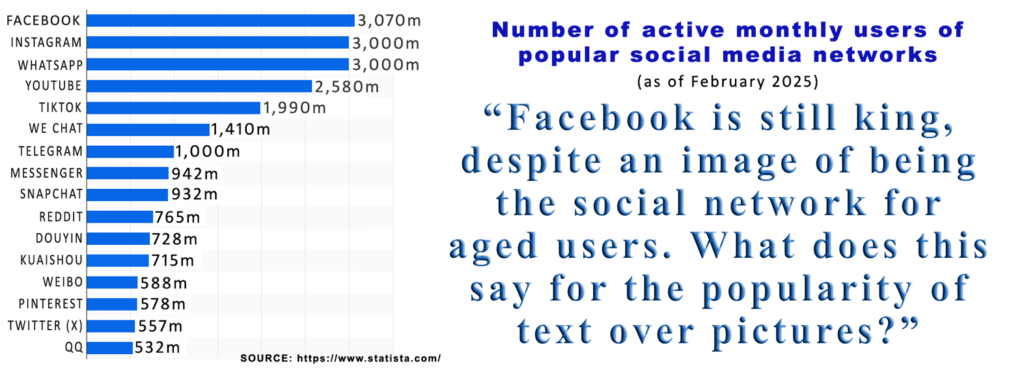
Even though Instagram and X are often perceived as younger, trendier platforms, their total user bases (monthly active) remain lower than Facebook’s global reach.
As of early 2025:
- Facebook leads with roughly 3.07 billion monthly active users (MAUs).
- By comparison, Instagram in many reports sits at around 2.0 billion MAUs.
- Meanwhile X (Twitter) is far behind on user count in most rankings: for example, one list puts X at ~611 million MAUs.
This chart reinforces this dominance by showing Facebook at ~3,070 million – top of the list.
Why has Facebook held on to the top spot — despite its age?
Several interlocking factors explain why Facebook remains #1 globally. It is not merely legacy — it’s structure, feature set, business-friendly tools, and scale.
1. Rich, Multi-Faceted Structure: Profiles, Friend Requests, Groups, and Pages
One of the biggest advantages of Facebook is its structural flexibility. Whereas newer social media often offer a narrow set of features (photo sharing, short video, following), Facebook provides multiple ways to connect, share, organize, and communicate. Some of the key structural elements are:
- Friend Request / Accept Mechanism: On Facebook, you connect by sending and accepting “friend requests,” which creates a two-way relationship. This solidifies social ties: you see content from “friends,” and there’s a sense of personal connection. This system is more personal than the mostly one-way “follow” model popularized by Instagram and X. On Instagram and X, “following” does not require mutual confirmation (unless one sets a private account), so connections tend to be looser and less personal. Because people often use Facebook to stay in touch with real-life friends and family — not just follow celebrities — this mutual-friend model builds deeper and more consistent social bonds.
- Profiles vs Pages vs Groups:
- Every user has a personal profile. But beyond that, Facebook supports Pages and Groups. Pages allow public figures, brands, businesses, organizations to have an official presence separate from personal accounts.
- Groups allow communities to form around shared interests — communities that can be private, public, or closed. Families, hobby groups, professional groups, support communities, local interest groups — virtually anything can be organized via Groups.
- This combination of profiles, pages, and groups gives Facebook a unique richness. You can have intimate friend networks, broader public brand followings, and interest-based communities — all within the same platform.
These structural capabilities are largely absent or underdeveloped in Instagram and X:
- Instagram is primarily oriented around photo/video sharing and following, with no real “friend request/acceptance” mechanism in the traditional sense (besides private accounts). It also lacks robust “group” or “community forum” features.
- X (formerly Twitter) is built for broadcasting and following rather than building close social networks or communities. Its strength is in real-time public conversation, not in sustaining long-term, interest-based communities.
Because of this, Facebook supports a wide spectrum of social use cases — from close personal contact to business, community, hobby groups — which keeps many kinds of users engaged over time.
2. Communities and Groups: Facebook Is a Platform of Communities — Not Just Broadcasting
Many of Facebook’s strengths derive from the fact that it is not just a “broadcast and follow” platform — it is also a platform of communities and conversation.
- Groups: As noted, Facebook Groups allow people to gather around shared interests — everything from local neighborhood communities, hobby clubs, parenting support, fan clubs, professional or alumni networks, local buy/sell/trade groups, non-profits, activists, and more. These groups often have real-world parallels (friends, classmates, colleagues, neighbors).
- Pages: Businesses, brands, public figures create Pages to connect with audiences. People can “like” or “follow” a Page to get updates. This separation — personal profile vs business/brand page — helps companies maintain professionalism while still engaging real people.
Because of this structure, Facebook becomes not only a social space but a hub for communities, commerce, and interest-based networking. That makes it very sticky — users return to groups and pages regularly, not just passively scroll.
Instagram and X, on the other hand, lean heavily on content discovery and broadcasting (photos, videos, tweets), often prioritizing public content over private or semi-private community engagement. That difference changes user behavior: people may “follow” celebrities or brands, but they don’t necessarily build meaningful smaller-group connections or communities.
Consequently, Facebook appeals to a broader array of needs — from personal social life to local community engagement to business presence — which helps sustain high user retention and engagement across demographics and geographies.
Advertising, Business & Monetization: Why Facebook Wins for Businesses and Communities
Another key reason for Facebook’s dominance lies in how advertising, business, and community-building work on Facebook — especially compared to Instagram and X.
Business, Brands and Ads: Pages + Groups Enable Marketing and Commerce
Because Facebook supports Pages (brands, businesses, public figures) and Groups (communities, interest-based gatherings), it’s very natural for businesses to use Facebook to build real, engaged audiences — not just passive followers.
- A business can create a Page, post updates, promos, content; followers get those posts in their feed.
- A brand or business can also create or sponsor a Group — for example, a community around a product, a niche interest, customer support group, or local community group — and thus build a more engaged, participatory audience.
- Groups and Pages give businesses more flexibility and depth than a simple “follow/unfollow” model. There are often higher engagement and stronger loyalty in group contexts (e.g., communities, local pages, niche hobbies).
In contrast:
- Instagram is very follower/content-driven: brands/influencers get followers, post photos/videos, rely on likes, comments, DMs. But there’s no built-in “community group” structure — that tends to limit deeper community engagement.
- X (Twitter) is even less favorable to businesses wanting tight-knit communities — it’s mostly for broadcasting, not building long-term, interactive communities.
Thus, for businesses (especially small to medium, local, or niche), Facebook remains easier and more natural for building community, engaging customers, and facilitating commerce.
Scale + Ad Reach: The More Users, the More Potential Customers
Because Facebook has over 3 billion users globally, businesses advertising on Facebook potentially reach a far wider audience than on Instagram or X.
Moreover, the depth — not just breadth — of Facebook’s user relationships (friend links, groups, pages) means ads and marketing can be more targeted, nuanced, and effective. A local business can target a specific geographic community or group; a brand can rely on existing followers + group members for word-of-mouth; a cause or nonprofit can build an engaged community.
That makes Facebook especially powerful for businesses seeking long-term relationships, community building, and stable customer bases — not just one-time visibility or viral reach.
Financial Muscle: Facebook (and Its Parent Company) vs. Others
Popularity and user numbers are one thing; financial success is another — and on that front, Facebook’s parent company, Meta Platforms, is far ahead.
Meta’s Revenue Dominance
- In 2024, Meta’s total revenue reached US$ 164.5 billion, a 22% increase over 2023. PR Newswire+2Meta Investor+2
- Almost all of that comes from advertising: the “Family of Apps” (which includes Facebook, Instagram, WhatsApp, Messenger) generated US$ 162.35 billion in 2024.
- According to industry analysis, in 2024 Meta accounted for roughly 60% of all social-app revenues worldwide.
- Of that ad revenue, a large share comes from Facebook itself — one estimate puts Facebook’s revenue at US$ 91.3 billion in 2024, with Instagram contributing about US$ 66.9 billion.
These numbers show that Facebook (via Meta) is not just winning in users — it’s also vastly winning in monetization, making it the primary destination for advertisers and businesses.
How Other Platforms Compare
While Meta leads by a wide margin, other platforms are growing and earning:
- YouTube (owned by Alphabet) is generating around US$ 36.1 billion in ad revenue in 2024, plus additional income from subscriptions (e.g., YouTube Premium) — roughly US$ 14.5 billion.
- TikTok (owned by ByteDance) is also growing quickly: third-party estimates suggest it earns somewhere in the tens of billions annually (some recent estimates put 2024–2025 revenue in the US$ 16–18 billion range).
- By contrast, X (Twitter) has far lower revenue. While older sources show ad-based monetization, recent years have been more challenging for X: declining advertiser confidence, user flight, and controversy have all hurt revenue.
Thus, from a revenue perspective, Meta/Facebook continues to dominate the “social media ad economy.” That financial strength enables it to invest in new features, infrastructure (AI, data centers), and maintain dominance — reinforcing a virtuous cycle: more users → more ad dollars → better product → even more users.
Why Older ≠ Obsolete: The Value of Scale, Community, and Utility
It might seem that because Facebook is older, it should naturally decline — overtaken by flashier, newer platforms aimed at younger audiences. But that underestimates the value of scale, structure, and versatility.
- Scale matters: 3 billion users worldwide is a massive reach. For many people — especially outside the youth demographic — Facebook remains the default social network. It’s where older adults, global users in emerging markets, and people seeking stable communities congregate.
- Versatility matters: Not everyone wants short videos (TikTok), ‘Stories’ or photos (Instagram), or real-time public broadcasting (X). Many want a platform where they can stay in touch with friends, join interest-based groups, find local communities, support businesses, buy/sell locally, etc. Facebook offers that versatility.
- Network effects and inertia: For many users, especially those who’ve built large friend networks, group memberships, and followed business/pages, leaving Facebook would mean losing a lot of social capital. That inertia helps sustain its dominance.
- Monetization + Ecosystem: With pages, groups, ads, and commerce integration (marketplaces, local businesses), Facebook is more than a social app — it’s a full digital ecosystem. That makes it useful not just for socializing, but for commerce, communication, business, and community building.
In that sense, Facebook has become less like “just a social media platform” and more like a global digital infrastructure for communities, businesses, and social connection — something few newer platforms can match in breadth.
The Limitations of Instagram and X (Twitter) in Comparison
Understanding why Facebook remains dominant also requires acknowledging what its rivals lack — or at least, where they are weaker.
- Instagram is largely about visual content — photos, short videos, Stories, Reels — and follower-based audiences. It’s excellent for influencers, visual-driven brands, lifestyle, fashion, travel, entertainment. But it lacks robust community features (e.g., public groups as on Facebook) or two-way social networks (friend requests/acceptance). The relationships are mostly one-directional (follower → followed), which limits deep connection.
- X (Twitter) is essentially real-time public broadcasting. It’s designed for short text (or media) updates, public conversation, news, trends — not for building close-knit communities. Its model is built around following, not mutual friendships. That makes it less suited for community building, niche groups, business-customer relationships, local commerce, or long-term social ties.
Because of that structural difference, Instagram and X tend to attract demographics and use cases that favor individual brands, influencers, trending content or virality — but they are less well suited for building stable, interest-based communities or long-term relationships.
So while Instagram or X may be “cooler” or trendier — especially among younger audiences — they simply do not provide the same depth of social infrastructure as Facebook. This limits their ability to fully replace Facebook especially for older demographics, local communities, or businesses seeking meaningful engagement.
What This Means for Advertising, Business, and Communities
From a marketing or business perspective, Facebook continues to be arguably the easiest and most effective platform for building a solid presence — especially for businesses, communities, and long-term engagement.
- If you run a small business, you can create a Facebook Page, target local or global users, post updates, engage with followers, run ads, promote events, and even build a community via Groups.
- If you manage a community — say, hobby group, alumni network, local club, interest-based gathering — you can create a Facebook Group and reach both people you know and strangers who share the interest.
- For e-commerce — local sales, second-hand marketplaces, group-based buying/selling — Facebook provides a natural environment that many other platforms lack.
- For content creators and brands — you benefit from both the wide reach (3 billion +) and the ability to build tight-knit audiences through pages or groups rather than relying solely on follower counts.
In short: Facebook combines the reach of a mass audience with the depth of community, which is why advertising and business on Facebook remains easier and often more effective (especially for long-term engagement) than on Instagram or X.
Revenue and Business Power: Facebook (Meta) vs The Rest
As noted, Facebook — via Meta — still leads by a wide margin when it comes to monetization. Key points:
- Meta’s 2024 revenue: US$ 164.5 billion.
- Family of Apps (Facebook, Instagram, etc.) revenue: US$ 162.35 billion.
- Meta responsible for ~60% of all social-app revenues in 2024.
- Of that, a huge part comes from Facebook itself (≈ US$ 91.3 billion), with Instagram contributing another ~US$ 66.9 billion.
Compare that with competitors:
- YouTube earns — by most estimates — tens of billions per year (e.g., ~$36.1B from ads + ~$14.5B from subscriptions in 2024).
- TikTok (ByteDance) is rising, but its estimated revenue remains a fraction of Meta’s — many estimates put it in the $16–18 billion range.
- X (Twitter) — by many recent reports — has ad revenue that is small compared to Meta, and has faced declines as many advertisers scaled back.
That financial strength gives Facebook and Meta huge advantages: the ability to invest in infrastructure (AI, data centers), develop new features, maintain global reach, and keep advertisers locked in. It also means communities and businesses building on Facebook benefit from a stable, well-supported environment — which continues to reinforce Facebook’s dominance.
How Older Doesn’t Mean Outdated: The Staying Power of Facebook
It’s tempting to view older platforms as inherently “past their prime.” But Facebook shows this isn’t the case. Instead, its age has become an advantage — because:
- It has built massive global scale — billions of users across continents, age groups, languages, demographics.
- It supports diverse ways of connecting — from personal friendships to public pages, from local communities to global interest groups.
- It provides versatile tools for businesses, brands, communities, and individuals — from Pages to Groups to targeted advertising, commerce, content sharing, and more.
- It monetizes that reach effectively — generating huge revenue, enabling reinvestment in product and infrastructure, which in turn improves user and advertiser experience.
- It maintains network effects and stickiness — people stay because their friends, communities, groups, and business connections are already there; leaving would mean losing social capital.
In short: Facebook isn’t just surviving — it’s still innovating. Its structure allows it to adapt to changing social media trends (video, commerce, communities) while retaining core functionality (friend-graph, groups, personal connections).
Limitations and Demographic Shifts — Why Facebook Isn’t Perfect
That said, the dominance of Facebook does face challenges:
- Among younger users, especially Gen Z, newer platforms (like TikTok, newer entrants, or simply more visual, short-form or ephemeral platforms) may be more appealing. Platforms that favor short-form video, entertainment, and viral content often attract younger demographics more.
- For influencers and content-first creators, the follower + content model of Instagram, TikTok, or YouTube may be more suitable than the friend + group + community model of Facebook.
- User behavior: some younger or more privacy-conscious users might perceive Facebook as “less cool,” more corporate, or too tied to older generations.
- Because of its size and reach, Facebook often faces more scrutiny — around privacy, moderation, regulation — which can sometimes undermine user trust or lead to negative press.
So while Facebook’s structure, scale, and monetization are powerful advantages, its broad appeal can also make it less tailored for certain audiences (especially younger, privacy-conscious, or content-first users) — which is why other platforms continue to grow and thrive in their niches.
Why Facebook Remains King — for Now
Despite being one of the oldest major social media platforms, Facebook remains the most used and popular worldwide — not because of nostalgia, but because of scale, structure, flexibility, and business value. Its combination of personal connections (friend requests), community-building (groups, pages), and versatile monetization (ads, commerce, businesses) gives it far more breadth than many newer platforms that focus mainly on content sharing.
For businesses, local communities, hobby groups, and millions of regular users around the world, Facebook remains the go-to platform — especially where long-term engagement, community building, and reach matter. Its dominance is reinforced by the fact that its parent company Meta controls a huge share of global social-app advertising revenue, enabling continuous investment in infrastructure, features, and stability.
In sum: Facebook hasn’t stayed on top because it’s old — it’s stayed on top because it continues to offer the widest, deepest, most versatile and business-friendly social ecosystem on the planet. Until a competitor matches that combination of scale, flexibility, and monetization, Facebook is likely to remain king.