
Su-57 for the Indian Air Force retiring most of Su-30 MKI: strategic promise, political risk, and how South Asia’s air battles might look over the next decade
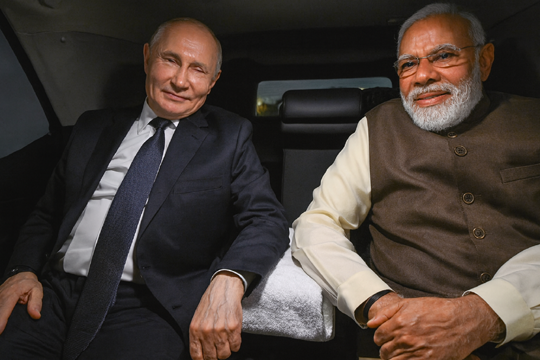
India and Russia have long practised a deep defence partnership. In December 2025 those ties again surfaced in public reporting: Delhi and Moscow discussed the Sukhoi Su-57 — Russia’s fifth-generation fighter — during high-level defence talks accompanying President Putin’s visit.
This article examines realistic paths by which India could acquire Su-57 technology (purchase, licensed production, or deep technology transfer), weighs pros and cons for Indian operational needs and domestic programs (notably the AMCA), and sketches plausible geopolitical and conflict scenarios over the next ten years — between India and Pakistan, and between India and China — if a meaningful Su-57 deal goes ahead.
Three acquisition/transfer pathways — and their feasibility
- Straight purchase of finished Su-57 aircraft.
This is the simplest route politically and logistically: buy a fleet of finished jets from Russia, upgrade IAF squadrons, and lean on Russian logistics support. It shortens the time to fielding new capability but leaves India dependent on Russian spares, avionics updates, and engine logistics — and limits transfer of cutting-edge design knowledge. - Licensed production in India (assembly or local manufacture).
India has used licensed production before (Su-30MKI via HAL and Russian partners). Licensed manufacture would create wider industrial benefits and reduce dependence on imports, but demands long negotiations on IP, workforce training, and firm commitments from Russia — and would require substantial local investment and supply-chain readiness. - Deep technology transfer / co-development (engines, stealth, sensors, AESA radars, sensor fusion).
This is the most attractive for India’s strategic autonomy: acquiring design knowledge that accelerates AMCA, indigenous engines, and avionics. But it is also the least likely in the near term. Russia has guarded select technologies; moreover, full transfer of subsystems risks triggering third-party political consequences (sanctions, export control friction), and Russia itself may be reluctant to share “crown-jewels” without offsetting guarantees. The state of Su-57 systems (airframe mature, but engines and sensor suites have been evolving) complicates unconditional transfer.
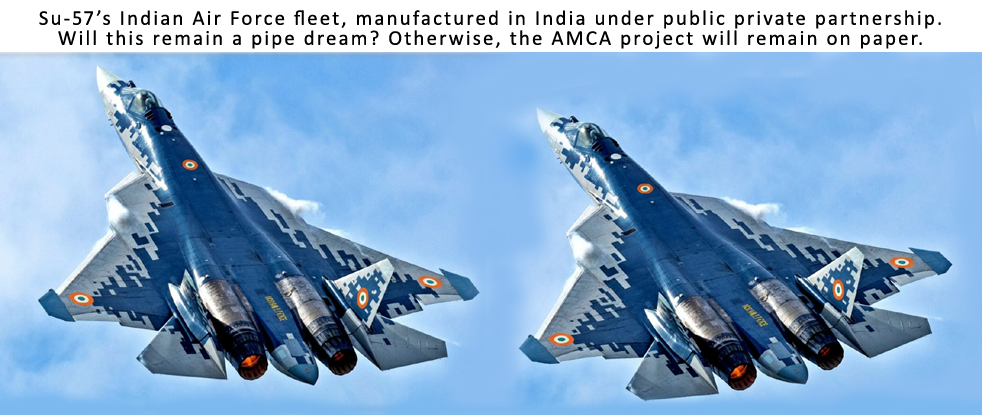
Feasibility check: India is already fast-tracking its indigenous fifth-gen AMCA programme (official timelines and public reporting put prototypes and early testing in the late 2020s–early 2030s). Induction of foreign fifth-gen fighters could both help the IAF bridge a capability gap and complicate the AMCA industrial roadmap.
Political and economic constraints: Sanctions and Washington’s posture
The U.S. sanctions law CAATSA gives Washington leverage over major defence purchases from Russia — although precedent exists for pragmatic carve-outs (the S-400 purchase led to intense Washington-Delhi diplomacy and legislative maneuvers, and some U.S. institutions signalled waivers or exceptions in that case). Any large Su-57 deal would therefore trigger Washington scrutiny and require Delhi to manage ties with Washington carefully.
Russia’s incentives and limits
Following isolation after 2022, Russia has sought closer trade and defence ties with India. Moscow may see defence transfers as both revenue and strategic outreach — but it will also look to protect its most sensitive technologies and maintain leverage over buyers. Recent discussions around expanding trade and defence cooperation create an opening, but transfer terms will be complex.
Industrial calculus for India
A pragmatic Indian approach could mix options: buy a small initial batch of Su-57s for operational learning and mission capability while negotiating licensed production + component transfer for mid-term industrial gains — all timed to inform AMCA development and engine programs. That hybrid model is politically and technically messy, but potentially the most attractive if New Delhi wants speed without surrendering future autonomy.
Operational effect: what would Su-57 bring to the IAF?
The Su-57 offers stealth, internal weapons bays, supersonic cruise potential and a modern sensor suite — capabilities that improve survivability against integrated air-defence systems and advanced enemy fighters. Fielding even a limited number (dozens, not hundreds) would change the IAF’s order-of-battle by providing a genuine fifth-generation option for air-superiority and deep-strike missions. But remember: the magnitude of operational effect depends on numbers, pilot training, supporting ISR, and how well Su-57 sensors/weapons are integrated into India’s broader C4ISR and doctrine.
At the same time, India’s AMCA program aims to deliver indigenous fifth-gen capability by the 2030s — so the Su-57 could be a “bridge” or a parallel capability. The strategic question becomes: does India want quick capability now (and accept dependence), or slower indigenous sovereignty later?
Regional strategic ripple effects
China
China already fields the Chengdu J-20 and has expanded its fleet and variants; J-20 deployments near Tibet have been reported, and Beijing continues to scale production of fifth-gen fighters. A Su-57 deal would accelerate India’s ability to contest PLAAF stealth assets in a future air domain fight — but it would likely accelerate China’s own force posturing (more J-20 deployments, better sensors, loyal wingman drone integration) and deepen military competition in the Himalaya and broader Indo-Pacific. Analysts have warned that J-20 fielding near the LAC is already a major India concern — Su-57s would shift the technologies contest but not eliminate China’s edge in production scale and integration.
Pakistan
Pakistan would interpret a high-level India-Russia deal as a shock to the regional balance. Islamabad’s likely responses include deeper procurement from China (more JF-17s/J-10s, advanced missiles), expansion of air-defence and strike assets, and leveraging asymmetric tools (missiles, tactical nuclear posture, proxies). A Su-57 fleet would raise the threshold for Pakistani air operations, pressuring Pakistan to invest in longer-range sensors and stand-off weapons.
Plausible conflict scenarios in the next ten years (what could change if a Su-57 deal happens)
A) India–Pakistan: plausible war situations
- Short-duration air-dominated escalation (limited 7–14 days).
If a crisis occurs (terrorist strike or cross-border raid), India might use Su-57s for precision strikes against hardened tactical targets and to suppress opposing air defences. Pakistan would respond with asymmetric strikes (ballistic/cruise missiles, stand-off strikes), seeking to avoid direct fighter confrontations where Su-57s can exploit air superiority. Outcome: high intensity but geographically constrained exchanges with major political pressure to de-escalate rapidly. - Protracted attritional air campaign (weeks to months) — lower probability but higher consequence.
If escalation spirals, Su-57s give India more credible deep-strike and air-superiority options, potentially allowing strikes deep into sanctuary areas. Pakistan’s counter would rely on dispersed air power (JF-17s), enhanced ground-based air defences, and strikes on airbases. Nuclear thresholds and international pressure become decisive variables; the deal raises Pakistan’s incentive to avoid conventional engagement and employ asymmetric methods. - Deterrence success without war.
A credible Su-57 capability could simply raise the costs of Pakistani adventurism, reducing the frequency or scale of cross-border strikes. This is the best strategic outcome, but hinges on India deploying and sustaining the capability visibly.
B) India–China: plausible war situations
- High-altitude LAC clash (localized, limited duration).
At high altitudes (Eastern Ladakh/Tibet border), air operations are constrained by thin air and short basing options. Su-57s provide advantage in survivability and BVR (beyond-visual-range) engagements, but logistics and basing limit their utility. Contests would focus on integrated ISR, early warning, and stand-off weapons; a Su-57 fleet tilts the balance in Indian favour in lower-altitude air corridors and for strikes away from the highest passes. - Integrated air campaign over wider theater (if escalation expands).
If conflict spreads to the plains or the north-east, the Su-57’s stealth and sensor fusion become more decisive. China’s numerical edge in J-20s and supporting air assets means any advantage from a handful of Su-57s could be ephemeral unless India fields sufficient numbers and supports them with AWACS, drone swarms, long-range missiles and electronic warfare. A Su-57 deal would likely accelerate an arms-race dynamic: more fifth-gen production on both sides, faster integration of loyal wingmen and networked sensors. - Escalation control through signaling.
Paradoxically, Su-57s could help with signaling: their presence can demonstrate credible lethality that deters large conventional advances — but they also increase the stakes, creating political pressure in a crisis. The net effect depends on command-and-control discipline and crisis management mechanisms between Beijing and New Delhi.
Risks and second-order effects
- Arms race and regional instability.
A visible Su-57 deployment could trigger accelerated Chinese and Pakistani procurement, worsening regional arms dynamics and increasing the risk of miscalculation. - Sanctions and diplomatic balancing.
Even though India has previously navigated CAATSA politics around S-400s, a large Su-57 transfer might again force Delhi to clinch political understandings with Washington (or accept the diplomatic cost). There is a clear precedent of U.S. legislative and executive attention to Indian Russian purchases. - Industrial and doctrinal friction.
Parallel dependence on Russian platforms and an indigenous AMCA program could produce doctrinal and logistical complexity. India must avoid technology and training fragmentation that lowers fleet readiness. - Technology transfer limitations.
If Russia offers limited transfer (airframe but not core avionics or engines), the industrial benefit will be muted. Conversely, full transfer could accelerate indigenous stealth and engine programs but faces political and export-control impediments.
Bottom line — balancing speed, sovereignty, and stability
A pragmatic Indian decision would weigh three competing objectives: rapid operational capability (speed), long-term strategic autonomy (sovereignty), and regional stability (manage escalation and diplomatic costs). A modest Su-57 purchase combined with targeted licensed production and negotiated partial technology transfer — sequenced to support AMCA development rather than supplant it — is the option that best balances those aims. But it is politically and technically delicate: it requires careful management of Washington (sanction risk), Moscow (willingness to transfer), and New Delhi’s own industrial timelines.
If executed well, a Su-57 deal would strengthen India’s deterrent posture, raise the cost of adversary adventurism, and provide operational lessons that speed indigenous design. If executed badly (overdependence, limited transfer, or poorly managed diplomacy), it could sharpen an arms race, complicate India’s domestic fighter programs, and entangle New Delhi in broader great-power politics. The next ten years will therefore be a test of strategy as much as of systems: aircraft alone do not win wars — doctrine, production scale, ISR integration, logistics, and the political will to manage crises do. A Su-57 deal changes several variables in India’s favour — but it does not magically resolve the hard problems of regional deterrence and stability.

