
India could export cheap but skilled labour to these lean loser regions in Europe. The India-EU FTA is a deal written by and for export-capable, capital-intensive, technology-heavy Europe. If you are outside that club, the upside is thin—or negative
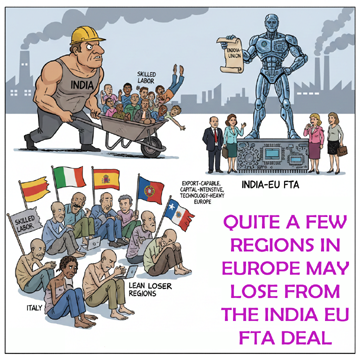
For all the triumphal language around the India–EU Free Trade Agreement, this deal does not lift all European boats. It is asymmetric by design, rewards industrial depth over social breadth, and quietly sidelines entire regions, sectors, and labour constituencies inside Europe. Some of the losers are obvious. Others are uncomfortable to acknowledge, which is precisely why they matter.
This is a deal written by and for export-capable, capital-intensive, technology-heavy Europe. If you are outside that club, the upside is thin—or negative.
1. Southern and Eastern European Low-Value Manufacturing: Squeezed, Not Saved
Who loses:
- Portugal, Romania, Bulgaria, parts of Southern Italy, Greece
- Labour-intensive manufacturers in:
- Textiles and garments
- Footwear (lower end)
- Simple metal fabrication
- Low-tech consumer goods
Why they lose:
The FTA integrates India more deeply into European value chains without protecting Europe’s weakest manufacturing base. Indian firms already dominate low- to mid-value manufacturing on cost. This agreement accelerates that reality.
European firms that once offshored to Eastern Europe will now find India cheaper, larger, and increasingly reliable, especially as tariffs on machinery and components vanish. Eastern Europe’s role as “cheap Europe” erodes further.
This deal does nothing to rebuild labour-intensive manufacturing inside Europe. It quietly concedes that battle.
Uncomfortable truth:
If your competitiveness relies on wages rather than technology, the EU just signed your eviction notice—politely.
2. European Farmers Outside Premium Niches: Protected, but Politically Marginalised
Who loses:
- Cereal farmers
- Sugar producers
- Beef and poultry sectors
- Small, non-branded agricultural producers
Yes, many of these sectors are formally “protected” by exclusion clauses. But that is not the same as winning.
Why they lose:
The agreement signals where Europe’s agricultural future lies: premium, branded, GI-protected products—not volume farming. Wine, olive oil, cheese, confectionery, specialty foods win. Commodity agriculture stagnates.
Indian imports are restricted, but Indian competition sets global prices, and European farmers continue to face:
- Rising input costs
- Environmental compliance burdens
- Shrinking political patience
This FTA does not kill European mass agriculture—but it confirms that Brussels is no longer building its future around it.
Brutal reality:
Protection is not growth. It is managed decline.
3. European SMEs Without Scale or Export Literacy: Left Behind Despite the “SME Chapter”
Who loses:
- Small firms in:
- Spain, France, Italy, Eastern Europe
- Traditional family-owned businesses
- SMEs without:
- Export finance
- Legal/IP sophistication
- India-specific market knowledge
Why they lose:
The SME chapter is well-intentioned but largely cosmetic. India remains:
- Bureaucratically dense
- Legally complex
- Relationship-driven
- Scale-biased
German Mittelstand firms with decades of export experience will use the FTA effectively. A small Portuguese machinery firm or Greek food processor will struggle.
This agreement rewards institutional memory and balance sheets, not entrepreneurial grit.
Hard truth:
Trade agreements don’t level the field. They widen it.
4. European Digital Platforms and Consumer Tech: Shut Out by Design
Who loses:
- EU consumer tech firms
- Digital platforms
- Data-driven service companies
Why they lose:
India has not meaningfully liberalised:
- Data localisation rules
- Platform regulation
- Digital competition policy
The FTA avoids confrontation here. India protects its digital sovereignty fiercely—and Europe quietly accepts it.
Unlike manufacturing or chemicals, European digital firms gain little new access, while Indian IT and services firms continue expanding in Europe.
Reality check:
Europe exports machines. India exports code.
This deal reinforces that imbalance.
5. Labour in Europe’s Legacy Industries: Invisible Casualties
Who loses:
- Mid-skilled industrial labour in:
- Traditional auto manufacturing
- Mechanical assembly
- Tier-2 and Tier-3 suppliers
Why they lose:
The FTA accelerates:
- Automation
- Component imports
- High-end consolidation
German OEMs and Tier-1 suppliers win—but they will:
- Import more components
- Automate more processes
- Reduce labour intensity
Eastern European and Southern European workers in extended supply chains bear the adjustment costs.
Political irony:
The EU sells this deal as “job creating,” but the jobs it creates are engineers, lawyers, and logistics managers—not factory workers.
6. France and Italy’s Mid-Tier Brands: Trapped Between Luxury and India’s Local Champions
Who loses:
- Mid-premium European brands
- Non-luxury fashion, food, and lifestyle companies
Why they lose:
India’s market polarises:
- At the top: luxury brands win
- At the bottom: domestic Indian brands dominate on price
Mid-tier European brands lack:
- Pricing power
- Brand myth
- Cost advantage
They are squeezed from both ends.
Unpleasant truth:
India is not a gentle learning market. It is brutally Darwinian.
7. Europe’s Climate Hypocrisy Problem: Exporting Standards, Importing Reality
Who loses:
- European firms facing:
- High carbon costs
- Strict ESG compliance
- Regulatory drag
Why they lose:
European firms must comply with:
- CBAM
- ESG reporting
- Labour and environmental standards
Indian competitors, even when integrated into EU supply chains, often face looser enforcement, at least in practice.
The FTA speaks eloquently about sustainability—but enforcement asymmetry remains.
Blunt assessment:
Europe moralises. India industrialises.
The balance of pain is unequal.
8. Countries That Lose Strategically: The UK by Absence, Not Error
Who loses:
- The United Kingdom
The UK is not part of this deal—and that matters.
European firms now enjoy preferential access to India that UK firms do not. London’s financial sector, already weakened post-Brexit, loses relative influence in India to Paris and Frankfurt.
This is not an EU internal loss—but it reshapes Europe’s economic centre of gravity.
The Meta-Loser: The Illusion of Symmetry
The deepest loss is conceptual.
This FTA is sold as a partnership of equals. It is not.
- Europe gains market access
- India gains industrial upgrading
- Europe exports machines
- India absorbs capability
Over time, that dynamic shifts bargaining power.
Europe wins the next decade.
India wins the decade after.
Final Verdict: A Deal That Chooses Winners—and Abandons Others
The India–EU FTA is strategically smart and economically rational. But it is not socially neutral.
It rewards:
- Germany over Greece
- Engineers over factory labour
- IP owners over commodity producers
- Scale over smallness
If Europe does not pair this deal with:
- Industrial policy for weaker regions
- Reskilling at scale
- SME export financing
- Labour transition support
Then the political backlash will not come from India—it will come from inside Europe.Brutally honest bottom line:
This is a deal for the Europe that exists, not the Europe that is promised.