
More than millions of engineers and doctors, India needs public policy experts who don’t misread social signs. Counting fridges automatically pointing towards a richer population than before is totally missing the point: The story about consumption, gender, and the illusion of poverty reduction
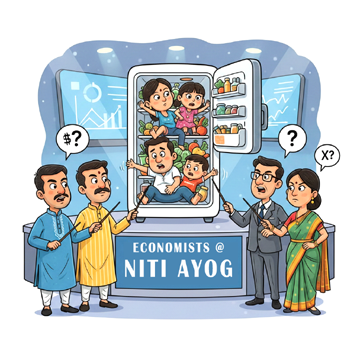
In policy discussions, market reports, and celebratory headlines, rising sales of consumer durables are often treated as shorthand for social progress. Among these, the humble refrigerator occupies a special place. Once a symbol of middle-class arrival, it is now increasingly found in poorer households, aided by cheaper models, easy credit, and aggressive marketing. At first glance, more fridges sold to poor families appear to signal a comforting narrative: incomes are rising, living standards are improving, and poverty is receding. But this narrative, neat and convenient as it is, deserves serious interrogation. The presence of a fridge in a household does not automatically mean the absence of poverty. In fact, it may conceal more troubling realities—economic distress, gendered burdens of survival, and structural failures masked by economies of scale.
To understand why, we must first disentangle consumption from well-being. A fridge is an object, not an outcome. It can preserve food, reduce daily drudgery, and improve nutrition. But it can also be bought through debt, distress spending, or social compulsion rather than surplus income. When policymakers or commentators equate appliance penetration with poverty elimination, they confuse the visibility of goods with the invisibility of struggle. The fridge becomes a proxy statistic—easy to count, easy to photograph, and easy to celebrate—while the deeper questions of who pays for it, how, and at what cost remain unanswered.
One uncomfortable possibility behind rising fridge ownership among poorer families is not economic empowerment but economic compulsion. In a failing or stagnating economy, where male employment is precarious, informal, or insufficiently paid, households often resort to additional earners to survive. In many such cases, it is the woman of the house who is forced to step out to supplement the family income. This is frequently framed as “women’s empowerment” or “increasing female labour force participation.” But empowerment that is born of necessity rather than choice is a hollow victory. When women enter the workforce not because opportunities have expanded but because male earnings have collapsed, the narrative shifts from progress to survival.
The fridge, in this context, becomes less a symbol of prosperity and more a marker of adaptation to stress. Dual incomes, however small, allow households to smooth consumption, qualify for loans, and justify purchases that were earlier unaffordable. Easy monthly instalments and micro-credit schemes further blur the line between affordability and indebtedness. A small fridge costing a few thousand rupees may look harmless, but for a poor household with unstable income, it represents a long-term financial commitment. Defaulting on such loans can be socially humiliating and economically devastating, pushing families further into precarity even as they appear better off on paper.
Economies of scale play a critical role in sustaining this illusion. As manufacturers produce refrigerators in massive volumes, costs fall. Smaller fridges, stripped of features and built with thinner materials, flood the market at prices once unimaginable. From an industrial perspective, this is efficiency at work: mass production lowers unit costs, expands markets, and boosts sales. From a social perspective, however, cheaper fridges do not necessarily mean richer households. They may simply mean that poverty has become a viable market. The poor are no longer excluded from consumption; they are actively targeted, segmented, and monetised.
This phenomenon reflects a broader shift in capitalism, where growth increasingly comes from extracting value from the bottom of the pyramid. When upper-income demand saturates, companies look downward, redesigning products to be “affordable” rather than durable, repairable, or efficient. The result is a flood of low-quality goods that meet aspirational needs without addressing structural deprivation. A poor family with a fridge but no reliable electricity, clean water, or healthcare is not meaningfully less poor than before. It is merely more integrated into consumer markets.
The gender dimension of this shift is particularly important. When women are compelled to work to stabilise household consumption, the costs are rarely accounted for. Domestic labour does not disappear when women enter paid work; it simply doubles their burden. Cooking, cleaning, childcare, elder care—all continue alongside low-paid, insecure jobs. The fridge may marginally reduce food spoilage or shopping frequency, but it does not compensate for the physical and emotional toll of overwork. Nor does it address the deeper injustice of an economy that cannot provide adequate livelihoods to men, forcing families into survival mode.
Moreover, women’s entry into the workforce under distress conditions often traps them in the lowest rungs of the labour market: domestic work, informal retail, piece-rate manufacturing, or gig labour without protections. These jobs rarely come with social security, healthcare, or stability. Yet their income is quickly absorbed into household expenses, loan repayments, and the maintenance of a consumer lifestyle that signals respectability. The fridge, once again, stands silently in the corner—cooling food while heating the pressure on women’s lives.
There is also a cultural dimension to appliance ownership that complicates the poverty narrative. In many societies, including India, owning certain goods is tied to dignity, status, and social acceptance. A fridge is not just a utility; it is a statement that one is not “poor-poor.” Families may prioritise its purchase even at great financial strain to avoid social stigma. In such cases, consumption is not a reflection of improved material conditions but a defence against shame. Measuring poverty reduction through such markers risks mistaking social anxiety for economic progress.
This misreading has serious policy consequences. When governments point to rising durable ownership as evidence of successful poverty alleviation, they may feel less urgency to address foundational issues like job creation, wage growth, public healthcare, education quality, and nutrition. The logic becomes dangerously circular: if people are buying fridges, the economy must be doing fine; if the economy is doing fine, structural reforms can wait. Meanwhile, households continue to juggle unstable incomes, debt, and unpaid labour, their struggles hidden behind gleaming appliance doors.
None of this is to argue that fridges are bad or that poor families should not have them. Access to technology and comfort is a legitimate aspiration. The problem lies in mistaking access for agency and ownership for security. A fridge does not guarantee food security if incomes are volatile. It does not ensure nutrition if diets are driven by cheap, ultra-processed foods. It does not eliminate poverty if healthcare costs can wipe out savings overnight. It simply preserves what is put inside it—just as economic indicators preserve what policymakers choose to measure.
A more honest assessment of poverty must therefore look beyond consumer goods. It must ask whether households have stable, dignified employment; whether women work by choice or compulsion; whether wages keep pace with living costs; whether public services reduce the need for distress spending; and whether economic growth translates into resilience rather than mere consumption. Without these, the spread of fridges risks becoming a comforting illusion—a cold statistic masking a hot crisis.
In the end, counting fridges is easy. Counting dignity, security, and choice is harder. But if poverty elimination is truly the goal, it is the harder count that matters. More fridges sold to poor families may tell us something about manufacturing efficiency and market reach. They tell us far less about justice, equity, or economic health. And unless we learn to see beyond the appliance, we risk celebrating progress while quietly normalising precarity.