
Instead of investing in democratic institutions, education, and industry, the new state quickly elevated the military as the central pillar of national identity. Over time, the army ceased to be a subordinate institution and became the state itself
Pakistan has always struggled to define itself as a modern nation-state anchored in civilian supremacy, rule of law, and economic productivity. Instead, it has evolved into a security-centric state where the military—particularly the Pakistan Army—functions not merely as a defender of borders but as the primary political, economic, and foreign-policy actor. Over time, this army has increasingly behaved less like a national institution accountable to its people and more like a rent-seeking security enterprise, offering its manpower, coercive capacity, and strategic geography to the highest bidder.
The recent report that Pakistan is weighing the deployment of 3,500 troops to Gaza under a US-backed “stabilisation force” is not an anomaly. It is the logical continuation of a decades-old pattern: Pakistan marketing its soldiers as exportable security assets while its own society remains underdeveloped, indebted, and politically captive.
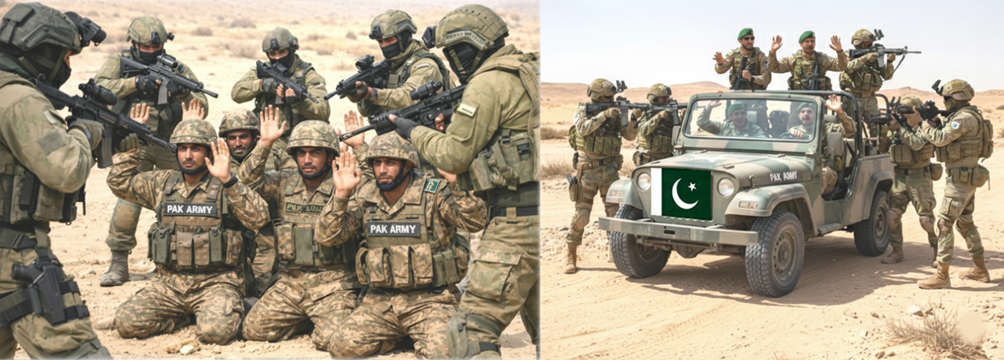
This phenomenon—where a nation commodifies its military—has deep historical roots, ideological drivers, and long-term consequences not only for Pakistan itself, but for regional and global stability.
A military without a nation, a nation without a civilian spine
Pakistan was born insecure. Partition left it geographically divided, economically weak, and ideologically uncertain. Instead of investing in democratic institutions, education, and industry, the new state quickly elevated the military as the central pillar of national identity. Over time, the army ceased to be a subordinate institution and became the state itself.
Unlike professional militaries that exist to protect civilian political choices, the Pakistan Army has repeatedly:
- Overthrown elected governments
- Engineered political outcomes
- Controlled large swathes of the economy
- Defined national ideology through hostility toward India
This distortion has produced a military that is politically dominant but strategically reckless, tactically aggressive but institutionally unaccountable.
Operation Gulmarg: The original sin
The DNA of the Pakistan Army’s conduct can be traced directly to Operation Gulmarg in 1947—it’s very first major strategic initiative.
Rather than respecting international norms or political processes, Pakistan chose covert aggression. The plan involved:
- Recruiting and arming 20,000 Pashtun tribal fighters
- Motivating them through religious incitement and promises of loot
- Sending them into Jammu & Kashmir to create chaos and force accession
This was not an act of national defense. It was an early experiment in plausible deniability, irregular warfare, and the outsourcing of violence—tactics that would later be replicated through militant proxies across South Asia.
The consequences were disastrous:
- Mass civilian violence in Kashmir
- Indian military intervention
- The creation of the Line of Control
- A permanent conflict that Pakistan has never resolved
Operation Gulmarg established a pattern: when Pakistan’s political objectives could not be achieved through diplomacy or development, violence—often subcontracted—would be used instead.
Mercenary logic masquerading as strategy
Over decades, the Pakistan Army refined a model that treats soldiers not as citizens in uniform, but as deployable inventory.
This model has several defining characteristics:
- Ideological Flexibility – Soldiers fight not for constitutional values but for whoever funds, arms, or legitimizes the deployment.
- Moral Ambiguity – Engagements are framed as jihad, peacekeeping, stabilization, or brotherly assistance depending on the audience.
- Economic Dependence – Foreign deployments are used to subsidize an otherwise unsustainable military-dominated economy.
The result is an army that behaves less like a national defense force and more like a security contractor wearing a flag.
Saudi Arabia and the institutionalization of soldier export
Pakistan’s long military relationship with Saudi Arabia illustrates this perfectly.
For decades, Pakistani officers and troops have served in the Kingdom, not under UN mandates, but as part of bilateral arrangements designed to protect Saudi internal and external security. The 2025 defense pact elevates this relationship to an unprecedented level.
Key Features of the 2025 Pact:
- Mutual Defense Clause: An attack on one is considered an attack on both.
- Large-Scale Deployment: Approximately 25,000 Pakistani troops stationed in Saudi Arabia, including armored, artillery, and air units.
- Economic Exchange: Saudi investments in Pakistan’s energy and infrastructure sectors.
- Technology Cooperation: Interest in Pakistani military platforms such as the JF-17.
This is not a conventional alliance between equals. It is a transaction where:
- Saudi Arabia buys security without political reform.
- Pakistan sells manpower without economic reform.
For Pakistan’s ruling elite, this arrangement is ideal. It monetizes the army while postponing the harder work of building schools, industries, and accountable governance.
Gaza and the expansion of the “security for hire” model
Against this backdrop, the proposal to deploy Pakistani troops to Gaza under a US-backed stabilisation force becomes easier to understand.
This is not about Palestinian welfare.
It is not about peace.
It is not even about ideology.
It is about relevance and revenue.
By offering troops:
- Pakistan signals utility to Washington.
- It reinforces its image as an “available” Muslim military.
- It seeks financial and diplomatic leverage without internal reform.
Yet the moral and strategic contradictions are stark:
- A country that has never stabilized its own tribal regions offers to stabilize Gaza.
- An army accused domestically of enforced disappearances positions itself as a neutral peacekeeper.
- A state unable to control militant proxies markets discipline abroad.
The cost at home: A hollow society
While the army rents itself out globally, Pakistan’s internal condition deteriorates:
- Chronic IMF bailouts
- Collapsing education and health systems
- Ethnic and sectarian fractures
- Youth radicalization and unemployment
The military’s economic empire—from real estate to fertilizers—crowds out civilian enterprise. The officer class prospers while ordinary citizens face inflation, debt, and insecurity.
This disconnect creates a dangerous paradox:
- The army grows richer and more autonomous.
- The nation grows poorer and more dependent.
A reputation problem that cannot be bought away
Over time, this behavior has shaped global perceptions.
Pakistan is increasingly viewed not as:
- A stable partner
- A principled actor
- A responsible nuclear power
But as:
- A tactical spoiler
- A provider of muscle without moral clarity
- A state whose loyalty follows funding streams
No amount of troop deployment can compensate for the absence of institutional credibility.
Conclusion: Security is not a substitute for nationhood
Pakistan’s greatest tragedy is not external hostility or regional rivalry. It is the substitution of militarism for nation-building.
Operation Gulmarg showed how shortcuts through violence create long wars.
The Saudi pact shows how manpower exports replace economic reform.
The Gaza proposal shows how relevance is sought abroad instead of legitimacy at home.
A country cannot indefinitely sell its soldiers and expect to buy respect.
An army cannot act as a mercenary force and still claim moral authority.
And a state cannot rent security without eventually losing sovereignty. Until Pakistan redefines its army as a servant of the people rather than a product for export, it will remain trapped in a cycle where uniforms travel the world—but the nation itself never moves forward.